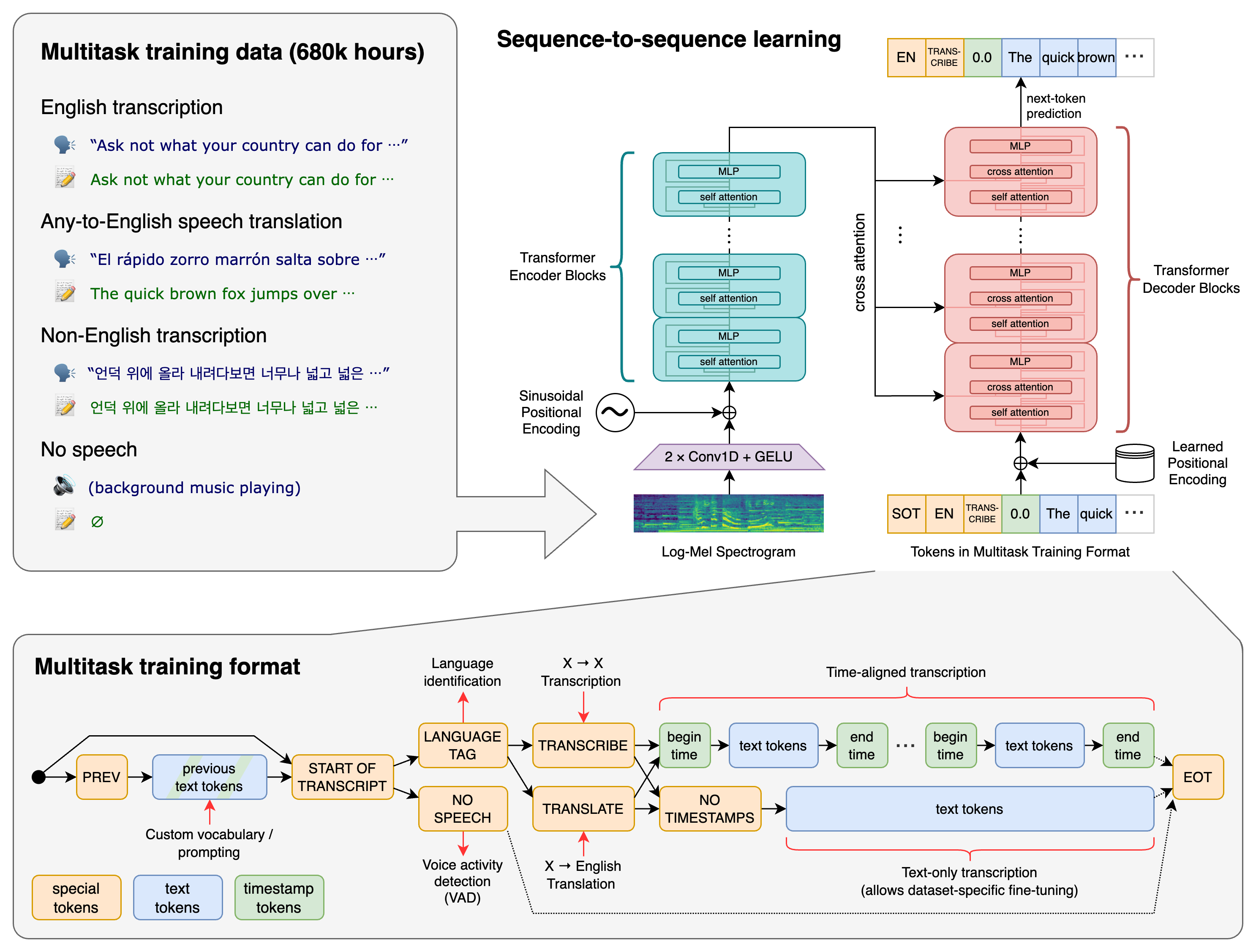
WhisperX is an open-source long-form speech pipeline by Max Bain and contributors. It combines voice-activity detection, batched transcription through a faster-whisper/CTranslate2 backend, language-specific forced alignment and optional pyannote speaker diarization. Its useful output is not merely “Whisper text faster”: it is a transcript whose words can receive finer timestamps and speaker IDs, with each stage remaining a separate model and a separate source of error.
That distinction matters. WhisperX does not replace the underlying speech recognizer with a new universal ASR model. It changes segmentation and inference, then aligns recognized text to audio using a phoneme-level model, and can reconcile the aligned words with diarization intervals. If the transcript is wrong, alignment cannot make it true. If the alignment model lacks a word or script, the timestamp can be missing or interpolated. If speakers overlap, a clean-looking label can still be wrong.
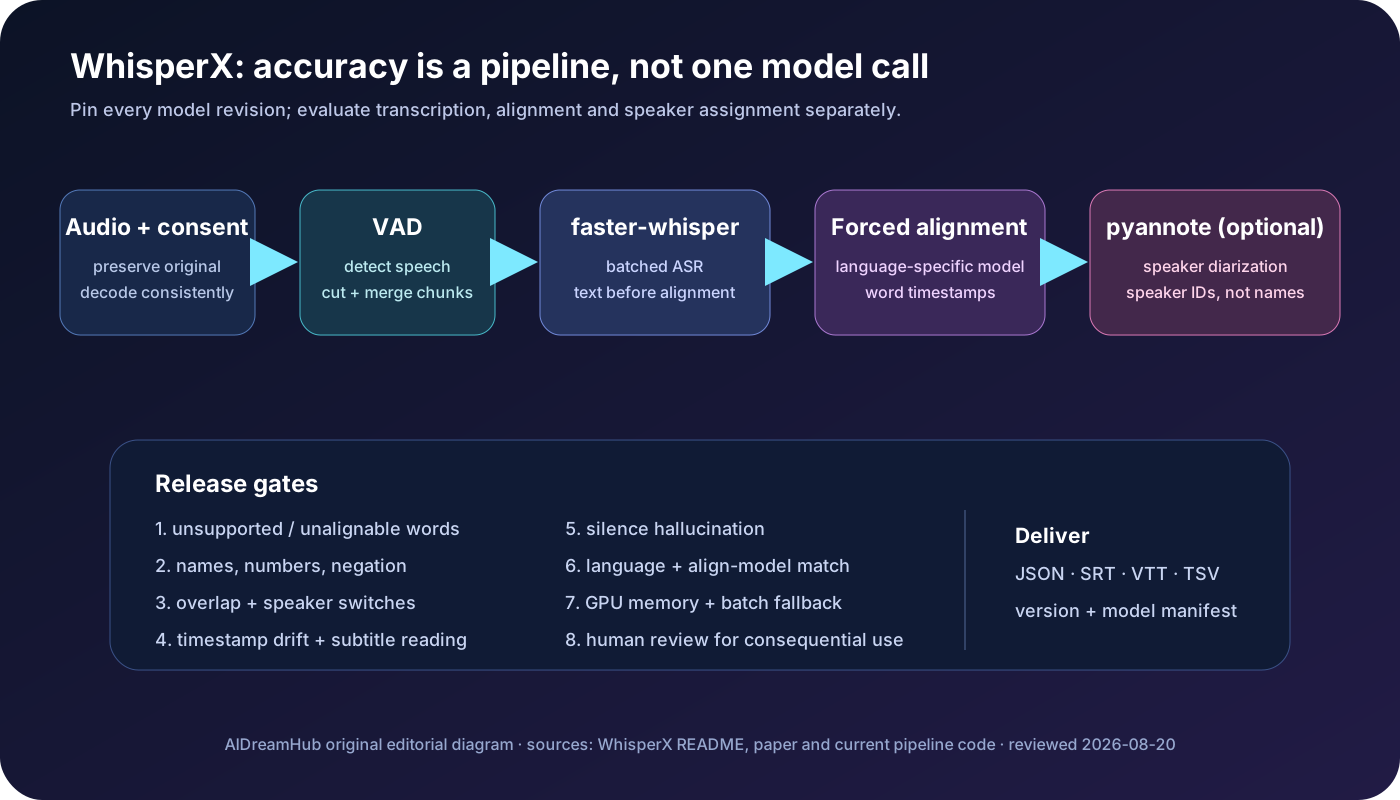
What WhisperX adds to Whisper
| Stage | Implementation | Value | Failure boundary |
|---|---|---|---|
| Speech segmentation | pyannote or Silero VAD, then cut/merge | Creates speech-focused chunks that can be batched | Thresholds may clip quiet speech or merge distinct turns |
| Transcription | faster-whisper/CTranslate2 backend | Batched inference and quantized compute options | Output differs from upstream Whisper’s timestamped, contextual decoding |
| Forced alignment | Language-specific wav2vec2/phoneme ASR model | Maps recognized words back to finer audio times | Unsupported characters, numbers, symbols, scripts or language models can fail |
| Diarization | pyannote.audio, currently Community-1 by default | Assigns anonymous speaker labels to aligned words/segments | Overlap, short turns and similar voices remain difficult; IDs are not real names |
| Writing | SRT, VTT, TSV, TXT and JSON paths | Supports subtitles and downstream processing | Reading speed, line breaks and editorial accuracy still need QA |
The original WhisperX paper addresses three long-form problems: buffered Whisper transcription can drift, repeat or hallucinate; sequential decoding prevents simple batching; and utterance timestamps are too coarse for word-level editing. Its VAD Cut & Merge strategy enables batched inference, while forced phoneme alignment supplies word times after transcription. The paper’s reported speed and segmentation results belong to its specified hardware, models and datasets. This page does not repeat a universal speed multiplier or WER because current releases, hardware, batch size, compute type and audio change the result.
Current project and dependency reality
WhisperX is maintained rather than abandoned. When reviewed, the latest stable GitHub release shown was v3.8.6, and current project metadata carried a newer 3.8.7 release-candidate version. Recent releases repaired word timestamps for unalignable characters, added progress callbacks and adjusted Torch/TorchCodec compatibility. This is encouraging maintenance activity, but it also demonstrates why production should pin a tested release instead of installing from the main branch on every build.
| Dependency boundary | Current project requirement | Operational implication |
|---|---|---|
| Python | 3.10 through below 3.14 | Use an isolated environment; system Python upgrades can break deployment |
| ASR runtime | faster-whisper ≥1.2 and CTranslate2 ≥4.5 | Model conversion, CUDA compatibility and decoding differences need regression tests |
| PyTorch family | Torch/Torchaudio around 2.8; Torchvision around 0.23 | GPU wheel, CUDA driver and platform must agree |
| Diarization | pyannote.audio ≥4 | Introduces TorchCodec, gated model access and a second model lifecycle |
| Platform acceleration | CUDA 12.8 documented for GPU setup; Triton on x86_64 Linux | CPU/macOS paths exist, but throughput and packaging differ |
| License | WhisperX BSD-2-Clause; dependencies/models have their own licenses | Track notices and model terms independently |
Installation and a controlled first run
python -m venv .venv
source .venv/bin/activate
pip install whisperx

# Transcribe and align; start with a modest batch size
whisperx interview.wav --model large-v2 --language en   --batch_size 4 --output_format json

# Optional speaker IDs after accepting the pyannote model terms
whisperx meeting.wav --model large-v2 --diarize   --hf_token "$HF_TOKEN" --min_speakers 2 --max_speakers 6
The README recommends PyPI for ordinary installation and warns that the development branch may contain experimental changes. GPU setup currently documents CUDA 12.8. CPU execution is available with --device cpu --compute_type int8, but performance and quality must be measured. To lower GPU memory pressure, reduce batch size first, then consider a smaller ASR model or int8 compute; the latter two may change recognition quality.
Store the Hugging Face token as a secret, never in a command history, source repository or transcript metadata. A token is only needed for gated diarization/model downloads, not for the core open transcription stage. Once models are downloaded intentionally, a local pipeline can run offline, but application logs, model caches, update checks and artifact storage still need inspection before claiming an air-gapped system.
Alignment languages and failure behavior
Forced alignment is language-specific. The README lists default torchaudio pipelines for English, French, German, Spanish and Italian, with many more mappings in DEFAULT_ALIGN_MODELS_HF. A detected language absent from the mapping needs a suitable phoneme-level ASR model supplied with --align_model and evaluated on representative speech. “Whisper transcribes this language” does not imply “WhisperX can align every word in it.”
The aligner must reconcile orthographic text with its character dictionary. Numbers, currency, symbols, mixed scripts, code-switching and invented spellings can be unalignable. Recent releases restored timestamp handling for such words, but interpolation is still an editorial choice: nearest or linear supplies a usable time without proving acoustic alignment, while ignore leaves the gap visible. Preserve an aligned/un-aligned flag in downstream data rather than presenting every timestamp with equal confidence.
| Case | Expected risk | Recommended check |
|---|---|---|
| Numbers and currency | Written form may not exist in aligner dictionary | Inspect “2014”, prices, dates and units separately |
| Code-switching | One language model may not cover both scripts | Split/evaluate language regions or supply a tested aligner |
| Proper nouns | ASR spelling and phoneme lexicon may disagree | Score names and timestamps against human references |
| Music/silence | VAD and ASR may disagree about speech evidence | Label false speech and hallucinated text |
| Overlapping speech | ASR, alignment and diarization all degrade | Use overlap-rich clips and permit “uncertain speaker” |
| Very short turns | Speaker interval may not overlap enough with a word | Review speaker switches around interruptions |
pyannote diarization: access, license and meaning
The current WhisperX CLI defaults to pyannote/speaker-diarization-community-1. To use it, a user must accept the gated model conditions and create a Hugging Face access token. The model card identifies Community-1 as CC-BY-4.0 and describes local/offline use after the model is copied to disk. This model license and access process are separate from WhisperX’s BSD-2-Clause code and from Whisper/faster-whisper model terms.
Diarization answers “which anonymous speaker cluster is active when?” It does not identify a person by name. Labels such as SPEAKER_00 can swap between files, split one person into two clusters or merge similar voices. Supplying realistic minimum/maximum speaker counts can help constrain the problem, but does not guarantee correctness. Community-1 also exposes exclusive diarization to simplify reconciliation with transcript timestamps; WhisperX’s actual supported output should be verified against the pinned version rather than assumed from pyannote’s standalone API.
Overlapping speech remains a stated WhisperX limitation. In an interruption, assigning one speaker to one word can conceal simultaneity. For legal, research, call-center quality or clinical documentation, retain the audio and treat speaker attribution as reviewable metadata, not evidence of identity.
A long-audio production workflow
- Obtain recording and transcription consent.Record purpose, source, retention and who may hear or export the audio.
- Preserve and fingerprint the original.Decode a working copy consistently and keep channel information before any mono conversion.
- Build a private evaluation set.Include silence, noise, music, overlap, interruptions, names, numbers, code-switching and the longest files.
- Pin the complete stack.Record WhisperX, faster-whisper, ASR checkpoint, alignment model, VAD, pyannote model, Torch/CUDA and compute type.
- Calibrate VAD and batch size.Measure clipped speech, false speech, GPU memory and real-time factor; never optimize throughput alone.
- Transcribe before alignment.Retain raw ASR segments so alignment failures do not erase the original hypothesis.
- Align and flag exceptions.Mark interpolated or unaligned words, then test timestamp error at the beginning, middle and end.
- Diarize only when needed.Use a secret token for download, constrain speaker count when known and inspect overlap/short turns.
- Run release gates.Check entities, numbers, negation, hallucination, timestamp drift, speaker switches and subtitle readability.
- Export with a manifest.Store JSON plus SRT/VTT as needed, model/config versions, review status and a deletion date.
WhisperX compared with adjacent choices
| Option | Choose it when | Main trade-off |
|---|---|---|
| WhisperX | Long files need batching, word alignment and optional local speaker labels | Multi-model dependency stack and compound error modes |
| OpenAI Whisper | You want the upstream Python reference and simpler model behavior | Coarser timestamps and no native diarization/batched long-form pipeline |
| faster-whisper | Transcription throughput and CTranslate2 deployment matter without alignment | You must add alignment/diarization and their QA if needed |
| whisper.cpp | C/C++, CPU, Apple Silicon, mobile/edge and quantized offline execution matter | Different deployment ecosystem; no WhisperX pipeline by default |
| Managed transcription API | You prefer vendor-operated inference, scaling and current hosted models | Data leaves your boundary, usage is billed and timestamp/diarization features vary |
Independent judgment:WhisperX is best understood as a post-ASR production pipeline, not an accuracy upgrade switch. It is valuable when word timing and anonymous speaker turns materially reduce editing labor. It is a poor fit when a simple transcript is enough, the target language lacks a validated aligner, overlapping speech dominates, or the team cannot maintain the Python/Torch/CUDA/model matrix. In those cases, simpler faster-whisper, upstream Whisper, whisper.cpp or a managed service can be more reliable operationally.
FAQ
Is WhisperX a different speech model from Whisper?
Not in the usual sense. It uses Whisper-family transcription through faster-whisper, then adds VAD segmentation, forced alignment and optional pyannote diarization. Each stage can improve a workflow while introducing its own errors.
Does WhisperX guarantee word-accurate timestamps?
No. Alignment can fail for unsupported characters, numbers, symbols, mixed scripts or mismatched language models. Interpolated times are useful estimates, not proof that a phoneme model aligned the word.
Does WhisperX identify people by name?
No. Diarization produces anonymous clusters such as SPEAKER_00. Linking a cluster to a real person requires separate evidence and should not be inferred from voice alone in high-risk uses.
Do I need a Hugging Face token?
Core transcription does not require the pyannote token. The default diarization path requires accepting the Community-1 conditions and using an access token to download the gated model. Store it as a secret.
Can WhisperX run offline?
Yes after all selected ASR, alignment and diarization assets are downloaded and cached locally. Verify application egress, update behavior, logs and output storage before describing the whole deployment as offline.
Why does WhisperX run out of GPU memory?
ASR batch size, model size, compute type, alignment and diarization models all consume resources. Reduce batch size first; then evaluate smaller models or int8 because those changes can affect quality.
Is diarization reliable with overlapping speakers?
Not reliably enough to treat as ground truth. The project explicitly lists overlapping speech and imperfect diarization as limitations. Include interruptions and crosstalk in evaluation and allow uncertain labels.
Which language alignment models are supported?
Defaults exist for several torchaudio languages and many Hugging Face mappings in alignment.py. Coverage changes. If the detected language has no mapping, supply and validate a phoneme ASR alignment model or skip alignment transparently.
Sources reviewed
- WhisperX official repository
- Official README and usage/limitations
- WhisperX INTERSPEECH paper
- Official releases and maintenance history
- Current Python and dependency metadata
- Alignment implementation and language mappings
- Current CLI defaults
- Diarization and speaker assignment implementation
- pyannote Community-1 model card, access and license
- faster-whisper backend
- OpenAI hosted transcription guide
- WhisperX BSD-2-Clause license
Independent technical review: 2026-08-20. Releases, dependency pins, model access and language mappings change; verify the pinned source and private test set before deployment.