About Whisper.cpp
Port of OpenAI's Whisper model in C/C++
Key Features
- Powerful AI technology
- User-friendly interface
- Efficient workflow integration
- Continuous updates and improvements
Use Cases
Whisper.cpp is an excellent tool in the Speech Recognition category, suitable for all users who need AI assistance.
How to evaluate the creative workflow
Whisper.cpp should be evaluated against a real user job rather than a polished demonstration. Judge the product by the complete path from source material to an export you can actually publish. Generation quality matters, but so do editability, consistency, rights, watermarking, queue time, credits, and the ability to reproduce a result.
Checks that create useful evidence
- Test the same brief with several prompts or references and compare subject consistency, motion or timing, text accuracy, artifacts, and adherence to composition or style constraints.
- Check supported input and export formats, resolution, duration, stems or layers, project history, private mode, watermark behavior, and whether edits require a full regeneration.
- Read the current plan and license for commercial use, client work, advertising, resale, training data, voice or likeness consent, and ownership of uploaded and generated media.
- Calculate the effective cost of an accepted result, including discarded generations, upscaling, extensions, retries, download tiers, and final work in another editor.
Recommended trial workflow
Begin with a production brief that specifies audience, format, duration or dimensions, visual or audio references, brand constraints, and delivery rights. Generate alternatives, select on structure, refine weak sections, export at the required quality, and complete a human rights and artifact review before publishing.
Important limitations
Outputs can vary between runs and may contain anatomy, continuity, speech, typography, timing, or audio defects. A subscription's commercial-use label does not clear third-party trademarks, copyrighted characters, music, voices, faces, or confidential source material.
How to compare alternatives
Compare one leading generator, one editor-first product, and the manual production workflow the tool is meant to replace. A tool with slower generation may still be cheaper if it offers better control, layers, stems, consistency, or fewer discarded outputs.
FAQ
Can the output be used commercially?
Only after checking the current plan, license, source-asset rights, and local law. Keep generation records and obtain consent for identifiable voices, faces, client assets, or protected source material.
How should output quality be tested?
Use the same brief, references, dimensions, duration, and acceptance criteria across competing tools. Count usable results rather than judging a curated gallery or the first attractive sample.
Does it replace a professional editor or creator?
Usually not. It can shorten ideation and first-pass production, while final selection, correction, continuity, mixing, typography, rights review, and brand judgment remain human work.
Source and freshness note
This evaluation framework was reviewed on 25 July 2026. The link below is the website currently stored for this listing; it may be an official product page, repository, app-store entry, regional page, or third-party service. Confirm ownership and current terms before signing in, paying, installing software, or uploading data.
What distinguishes Whisper.cpp
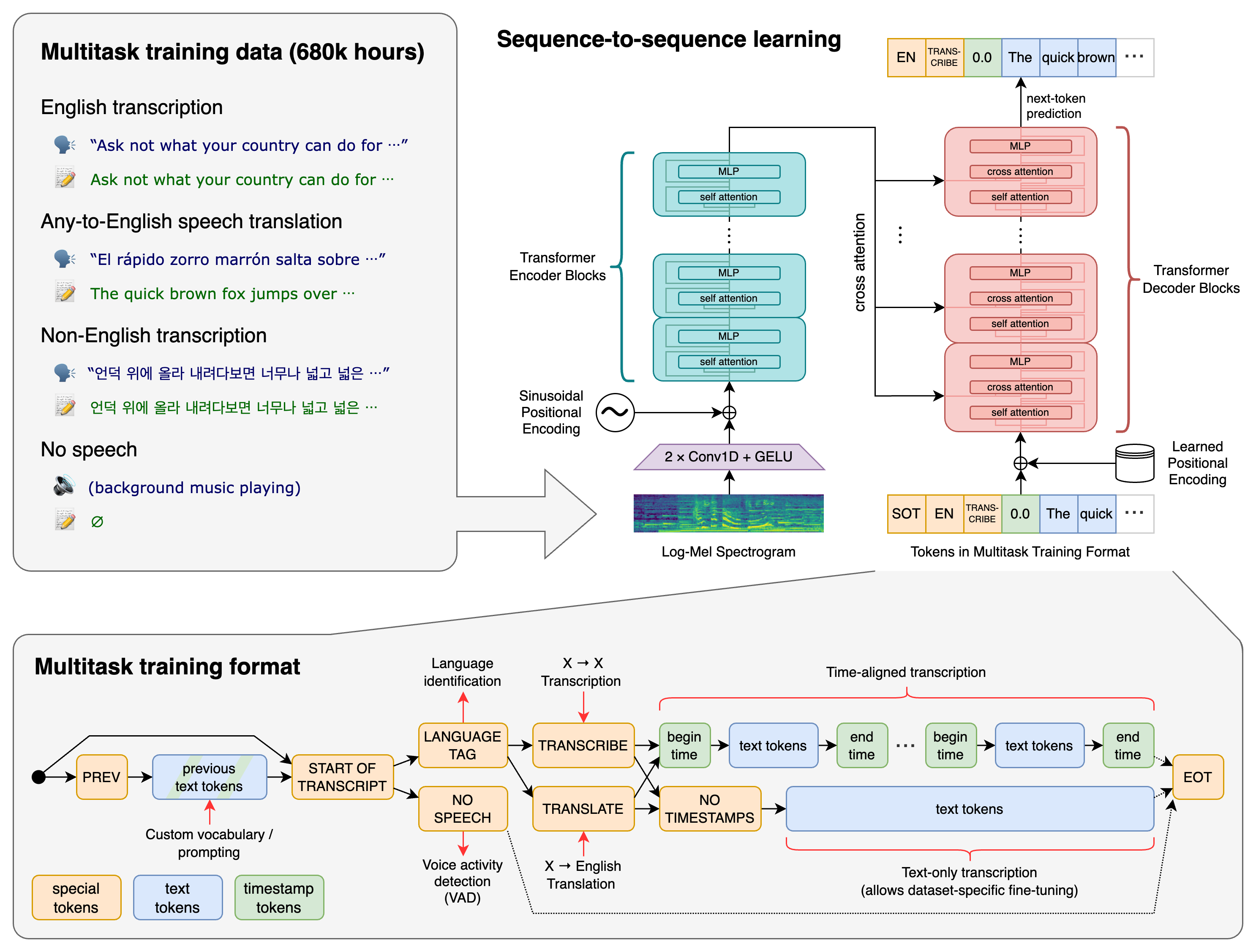
Whisper.cpp ports the Whisper speech-recognition model family to a compact C/C++ runtime. Its value is deployment flexibility rather than a different speech model: it can run locally without a Python service and targets x86, Apple Silicon, Android, iOS, WebAssembly, Raspberry Pi, and several acceleration backends documented by the project.
- Local processing: audio can stay on the device, subject to the surrounding app and model-download path.
- Model choice: smaller models use less memory and run faster; larger models generally improve recognition at greater compute cost.
- Operational paths: the repository includes command-line transcription, streaming, server, benchmarking, quantization, and platform examples.
- Accuracy reality: results still depend on language, accent, noise, overlapping speech, microphone quality, model size, and segmentation.
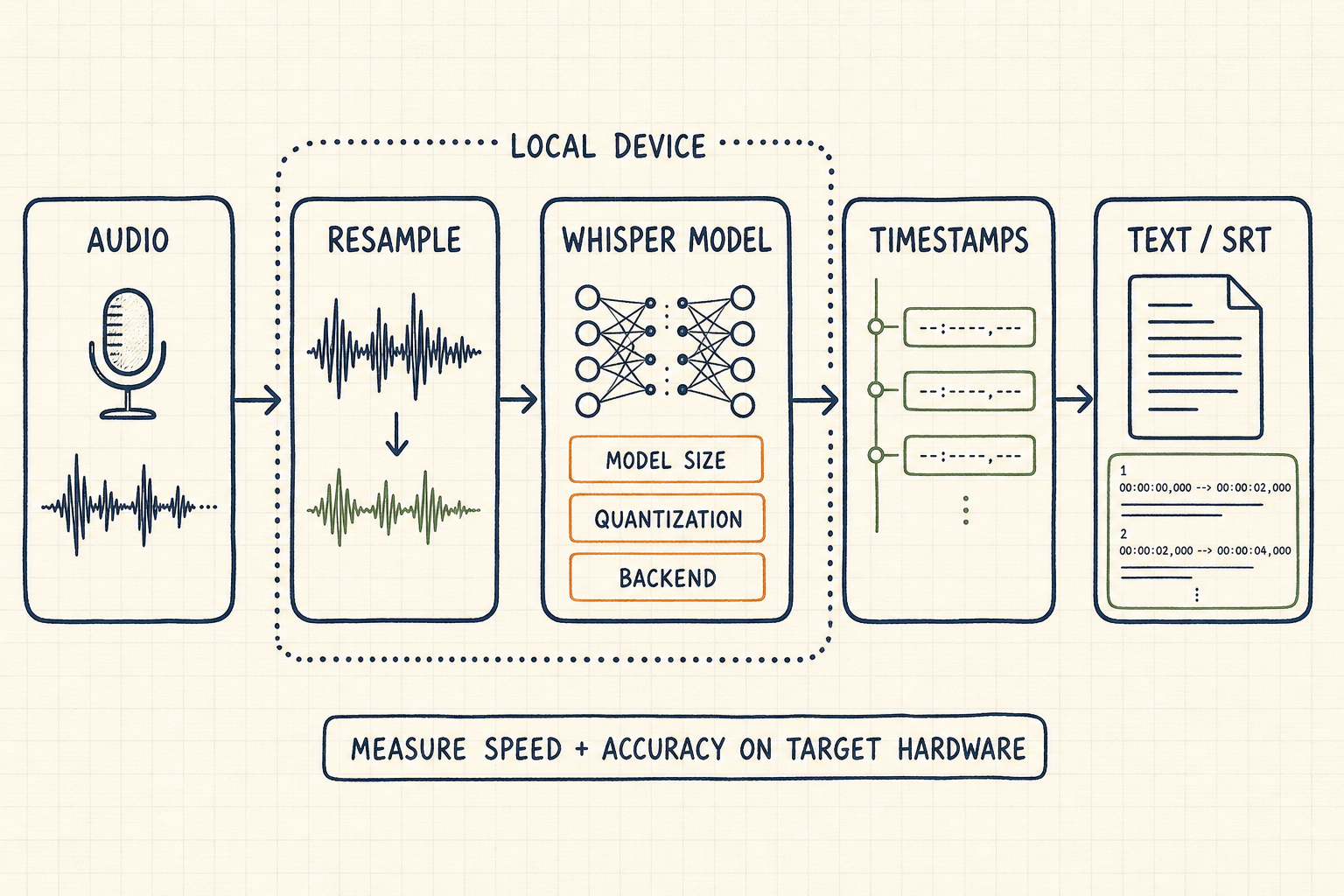
For a real deployment, measure real-time factor, peak memory, word error rate, timestamp quality, and battery or thermal behavior on the target device. Compare with faster-whisper for Python/CTranslate2 workflows and managed speech APIs when diarization, support, or elastic scaling matters more than offline control.
Current sources
What Whisper.cpp changes—and what it does not
Whisper.cpp reimplements inference for OpenAI's Whisper model family in C/C++ using the ggml ecosystem. Its advantage is a compact, portable runtime that can be embedded without operating a Python transcription service. The project documents support across x86, Apple Silicon, NVIDIA GPU, Vulkan, Android, iOS, WebAssembly, Raspberry Pi, and other targets, but supported acceleration and actual performance depend on the current build, drivers, model, and device.
Whisper.cpp does not train a new speech model and does not automatically improve the underlying Whisper model's language or acoustic accuracy. Recognition still depends on model size, audio quality, language, accent, domain vocabulary, overlapping speech, segmentation, and decoding settings.
| Choice | Effect | Measure on target hardware | Typical failure |
|---|---|---|---|
| Smaller model | Lower memory and faster inference | Word error rate, real-time factor, battery, and latency | More substitutions, missed names, and language errors |
| Larger model | Usually higher recognition capability | Accuracy gain versus memory, thermal load, and queue capacity | Cannot meet real-time or device limits |
| Quantized model | Reduces storage and memory and may improve speed | Accuracy drift and throughput versus reference precision | Aggressive quantization damages difficult-language or noisy-audio results |
| CPU backend | Broad availability and simpler deployment | Threads, real-time factor, power, and contention | Long files block shared application resources |
| GPU or platform acceleration | Potentially higher throughput or lower latency | Warm/cold speed, transfer overhead, supported operators, stability | Benchmarks from another backend do not reproduce |
| Streaming | Lower perceived latency for live audio | Partial stability, endpointing, correction rate, and end-to-end delay | Repeated or revised partial text confuses downstream consumers |
Choose a model with evidence
Whisper model names such as tiny, base, small, medium, and large represent major memory and quality differences. English-only variants can be useful for English workloads, while multilingual variants are required for broader language coverage and speech-to-English translation. Do not choose from a generic benchmark alone. Build a test set from the actual microphones, rooms, speakers, languages, background noise, compression, and domain vocabulary the product will encounter.
Measure peak resident memory and model-load time as well as inference time. A mobile app may pass a one-minute speed test but fail after sustained use because of heat or battery drain. A server may have enough total GPU memory but poor concurrency because each worker duplicates model state or key/value buffers.
Transcription, translation, timestamps, and diarization
| Output need | Whisper.cpp role | Important caveat |
|---|---|---|
| Same-language transcription | Decode speech into text in the detected or specified language | Language detection and short clips can be unreliable; supply known language when appropriate |
| Speech-to-English translation | Use Whisper's translation task with a multilingual model | This is not arbitrary text translation between any two languages |
| Segment timestamps | Return time ranges for decoded segments and subtitle formats | Boundaries may not align with sentence, speaker, or edit points |
| Word-level timing | Experimental/token-derived timing paths can provide finer alignment | Validate carefully before captions, search, or editing automation |
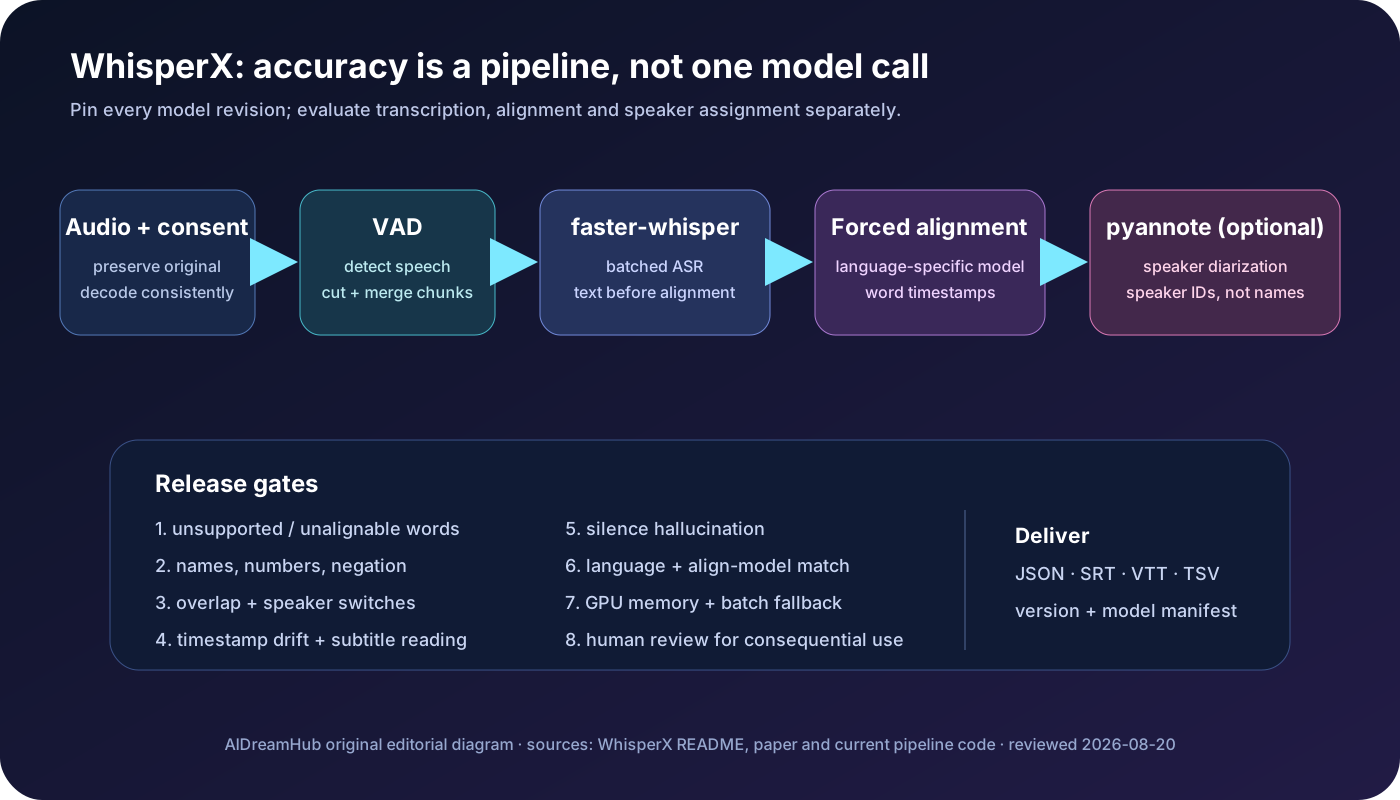
| Speaker diarization | Not a full built-in speaker-identification solution | Use a dedicated diarization pipeline and align speaker turns with transcription |
| Live captions | Streaming examples can process microphone audio incrementally | Requires endpointing, partial-result handling, device audio integration, and latency design |
A production transcription pipeline
- Validate and decode audio. Enforce file size, duration, codec, channels, and safe paths; isolate media decoders from untrusted uploads.
- Normalize input. Convert to the sample format required by the runtime without destroying useful speech frequencies or channel information.
- Segment deliberately. Long silence, music, overlapping speech, and arbitrary fixed chunks can reduce accuracy or break context.
- Run inference with bounded resources. Limit duration, threads, memory, concurrency, and wall time per job.
- Post-process conservatively. Normalize punctuation or terminology only when the raw transcript remains recoverable and changes are auditable.
- Emit structured results. Store language, segments, timestamps, confidence proxies where available, model/build ID, and processing metadata.
- Review uncertain content. Names, numbers, addresses, medical terms, legal statements, and low-quality passages need human verification.
Whisper.cpp versus alternatives
| Option | Potential advantage | Choose carefully when |
|---|---|---|
| Whisper.cpp | Portable C/C++, local processing, broad device targets, embedding, quantization | You need managed diarization, elastic scaling, or vendor support |
| faster-whisper | Python-friendly CTranslate2 inference and common server/data workflows | The application must embed a small native runtime without Python |
| Original OpenAI Whisper | Reference PyTorch implementation and research baseline | Deployment footprint and optimized inference matter |
| Managed speech API | No model serving, elastic capacity, support, and possible diarization/domain features | Audio cannot leave the device or recurring cost and retention are unacceptable |
| Platform speech framework | Native mobile/desktop integration and low setup | Language, offline behavior, accuracy, or cross-platform consistency is insufficient |
Privacy and security boundaries
Local inference can keep raw audio off a third-party transcription service, but “local” is not the same as private by default. The surrounding application may upload crash reports, analytics, transcripts, model-download requests, or audio backups. Protect temporary files, subtitles, logs, caches, clipboard output, model paths, and any local HTTP server.
- Bind servers to a trusted interface, require authentication, set request limits, and do not expose example endpoints directly to the public internet.
- Store sensitive audio and transcripts only as long as required; encrypt at rest where appropriate and implement deletion.
- Review model and binary provenance, hashes, dependencies, media decoders, and build flags.
- Inform users when audio is recorded and obtain consent required for transcription, monitoring, or speaker analysis.
- Do not treat a transcript as authoritative evidence without retaining the source and review status.
Evaluation metrics
- Word error rate: substitutions, deletions, and insertions against human-verified transcripts.
- Entity accuracy: correct names, numbers, products, acronyms, and domain terms.
- Real-time factor: processing time divided by audio duration; below 1.0 processes faster than real time.
- End-to-end latency: capture, buffering, inference, post-processing, and delivery—not inference alone.
- Memory and thermals: peak RAM/VRAM, battery use, sustained clock behavior, and device temperature.
- Timestamp quality: boundary error against the intended caption, search, or editing use case.
Frequently asked questions
Is Whisper.cpp an official OpenAI project?
No. It is a community open-source C/C++ implementation of OpenAI's Whisper models, maintained in the ggml-org repository.
Can Whisper.cpp work offline?
Yes, after the application and model files are present, inference can run locally without sending audio to a transcription API. Verify the surrounding app's networking, telemetry, and storage behavior.
Which Whisper model should I use?
Start with the smallest model that passes accuracy requirements on representative audio, then evaluate quantization and acceleration on the target device. Larger is not automatically better when latency, heat, memory, or concurrency fails.
Does Whisper.cpp identify speakers?
Whisper transcription and speaker diarization are different problems. Use a dedicated diarization system when reliable speaker labels are required.
Can Whisper.cpp create SRT subtitles?
Yes, the project supports timestamped transcription and subtitle-oriented outputs. Validate timing and reading speed, then review names and critical statements before publishing.
Is local transcription automatically compliant?
No. Compliance depends on consent, purpose, access, retention, deletion, security, user rights, and local law. Local processing reduces one data transfer but does not resolve the complete lifecycle.
Official and supporting sources
- Official whisper.cpp repository, examples, backends, and benchmarks
- Original OpenAI Whisper repository and model information
- whisper.cpp model conversion and download resources
- whisper.cpp command-line, streaming, server, and platform examples
- faster-whisper repository for comparison
- ggml tensor library and backend ecosystem
Last reviewed July 25, 2026. Supported models, quantization formats, acceleration backends, build instructions, and examples change; verify the current repository for the target platform.