ThoughtSpot review: strong governed conversational analytics, if the semantic layer earns trust
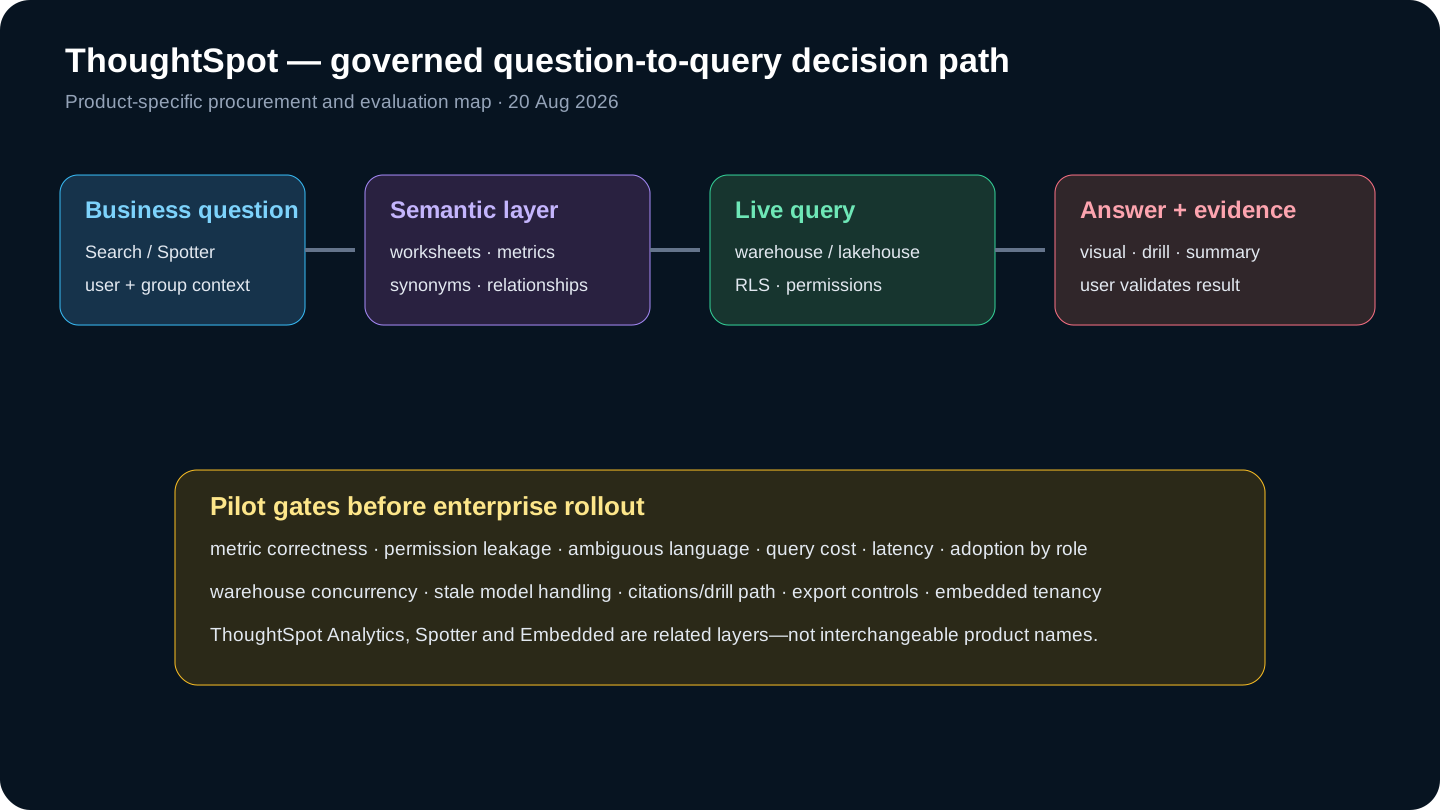
ThoughtSpot is an enterprise analytics platform built around search-driven exploration, interactive Liveboards and AI-assisted analysis. The name now covers several related products. ThoughtSpot Analytics is the internal business-intelligence platform; Spotter is its conversational/agentic analytics experience; ThoughtSpot Embedded is the SDK/API product for placing analytics inside another application. Treating Spotter as a standalone database or calling every embedded chart “Spotter” creates a bad procurement comparison.
The value proposition is compelling: a business user asks a question in natural language, the governed semantic model translates business terms, ThoughtSpot queries connected cloud data and returns an answer that can be visualized or explored. The hard part is not the chat box. Teams must model metrics, joins, synonyms and access correctly, then evaluate whether generated queries answer the intended business question. A fluent explanation of the wrong metric is still wrong.
Pricing is commercial context, not a timeless fact. On 20 August 2026, the official page showed Analytics Essentials starting at $25 per user/month billed annually; Pro offered user- or credit-oriented options, and Enterprise was custom. Embedded had a free Developer offer and custom Enterprise pricing. The page also described a 14-day no-card trial and various row/user limits. Verify the live plan and add-ons: feature tables, Spotter query allowances, unlimited-token language and BYO-LLM fees can change.
Know which ThoughtSpot product you are buying
| Layer | What it is | Buyer question |
|---|---|---|
| ThoughtSpot Analytics | Internal BI: Search, Liveboards, automated insights and governance | Can business teams answer governed questions without analyst queues? |
| Spotter | Analytics agent inside the platform/embedded experiences | Does it select the right metric, query and evidence? |
| ThoughtSpot Embedded | Visual Embed SDK, REST APIs and white-labeled analytics | Can product teams isolate tenants and control UX/cost? |
| Analyst Studio / Spotcache | Advanced analysis, modeling/cache capabilities; plan/add-on dependent | Is it included, and who operates it? |
| Cloud data connections | Live access to warehouses/lakehouses | What workload, latency and warehouse spend will queries create? |
| Semantic layer | Worksheets, relationships, terms and governed metrics | Who owns definitions and regression tests? |
| Security controls | RLS, encryption/data isolation listed; SSO/VPC/SLA vary by plan | Which controls are contracted for this exact tier? |
The real work: semantic modeling before chat
Natural-language analytics succeeds only when business terms resolve predictably. Build one certified definition for revenue, active customer, margin and churn; document time zones, currency, grain and exclusions; hide ambiguous fields; encode relationships and synonyms. Give Spotter adversarial questions such as “sales last month” across fiscal/calendar periods, and require clarification instead of silent guessing.
Test permission semantics separately from answer quality. A user should receive the same row/column restrictions through Search, Spotter, Liveboards, export, API and embedded surfaces. Create synthetic users for regions, subsidiaries and customers; ask questions designed to infer restricted totals or compare visible and invisible cohorts. “Row-level security available” is a feature claim, not proof that your model, groups and embed token are configured correctly.
ThoughtSpot commonly queries live cloud data. That keeps answers current but moves performance and cost into the warehouse path. Measure generated-query complexity, concurrency, cache behavior, cancellation, p95 latency and warehouse credits for realistic user questions. A demo on a small sample says little about 250 concurrent users, wide joins or month-end workloads.
A 30-day procurement evaluation
- Choose one bounded domain such as pipeline or subscription revenue; name a business owner and semantic owner.
- Connect a non-production warehouse/schema with realistic volume, permissions and cost monitoring.
- Model 10–20 certified metrics, descriptions, synonyms, joins, fiscal calendars and exclusions.
- Create 50–100 expected-answer questions plus ambiguous, restricted, stale and adversarial cases.
- Test Search, Spotter, Liveboards, export and API/embedded paths with synthetic roles and tenants.
- Record metric/filter/grain correctness, clarification, evidence, p50/p95 latency, query cost and failure type.
- Compare the same corpus with Tableau Pulse, Power BI Copilot or Looker where those stacks are realistic.
- Validate SSO/group mapping, RLS, audit, retention, region, network, support and incident terms for the quoted tier.
- Model three-year cost for users/credits, warehouse compute, add-ons, embeds, implementation and maintenance.
- Canary one certified domain, publish known limits and re-run tests after schema, model or Spotter changes.
Governance, cost and operational limits
| Risk | Control | Acceptance evidence |
|---|---|---|
| Wrong metric | Certified definitions, synonyms and clarification tests | Expected metric/filter/grain match |
| Permission leakage | Synthetic role/tenant adversarial suite | Zero restricted rows or inferred totals |
| Warehouse bill | Query monitoring, limits and cost budget | Cost per question and peak concurrency |
| Plausible narrative | Evidence/drill path and analyst review | Unsupported-claim rate |
| Stale semantics | Owner, versioning and regression suite | Change log plus passed corpus |
| Vendor lock-in | Export/API inventory and exit test | Recover definitions, content and audit data |
| Plan mismatch | Contracted feature matrix | SSO/RLS/VPC/SLA mapped to SKU |
| Low adoption | Role-based pilot and workflow integration | Repeat use and resolved-question rate |
The current pricing page says ThoughtSpot does not meter or charge LLM tokens under described subscriptions, while BYO provider fees may apply. That does not mean total cost is unmetered: users, platform credits, row limits, warehouse compute, add-ons, implementation, semantic-model maintenance and support tiers matter. Price a scenario with named users, question frequency, embeds, concurrency and data growth; contract the unit that actually scales.
Security review must match deployment and plan. Validate identity federation, group synchronization, least-privilege admin roles, RLS, encryption, audit/export logs, data residency, network path, backup, incident notice and deletion. Pricing lists SAML/OAuth/OIDC, VPN/VPC, advanced encryption and one-hour support SLA in different tiers. Do not infer that every trial or Essentials tenant includes Enterprise controls.
Spotter marketing pages cite impressive reductions and customer adoption. These are vendor-selected signals, not a universal benchmark. Your acceptance test should use 50–100 questions from finance, sales and operations, with expected metric, filters, grain and evidence. Score exactness, clarification, unsupported conclusions, citation/drill path, latency and analyst review time. Publish failed-question patterns, not only aggregate success.
ThoughtSpot versus Tableau, Power BI and Looker
| Platform | Best when | Important distinction |
|---|---|---|
| ThoughtSpot + Spotter | Open-ended search/conversation over governed cloud data | Semantic quality and live-query cost drive outcomes |
| Tableau Pulse | Personalized metric digests and Tableau Cloud/Embedded estate | Pulse is metrics-oriented; premium Q&A tied to Tableau+ |
| Power BI Copilot | Microsoft Fabric/Power BI semantic models and report authoring dominate | Requires paid capacity, tenant/region settings and AI-ready models |
| Looker Conversational Analytics | LookML is the governed semantic source of truth | Gemini answers are grounded in Explores; Google says validate early-stage output |
| Traditional dashboards | Questions and KPI paths are stable | Less conversational, easier to certify and cost-control |
| Custom semantic API + LLM | Unique workflow/control justifies engineering | Maximum ownership, highest build/eval burden |
Our judgment: ThoughtSpot is strongest for organizations with a modern cloud warehouse, committed semantic owners and a real need for open-ended governed exploration or embedded analytics. It is a poor shortcut for weak data modeling. If most users consume a fixed KPI digest, Tableau Pulse may be simpler. If Microsoft Fabric capacity and Power BI models already dominate, Copilot reduces stack change. If LookML is the source of truth, Looker's conversational layer keeps governance closest to that model.
Run the pilot as a decision, not an AI showcase. Require metric parity with existing finance reports, zero permission leakage, bounded query cost, acceptable p95 response, clear evidence, admin operability and adoption by non-analysts. Roll out by certified subject area and role; keep a visible route to dashboards/SQL and analyst escalation when Spotter is uncertain.
Frequently asked questions
What is the difference between ThoughtSpot and Spotter?
ThoughtSpot Analytics is the BI platform; Spotter is the conversational analytics agent that works with its governed semantic layer. Spotter is not a separate warehouse.
What is ThoughtSpot Embedded?
It is the developer product for adding ThoughtSpot analytics to another application through visual embedding and APIs, with separate tenancy, UX, identity and pricing decisions.
Is there a free trial?
The official site advertised a 14-day no-credit-card trial on the review date. Embedded also showed a Developer offer. Verify current limits and data-connection eligibility.
How much does ThoughtSpot cost?
On 20 August 2026, Essentials started at $25/user/month annually; Pro exposed user/credit options and Enterprise was custom. Warehouse, add-on and implementation costs are separate.
Does Spotter always return accurate answers?
No conversational analytics system can guarantee this. Accuracy depends on semantic modeling, permissions, ambiguity and model behavior. Evaluate a labeled business-question corpus.
Does ThoughtSpot copy data?
ThoughtSpot emphasizes live connections to cloud data, while cache/modeling options also exist. Confirm the architecture for each connector and add-on in your design.
Is it better than Power BI?
Not universally. ThoughtSpot favors search-led exploration; Power BI may fit Microsoft/Fabric estates better. Compare semantic effort, governance, capacity, authoring and total cost.
Who should own ThoughtSpot?
A joint team: analytics engineering owns semantic definitions, security owns access, platform/FinOps owns performance and cost, and business owners approve metrics.
Can I trust vendor benchmark claims?
Treat them as case-specific marketing evidence. Reproduce time-to-answer, adoption and accuracy on your users, data and security model.
Sources
- ThoughtSpot product portfolio
- ThoughtSpot Analytics
- Spotter analytics agent
- Current plans and pricing
- 14-day free trial
- ThoughtSpot Cloud documentation
- ThoughtSpot security and trust
- ThoughtSpot Embedded developer docs
- Tableau Pulse official page
- Power BI Copilot overview
- Looker Conversational Analytics
Independent review dated 20 August 2026. Pricing, plan limits, AI features and regional availability change; verify the live quote and official documentation.