Morphik in this directory means the developer product at dev.morphik.ai and the public morphik-org/morphik-core repository: a document store and retrieval layer for AI applications that ingests unstructured files, exposes retrieval and generation APIs, and supports text-plus-visual search. It does not mean only the company’s current healthcare product. Morphik’s main homepage now sells AI workers for skilled nursing and senior living, but its banner explicitly sends developers to the separate dev platform.
That distinction matters. The healthcare homepage’s facility count, operational savings and back-office automation claims are not retrieval benchmarks. This review evaluates the developer service and Core code: ingestion, multimodal retrieval, metadata and access scoping, deployment, license, pricing and private-data validation. The useful question is not whether a homepage says “most accurate,” but whether Morphik retrieves the right evidence, respects permissions and remains operable on your corpus.
Which Morphik is this? Product, cloud and code boundaries
| Layer | Verified role | Boundary |
|---|---|---|
| Morphik company | 2026 homepage: AI workers for skilled nursing and senior living | Business metrics and HIPAA messaging belong to that service; do not treat them as retrieval accuracy |
| Morphik developer platform | Hosted ingestion, query, research-agent and collaboration plans at dev.morphik.ai | Plan limits, retention, VPC and support vary |
| Morphik Core | Public Python repository for multimodal retrieval, SDK/API, console and MCP | Source-available under BSL 1.1, not an OSI open-source license |
| Maintenance signal | Repository not archived; 822 commits; pushed 2026-07-23 when checked | Active code does not substitute for a release policy: GitHub API returned no Releases or tags |
| License | Root LICENSE names BSL 1.1, Morphik 0.1.0, change date 2029-06-18, then Apache-2.0 | Additional grant allows production use below $2,000/month attributable gross revenue; above it requires a commercial license |
Morphik’s own pages use inconsistent shorthand. The current GitHub description and pricing page may call Core “open-source,” while the repository README says source-available and the root license explicitly says the Business Source License is not an open-source license. The root LICENSE is the governing evidence for the checked tree. A Docker-guide footer that says MIT is stale or inconsistent and should not override it. Teams should review the license for the exact version they deploy, because BSL change dates and grants can be version-specific.
There is also no formal version trail to rely on: the repository was visibly active, but the GitHub releases and tags endpoints were empty on the review date. Pin a full commit SHA and container digests, retain a software bill of materials, and define who owns upgrades. “Main is active” is a maintenance signal, not a reproducible production artifact.
What the developer platform actually provides
| Stage | Documented capability | What to verify |
|---|---|---|
| Ingest | PDFs, images, video and other unstructured data; connectors include Google Suite, Slack and Confluence | Format matrix, corrupt/encrypted files, OCR language and ingestion failures |
| Represent | Chunks, metadata, images and visual-aware techniques such as ColPali | Whether charts, diagrams and page context survive for your document classes |
| Retrieve | Semantic/multimodal search, metadata filtering, batch chunk retrieval and image retrieval | Recall@k, ranking, filter correctness and citation provenance |
| Generate/agent | Completions and a Research Agent can consume retrieved evidence; MCP exposes knowledge to clients | Retrieval and answer quality are separate; test abstention and prompt injection |
| Isolation | Users, folders and per-app Morphik URIs provide documented scoping mechanisms | Negative authorization tests across tenants, folders, API keys and deleted users |
| Operate | Cloud, Docker self-host and local inference configuration | Models, object storage, pgvector, secrets, backups, observability and upgrade path |
Morphik’s strongest product idea is vertical integration around visually rich documents. A team can use one API for ingesting files, retrieving chunks or images, filtering metadata and then generating from evidence. That reduces glue code compared with combining a parser, embedding job, vector store, reranker, auth layer and agent tool. It also concentrates failure: a parser or model change can alter chunk identity and rankings across the whole stack.
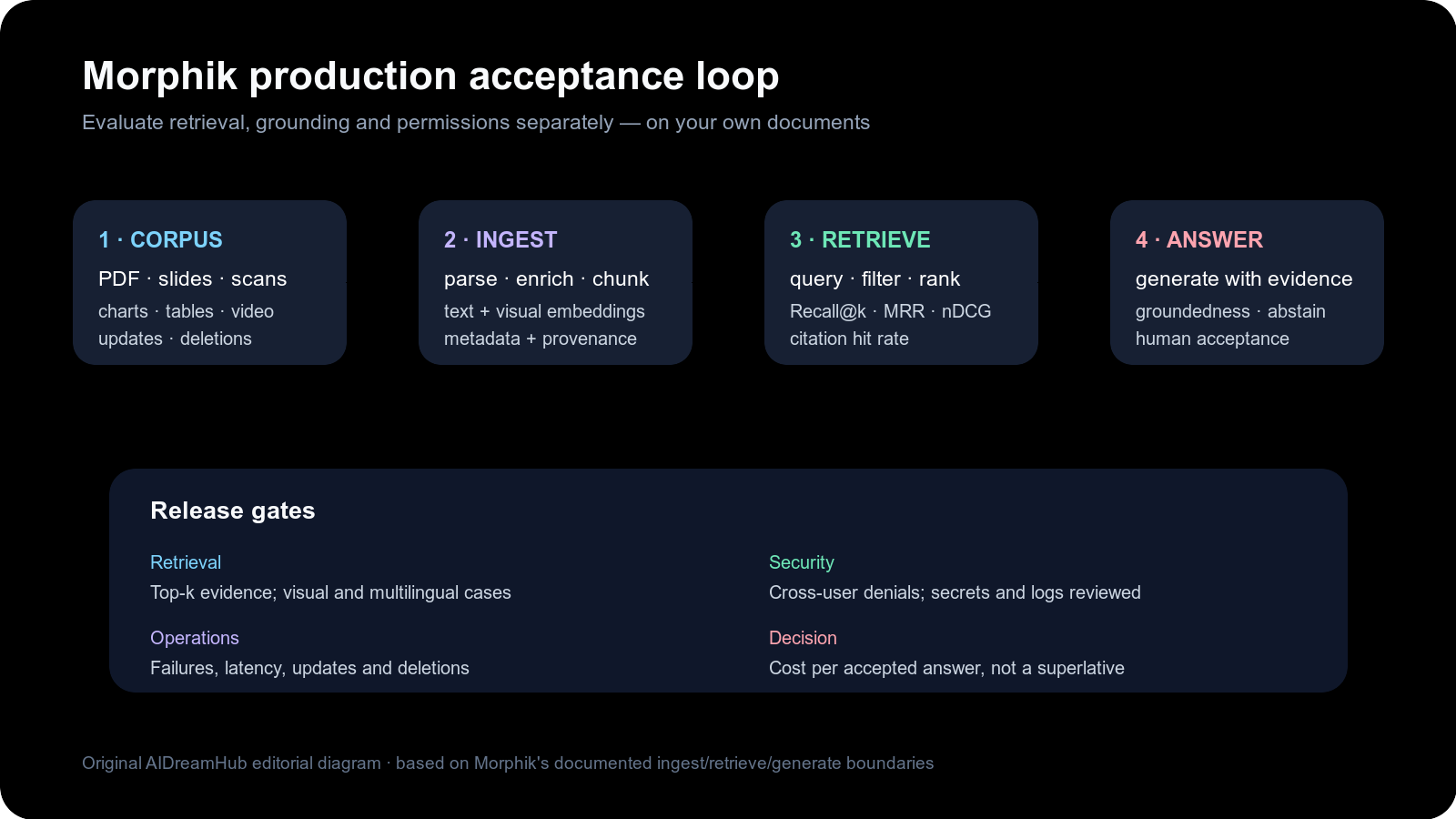
Do not collapse retrieval into answer accuracy. A correct top-k evidence set can still produce a hallucinated answer, while an answer model can occasionally guess correctly after retrieval missed. Store the retrieved chunk IDs, page coordinates, images, scores, filters and model/config version for every evaluation. The public evaluations directory includes a HotpotQA/RAGAS script and custom/science-graph material, which is useful implementation evidence, but it is not a maintained public leaderboard proving performance on invoices, manuals, scans or a private multilingual corpus.
Cloud plans and self-hosting choices
| Option | Public terms checked 2026-08-20 | Best fit / caveat |
|---|---|---|
| Free | $0; 200 pages; 3 Research-Agent calls/month; shared GPU ingestion queue | Prototype only; queue and tiny quota are not a production load test |
| Pro | $59/month; 2,000 pages; 30 agent calls; $0.03/page overage; 7-day daily backups; 5 collaborators | Small evaluation; clarify deletion, storage and query limits contractually |
| Team | $799/month; 10 GB, unlimited queries; extra nodes $2.50/GPU-hour; isolated VPC, SSO, audit logs, 14-day PITR, 99.9% SLA | Managed team workload; overage after 10 GB listed at $0.03/page |
| Enterprise | Custom; BYO cloud/on-prem, BAA, custom evals/models/tools and support | Regulated workloads need the executed agreement, DPA/BAA and architecture |
| Self-host Core | Docker stack; guide recommends 8 GB+ RAM and 10 GB free disk; PostgreSQL/pgvector, API and optional local Ollama models | Maximum control, but you own auth, model endpoints, capacity, backups and license compliance |
Pricing is dynamic and the word “page” is not a universal workload unit. A scanned drawing, a ten-slide deck and a dense financial page can have very different ingestion cost. Forecast with your actual files, re-ingestion rate, storage growth, GPU queue time, query volume and accepted answers. Treat all numbers in this table as a snapshot, not a quote.
Self-hosting is not automatically private. The default Docker path can run local Ollama models, but configuration may point to external embedding, vision or language-model providers. Map every outbound call. The Docker guide’s local-development authentication bypass and example secrets are especially important: never expose a stack with bypass auth enabled; rotate JWT/database credentials, terminate TLS, restrict networks, back up pgvector and object data together, and test restoration.
A production evaluation you can reproduce
- Freeze the candidate. Record Morphik Core commit SHA, images, model registry, parsers, embedding/reranking models and every cloud plan assumption.
- Build a representative corpus. Use 30–100 documents covering native PDFs, scans, tables, charts, slides, images, video, multiple languages, large files, revisions and deletions. Remove or synthesize sensitive data for the first trial.
- Label questions and evidence. For each query, mark acceptable pages/chunks/images, required metadata filters, allowed tenant and whether the correct action is to abstain.
- Measure ingestion. Record success/failure reason, processing time, queue time, page/image extraction, metadata preservation, duplicate handling and re-ingestion behavior.
- Measure retrieval before generation. Calculate Recall@k, MRR or nDCG where appropriate, plus visual-evidence hit rate and filter precision. Inspect misses rather than averaging them away.
- Run authorization negatives. Query as the wrong user, folder, app and tenant; attempt guessed document IDs, deleted documents and conflicting metadata filters.
- Evaluate answers separately. Score citation correctness, supported claims, completeness, abstention, prompt-injection resistance and human acceptance. A fluent answer without evidence fails.
- Test lifecycle operations. Update and delete documents, rotate credentials, restore backups, rebuild indexes and simulate model/provider failure. Measure propagation delay.
- Compare the same corpus. Run Morphik against a composed baseline such as Docling or Unstructured plus the same embedding/reranker, and against one managed RAG service.
- Decide with workload economics. Compare total cost and engineering hours per accepted answer, p50/p95 latency, operational incidents and licensing—not demo aesthetics.
Accuracy, security and operations limits
| Risk | Why it matters | Control |
|---|---|---|
| Marketing benchmark transfer | HotpotQA/RAGAS or a science-graph demo differs from private visual documents | Publish dataset, labels, commit, models and raw retrieval results; rerun privately |
| Visual hallucination | A vision model may infer text, relationships or chart values not present | Retain page image/coordinates; require evidence and human review for high impact |
| Permission leakage | Semantic retrieval can return a relevant chunk from the wrong folder/customer | Server-side scoping, deny tests, audit logs and separate apps for hard isolation |
| Prompt injection | Retrieved documents may contain instructions targeting the answer agent | Treat documents as data, isolate tools, allowlist actions, quote provenance |
| Deletion drift | Object, chunk, embedding and cache layers can diverge | Verify delete/update across every store and backup policy |
| Model/data egress | Self-hosted Core may still call remote models | Inventory endpoints, redact/minimize, execute DPAs and choose local models where required |
| License/release risk | BSL revenue condition and no formal tags/releases complicate reproducibility | Legal review, commit pin, SBOM, vulnerability scan and maintained fork/exit plan |
The most consequential evaluation is the permissions test, not the happy-path answer. User and folder scoping are documented features, but configuration mistakes, metadata mismatches and application code can bypass an intended boundary. Use canary documents and cross-tenant queries in CI. For high-sensitivity workloads, infrastructure isolation and separate keys may be preferable to a single logical filter.
Morphik’s public privacy link at dev.morphik.ai/privacy failed to load during this review, while the current company privacy and terms links returned 404. That does not prove the service lacks contractual terms, but it means this directory page cannot responsibly state a complete public retention or training policy. Before uploading private data, obtain the current privacy notice, terms, DPA, subprocessor list, data-location and deletion commitments in writing. Enterprise SOC 2/HIPAA/BAA claims on pricing should be verified against the executed contract and trust evidence.
Morphik versus adjacent RAG building blocks
| Option | What it is | Where it wins / loses versus Morphik |
|---|---|---|
| Morphik | Integrated source-available document store, multimodal retrieval, cloud/self-host, MCP | Less assembly and stronger visual-first story; BSL, smaller ecosystem and private evaluation still required |
| LlamaIndex | Broad framework and connector/index/retriever ecosystem | More composable and vendor-neutral; you select and operate parsers, stores, auth and models |
| Unstructured | Partitioning and ingestion tooling/platform | Excellent preprocessing choice and wide format focus; not by itself a complete retrieval database/agent service |
| Docling | Local document conversion and structured representation with RAG integrations | Strong inspectable parsing and permissive project path; requires a separate store/retrieval/tenant layer |
| Managed RAG (e.g. Bedrock Knowledge Bases) | Cloud-managed ingestion, indexing and retrieval with provider integrations | Lower infrastructure burden and enterprise cloud controls; provider lock-in, region/pricing and less stack transparency |
| Custom pipeline | Chosen parser + embeddings + vector/keyword store + reranker + policy layer | Maximum control and measurable components; highest integration and operations cost |
Independent judgment: Morphik is most compelling when visual retrieval and a unified API are more valuable than choosing every component independently. It can be a productive middle ground between a framework and a fully opaque managed knowledge base. Its differentiator is not generic RAG; it is the attempt to preserve images, layout-derived evidence and document operations within one developer surface.
The adoption gate is governance. BSL is a genuine commercial condition, the public versioning story is weak, and public benchmark artifacts do not establish your accuracy. A small team with visually rich documents should benchmark Morphik early. A regulated or multi-tenant team should proceed only after contractual privacy evidence, reproducible artifact pinning, denial tests, backup restoration and a documented export path.
Morphik FAQ
Is Morphik open source?
The repository is public and source-available, but the checked root license is BSL 1.1 and explicitly not an open-source license. It changes to Apache-2.0 on the stated date for the named work.
Is the healthcare Morphik the same product?
It is the same company/brand, but the current main homepage markets healthcare AI workers and directs developers to dev.morphik.ai. This page evaluates the developer platform and Core.
Can Morphik run locally?
Yes, official Docker and local-inference paths exist. You still need to secure auth, storage, models, TLS, backups and outbound providers.
Does it understand images and charts?
It documents multimodal ingestion/search and techniques such as ColPali. Accuracy on a particular diagram or chart must be measured with labeled evidence.
What is the latest release?
No GitHub Releases or tags were returned on 2026-08-20. Pin a tested commit SHA rather than inventing a semantic version.
Are the cloud prices current?
They were checked 2026-08-20: Free $0, Pro $59, Team $799, Enterprise custom. Reconfirm plan quotas and overages before purchase.
Is private data used for training?
A complete current public policy could not be verified because linked privacy pages failed/404. Obtain written terms, DPA and retention/training commitments before upload.
How should I compare it with Docling or Unstructured?
Use the same corpus and retrieval models. Those products emphasize conversion/partitioning; Morphik includes storage and retrieval, so compare end-to-end cost and accepted answers.
Does a benchmark prove my RAG will work?
No. Public scripts demonstrate an evaluation path; they do not predict scans, domain vocabulary, permissions or visual layouts in your corpus.
Who should choose Morphik?
Teams that want multimodal document retrieval with fewer assembled components and are comfortable validating BSL, security and operational boundaries.
Sources and evidence
- Morphik company homepage and developer-platform redirect
- Morphik developer platform
- Morphik Cloud pricing
- Morphik developer documentation introduction
- morphik-org/morphik-core repository
- Morphik Core Business Source License 1.1
- Official Docker deployment guide
- Official evaluations directory
- HotpotQA/RAGAS evaluation script
- User and folder scoping documentation
- Local inference documentation
- LlamaIndex official connector documentation
- Unstructured official partition documentation
- Docling official usage documentation
- Amazon Bedrock Knowledge Bases documentation
- Official Morphik repository media
Independent review dated 2026-08-20. Entity, license, release endpoints, docs, pricing and evaluation code were checked. Vendor claims are identified as claims; no private-data accuracy or fabricated benchmark is asserted.