Perplexity review: answer-first search with an evidence problem to manage
Perplexity is an AI search and research product that retrieves web sources, synthesizes an answer and places citations next to many claims. It is best understood as an answer engine and source-discovery layer, not as a replacement for the underlying evidence. The interface can save substantial time during market scans, technical comparisons, travel planning, current-affairs research and the first pass over an unfamiliar topic. Its citations also make verification easier than with a chatbot that gives an uncited paragraph.
That last sentence needs a qualifier: a citation is an interface affordance, not a truth guarantee. A link may be credible yet fail to support the exact sentence, a synthesis can overstate a cautious source, and relevant contrary evidence may not be retrieved. Academic studies of generative search have repeatedly found gaps in citation completeness, support and robustness. Those studies tested earlier system versions and should not be treated as a current Perplexity scorecard; they do establish the right evaluation habit. Open the important sources, inspect the cited passage and cross-check consequential claims.
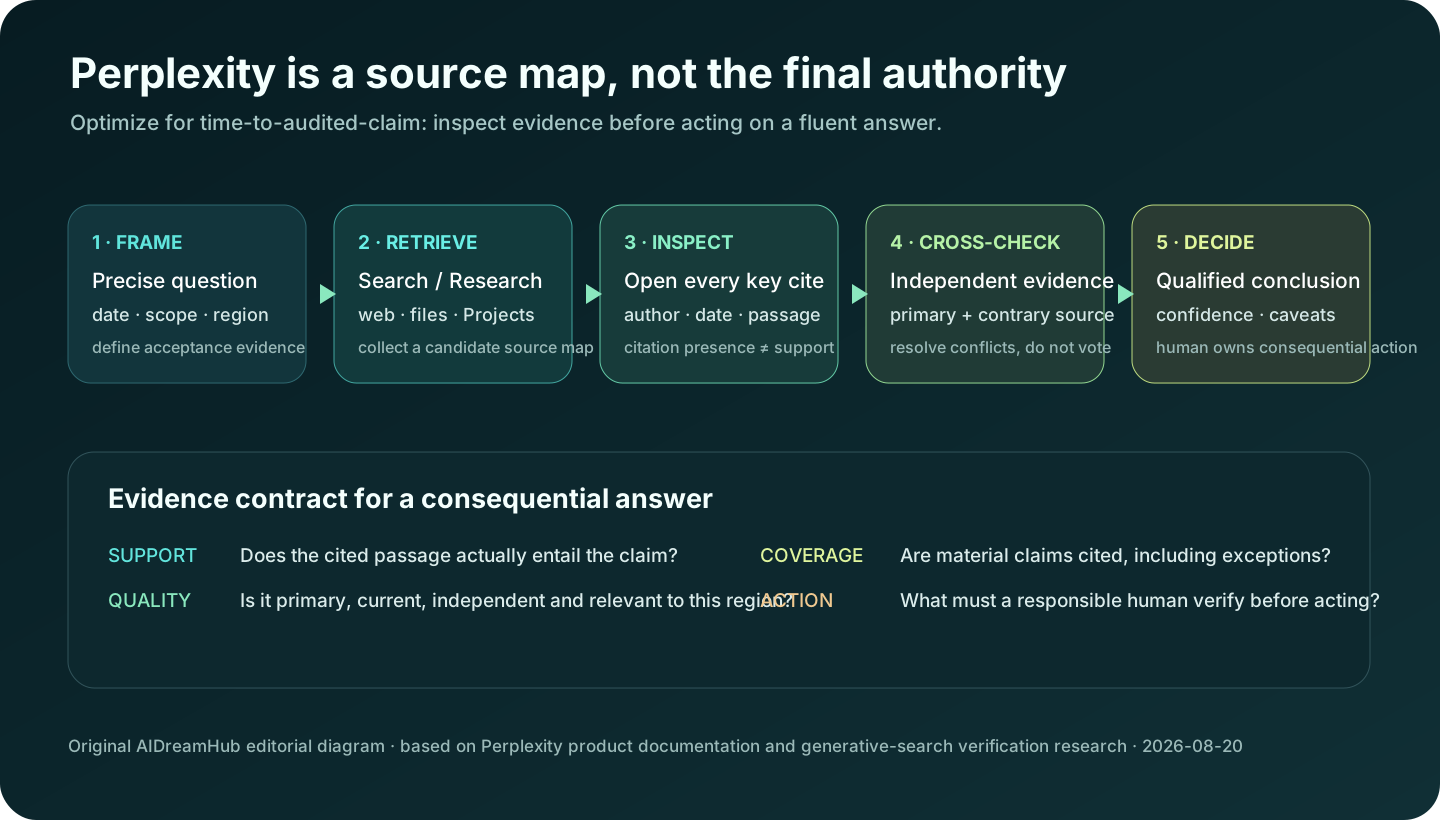
Our editorial thesis is simple: Perplexity is most valuable when it shortens the path to an auditable source map. It is least safe when the polished answer becomes the end of the research process. The right success metric is not “time to an answer,” but time to an audited claim—a conclusion whose source, date, scope, uncertainty and counter-evidence have been checked.
Search, Research, Projects, Comet and API are different products
“Perplexity” now refers to several related surfaces. Choosing the wrong one produces both bad comparisons and bad budgets. Search answers a question in the consumer or enterprise app. Research performs a longer autonomous search-and-synthesis process and writes a report. Projects—called Spaces before the July 2026 rename—hold continuing context, files, instructions and collaboration. Comet is a browser with an assistant that can use page context and perform browser tasks. The API is a separately billed developer platform; a Pro, Max or Enterprise subscription does not include programmatic API usage.
| Surface | Best job | What it adds | Boundary to remember |
|---|---|---|---|
| Search / Pro Search | Fast questions, current facts, comparisons and follow-ups | Web retrieval, answer synthesis, citations and optional model choice depending on plan | A confident paragraph can still contain a weak, stale or mismatched citation |
| Research | Multi-source briefs and complex questions that need a structured report | Iterative searches, reasoning, report generation and export; Perplexity chooses the model combination | More searches increase coverage, not certainty; the report still needs source inspection |
| Projects (formerly Spaces) | Ongoing personal or team research with repeatable context | Sessions, files, custom instructions, connected tools, collaboration and persistent project context | Permissions, stale files and contradictory instructions can contaminate every later answer |
| Comet | Research and task execution inside a browser | Page/tab context, browser assistance and agentic actions; enterprise admins receive additional controls | Browser context can include sensitive sessions; review permissions and confirm consequential actions |
| Perplexity API | Building search, answer or agent features into software | Search, Sonar, Agent and related developer APIs with usage-based billing | API keys, models, tool invocations, rate limits, logging and costs are separate from app subscriptions |
| Enterprise | Internal knowledge search and governed team use | Organization administration, repositories/connectors, data controls and enterprise support | Vendor claims still require DPA, retention, connector-permission and configuration review |
Who should use Perplexity—and who should not
Perplexity fits analysts, product teams, journalists, consultants, students, researchers and buyers who ask many open-web questions and are willing to inspect evidence. It is particularly effective for vocabulary discovery: learning the organizations, standards, papers, product names and disagreements that define a topic. Follow-up questions preserve a thread, so a broad query can become a narrower investigation without rebuilding context from scratch.
It is a weaker fit when the task requires an exhaustive literature review, a legally defensible search protocol, access to specialist databases, deterministic monitoring or a final high-stakes decision. Academic researchers still need databases such as PubMed, Web of Science, Scopus or subject-specific repositories and a documented search strategy. Lawyers, clinicians and financial professionals need authoritative sources and professional review. A team that only monitors a fixed set of pages may get more reliability from alerts, RSS, a crawler or a structured data feed than from repeated generative answers.
Perplexity also should not be confused with a general creation workspace. ChatGPT, Claude and Gemini may provide broader coding, document, multimodal and workflow ecosystems. Perplexity’s differentiator is the tight loop between a question, live retrieval and visible citations. If the job does not benefit from that loop, a different assistant—or ordinary search—may be the clearer choice.
A practical retrieval-and-verification workflow
- Write the question as a testable brief. Add geography, time window, audience, definitions and the decision you need to make. “Compare European AI regulations effective in 2026 for a health app” is more auditable than “tell me about AI law.”
- Ask for source constraints. Request primary sources first, a publication-date cutoff, and explicit separation of confirmed facts, vendor claims and inference. If the topic is contested, request the strongest contrary evidence.
- Use Search for reconnaissance, Research for breadth. Do not pay the latency and usage cost of Research for a simple lookup. Move to Research when the question requires several subquestions, competing sources or a report-shaped deliverable.
- Open the load-bearing citations. Check author, publisher, date, jurisdiction, methodology and the exact passage. A source can be reputable but irrelevant to the claim beside it.
- Trace claims to primary evidence. Prefer laws, filings, official documentation, original papers and first-party datasets over summaries. Use secondary reporting to find context and criticism, not to erase provenance.
- Cross-check outside Perplexity. Run a traditional search, query a specialist database or inspect the primary site directly. Search for evidence that would change the conclusion, not only evidence that confirms it.
- Record an evidence ledger. Save the claim, canonical URL, relevant passage, publication/update date, access date and caveat. This makes a useful answer reproducible after the model, ranking or source changes.
- Keep a human decision gate. For publication, procurement, health, legal, finance, security or external actions, assign a named reviewer who owns the conclusion and can reject the AI synthesis.
How to evaluate citation quality instead of counting links
A long source list can create false confidence. Evaluate the relationship between claim and evidence, then assess the source itself. “Ten citations” is a volume measure; it says nothing about whether the important claims are supported. The following test works for Search, Research and competing answer engines.
| Test | Question to ask | Failure example | Action |
|---|---|---|---|
| Entailment | Does the cited passage support this exact claim? | The source mentions a feature but not the claimed price or availability | Narrow or remove the claim; find direct evidence |
| Coverage | Are all material claims cited, including exceptions? | The headline statistic has a citation but the regional limitation does not | Mark uncited synthesis and research the missing condition |
| Authority | Is this the primary or most competent source? | A scraped blog summarizes a regulator while the regulation is available | Replace with the canonical source and retain analysis separately |
| Freshness | Was it current for the question’s date? | An old pricing article is used after plan limits changed | Check current docs, changelog and checkout |
| Independence | Are multiple citations truly independent? | Five articles repeat one press release | Trace them to the shared origin; find independent evidence |
| Conflict | Did the answer surface credible disagreement? | A policy debate is presented as settled because dissenting sources ranked lower | Ask for contrary sources and explain unresolved uncertainty |
Plans, limits and the separate API bill
Perplexity offers Free, Pro, Max and enterprise tiers. At review time, official help pages list Pro at US$20 per month or US$200 per year, Max at US$200 per month or US$2,000 per year, Enterprise Pro starting at US$40 per month or US$400 per year per seat, and Enterprise Max at a higher per-seat level. Regional taxes, app-store billing, promotions and plan details can differ. More importantly, product limits are moving targets: the help center uses plan-specific daily, weekly or monthly allowances for searches, Research, browser-agent queries, files and other features. Check the account page immediately before purchase.
| Option | Choose it when | Cost/limit question | Editorial caution |
|---|---|---|---|
| Free | Occasional search and evaluation | Which advanced searches, uploads and Research runs are included now? | Useful for fit testing, not evidence of paid-plan throughput |
| Pro | Frequent individual research and advanced model access | Are current weekly/monthly limits sufficient for the real workload? | “Access” does not mean unlimited use of every model or mode |
| Max | Power users needing the highest consumer limits and early features | Does the accepted-result volume justify a 10× subscription step? | Do not pay for model novelty if Search/Pro already passes your evaluation |
| Enterprise | Teams needing administration, internal knowledge and contractual controls | What are the seat minimums, retention options, connectors and support terms? | Security depends on plan and configuration, not the product name alone |
| API | Software integration and automated pipelines | Model tokens, search context, tool calls and request fees | App subscription and API billing are separate; model catalogs can differ |
The API documentation currently describes several meters: model tokens, Search API requests, Sonar request fees by search-context size, and Agent API tool invocations. A consumer Pro subscription does not grant API credits. Estimate cost from representative queries and inspect returned usage fields where available. A cheap answer that requires repeated retries or extensive human correction can cost more per accepted result than a deeper request.
Privacy, uploaded files and browser permissions
For Free, Pro and Max consumer accounts, Perplexity’s current help center says AI data retention is enabled by default and users can opt out of using future collected data for AI training in account preferences. The opt-out does not retroactively remove previously collected training data and does not prevent processing required for service operation, legal compliance or product improvement. Uploaded session files have retention rules, while files stored in a Project or repository may persist until deletion. Do not upload secrets, privileged documents or regulated records before checking the current terms and settings.
Perplexity says enterprise data is not used for model training and describes additional retention and third-party protections. Treat those as vendor claims to verify through the contract, trust center, DPA and configuration. Connector security depends on the identity and permissions of the connected service. Test multiple user roles and confirm that retrieval respects source permissions. For Comet, page and session context expand the data boundary; restrict agent permissions, review proposed actions and avoid using an authenticated browser profile for untrusted experiments.
Perplexity compared with alternatives
| Option | Strongest reason to choose it | What to verify | Best fit |
|---|---|---|---|
| Perplexity | Fast answer-first web research with visible citations and strong follow-up flow | Citation support, source diversity, plan limits and privacy settings | Reconnaissance and source mapping |
| Google Search | Direct control over result exploration, operators, local results and source selection | Ads, SEO noise and the time needed to synthesize | Finding canonical pages and checking what the answer engine missed |
| ChatGPT Search | Search combined with a broad assistant, coding and creation ecosystem | Which claims are sourced and whether the workflow needs deeper web-native research | Users wanting research inside a general workbench |
| Gemini / Google ecosystem | Integration with Google products and a broad multimodal model platform | Differences among Search, Gemini app, Workspace, AI Studio and Vertex AI | Google-centered work and multimodal analysis |
| Claude | Long-document reasoning, writing, coding and project/connector workflows | Web-search availability, citation behavior, model and plan limits | Deep work on supplied context rather than rapid public-web source mapping |
| Specialist databases | Curated coverage, controlled metadata and reproducible search | Database scope, query strategy, access and export | Systematic academic, legal, medical or financial research |
There is no universal winner. Use Perplexity to discover the source landscape, traditional search to test coverage and specialist databases when the corpus itself must be controlled. For serious work, the comparison unit should be a completed, verified research task—not a single attractive response. Measure supported-claim rate, correction time, source diversity, freshness, latency and total cost per approved deliverable.
Independent verdict
Perplexity’s strongest design choice is putting sources inside the answer loop. That reduces the friction of checking a claim and makes follow-up research feel coherent. Its weakness is the same compression: several retrieval, ranking and synthesis decisions disappear behind one polished response. Users can mistake visible citations for completed verification.
We recommend Perplexity for rapid reconnaissance, comparison and source discovery, especially for people who already know how to evaluate evidence. Research mode is useful when the question genuinely needs breadth; Projects are useful when files and instructions must persist; Comet is a different risk class because it can see and act inside the browser; and the API belongs in a software procurement and observability review, not a consumer-plan comparison.
The most defensible operating principle is: let Perplexity propose the map, but let primary sources determine the territory. If a decision matters, preserve the evidence ledger and make uncertainty visible. That workflow keeps the speed advantage without outsourcing judgment.
Frequently asked questions
Is Perplexity a search engine or a chatbot?
It is an answer-first search and research product with a conversational interface. It retrieves current web material, synthesizes an answer and links sources. It can feel like a chatbot, but live retrieval and citations are central to its value.
Is Perplexity accurate because it provides citations?
No. Citations improve inspectability, but a link may not support the exact claim and the system can miss contrary or newer evidence. Open the important citations, inspect the passage and cross-check high-stakes conclusions.
What is the difference between Search and Research?
Search is for faster questions and follow-ups. Research runs a longer multi-step process across many sources and produces a report; Perplexity selects the model combination. Use it for complex briefs, then verify its load-bearing claims.
What happened to Perplexity Spaces?
Perplexity renamed and expanded Spaces as Projects in July 2026. Existing Spaces were migrated. Current Projects combine continuing sessions, files, instructions, collaboration and additional context, so older Spaces tutorials may not match the current interface.
Does Perplexity Pro include API access?
No. Official documentation states that API usage and billing are separate from consumer and enterprise app subscriptions. The API has its own catalog, request/tool charges, keys, rate limits and usage reporting.
Can I upload confidential files to Perplexity?
Review the plan, settings, current retention rules, contract and data classification first. Consumer and enterprise policies differ. Minimize uploads, disable training use where appropriate, avoid secrets, and verify connector permissions and deletion behavior.
Is Perplexity better than Google or ChatGPT?
It is often faster for citation-led reconnaissance. Google provides direct result control and canonical-page discovery; ChatGPT offers a broader creation and coding workspace. Compare them on verified tasks, not one response.
Sources reviewed and review date
- Perplexity Help Center: Research mode
- Perplexity Help Center: Projects (formerly Spaces)
- Perplexity Help Center: plan comparison
- Perplexity Help Center: current model availability
- Perplexity Help Center: data collection and training opt-out
- Perplexity Help Center: Comet for Enterprise
- Perplexity API pricing documentation
- Perplexity: Spaces are now Projects
- Stanford CRFM: Evaluating Verifiability in Generative Search Engines
- ACL 2024: Evaluating Robustness of Generative Search Engine on Adversarial Factual Queries
- Research: The False Promise of Factual and Verifiable Source-Cited Responses
Independently reviewed 2026-08-20. Perplexity changes model access, modes, usage limits, pricing, Projects, Comet and API features frequently. Official pages describe vendor capabilities; academic studies provide risk calibration, not a current product benchmark. Verify the account, checkout, help center, privacy terms and API documentation before relying on a specific limit or control.