Independent verdict: SEO Skill is an Apache-2.0 CLI and MCP server that gives agents access to a site's own Search Console, Analytics and Bing data, with optional keyword and backlink providers supplied by the user. Its strongest fit is site owners who want first-party search evidence inside Codex or Claude while retaining a local option for crawl data. The main adoption mistake would be to treat an open repository or a high star count as proof that its recommendations, data or scores are correct for every site.
Separating facts from advice is a strong design choice: it makes the agent's reasoning visible instead of hiding recommendations inside a proprietary score.
What SEO Skill actually does
SEO Skill should be evaluated as a data tool, not as a universal SEO platform. The verified repository description is: “The only SEO skill your agent needs. 70+ SEO audit tools through a local CLI and MCP server, using your own crawl, Search Console, and GA4 data.” The distinction matters because a crawler, a structured-data library and an MCP connector solve different layers of the SEO workflow.
| Verified capability | Practical meaning |
|---|---|
| Provides more than 70 local SEO tools and a set of eight primary commands documented by the project. | Check the official setup and version before relying on it. |
| The hosted MCP says it keeps linked accounts and encrypted API keys but not report rows or request logs; local-only crawl functions remain on the user's machine. | Treat integrations as separate trust and cost boundaries. |
| The tool intentionally returns dated facts without hard-coding advice, leaving interpretation and action approval to the agent and user. | Benchmark the behavior on a representative site or account. |
Current GitHub evidence snapshot
The table below was captured on 19 October 2026. “Latest” means recent repository activity in this review, while “hot” is a blend of attention and activity. Neither term is a quality guarantee.
| Evidence | Observed | How to interpret it |
|---|---|---|
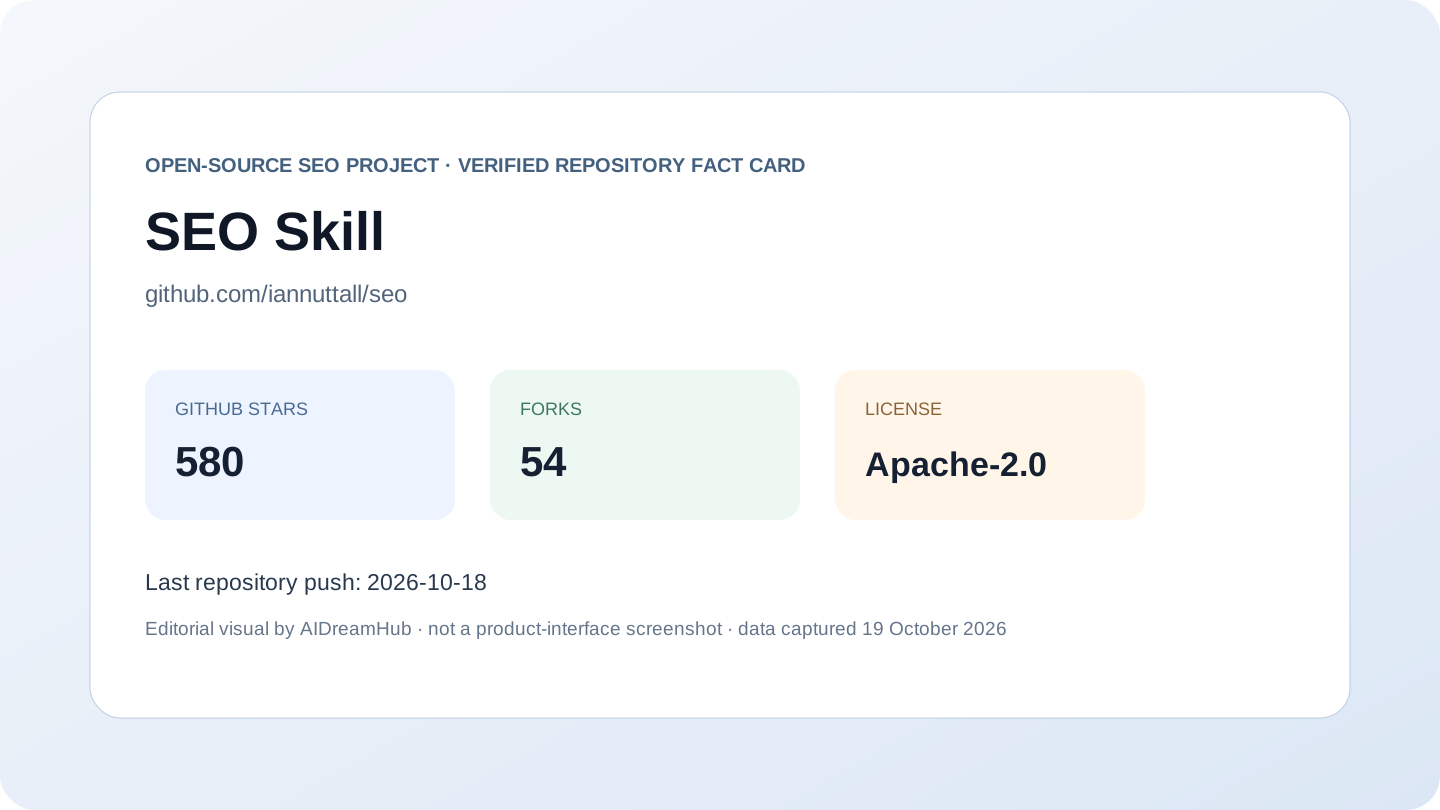
| Repository activity | 580 stars · 54 forks | Community attention and reuse signal; not proof of SEO outcomes |
| Last push | 2026-10-18 | Recent code activity; inspect releases and breaking changes before production |
| License | Apache-2.0 | Confirm obligations for distribution, SaaS use and modifications |
| Primary stack | TypeScript | Indicates the likely maintenance skills, not feature completeness |
Best-fit workflows
Best fit: site owners who want first-party search evidence inside Codex or Claude while retaining a local option for crawl data.
- Explain changes using GSC, GA4 and known Google update dates.
- Find near-ranking pages, weak CTR and internal-link opportunities from owned data.
- Add DataForSEO or Ahrefs only when competitor or keyword data is required.
Practical starting point: Connect one property, reproduce the main report, review privacy and key storage, run crawl commands locally, and require confirmation before page changes.
Limitations, security and operating cost
- Hosted OAuth and saved keys remain a trust decision even when report rows are not retained.
- Third-party provider costs and licenses are separate from the open-source client.
- Facts without embedded advice reduce bias but require a capable analyst to choose the right comparison.
Open source removes one form of lock-in, but it does not remove engineering time, model or API charges, browser/proxy costs, data-provider terms, authentication work, backups or upgrade risk. Map every external service and every write-capable action before production use.
SEO Skill compared with alternatives
| Option | Choose it when | Trade-off |
|---|---|---|
| MCP GSC | narrow Search Console access | simpler surface, fewer joined data sources |
| SEOMonster | local user-credential MCP plus guarded writes | more operational and action tools |
| Ryze MCP Skills | hosted marketing-data connector and skill library | broader account scope, different trust boundary |
The comparison is task-based, not a claim that one product is universally better. A narrow library may outperform a suite inside its framework, while a mature commercial crawler may be cheaper than maintaining an open tool at large scale.
A seven-step evaluation before adoption
- 1. Define one decision and a bounded test set before installing or connecting accounts.
- 2. Pin the repository revision or release and record the configuration used.
- 3. Verify several outputs against the live page, source console or another independent tool.
- 4. Separate deterministic observations from scores, estimates and model-written recommendations.
- 5. Measure false positives, missing coverage, runtime and provider cost on a realistic sample.
- 6. Use least-privilege credentials; require approval for edits, submissions, purges or publishing.
- 7. Keep raw exports and a rollback plan so the result can be audited after an update.
Our independent take
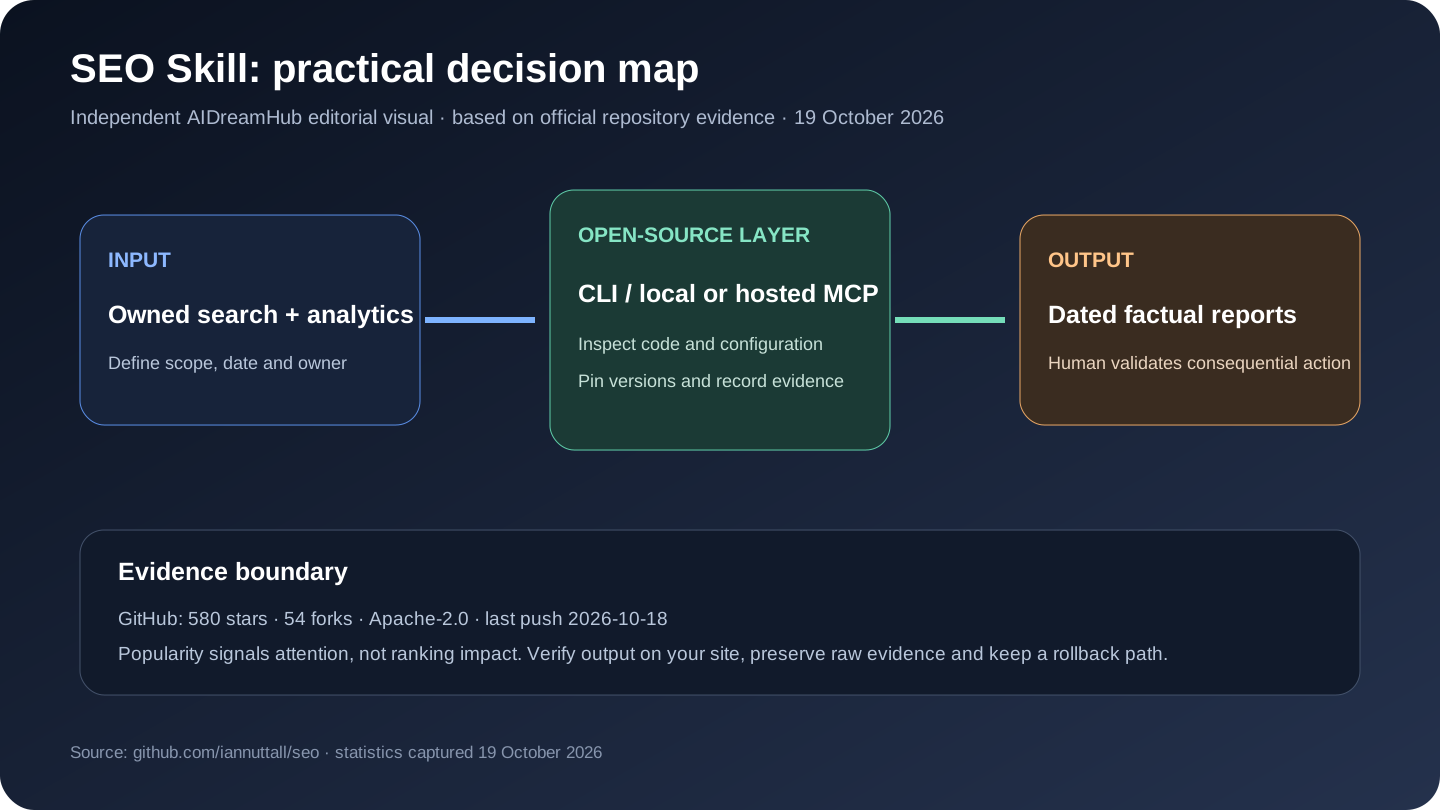
Separating facts from advice is a strong design choice: it makes the agent's reasoning visible instead of hiding recommendations inside a proprietary score. That is also the decision boundary: keep the tool if it produces reproducible evidence and reduces work on a real site; reject it if the team mainly receives more scores, prose or issue volume without clearer decisions.
Frequently asked questions
Is it really open source?
The GitHub API reported Apache-2.0 on 19 October 2026. Review the repository's license file and dependency licenses for the exact rights and obligations. A connected cloud API or hosted service can have separate terms even when the client code is open.
Does GitHub popularity mean it improves rankings?
No. Stars and forks indicate attention and reuse, not ranking lift, data accuracy or suitability for a particular site. Use a controlled evaluation with Search Console, analytics and manually verified output.
Who is it best for?
SEO Skill is best suited to site owners who want first-party search evidence inside Codex or Claude while retaining a local option for crawl data. It is a poor fit when the team cannot operate its runtime, verify its evidence or own the permissions it requests.
What should be tested first?
Use one representative workflow: Explain changes using GSC, GA4 and known Google update dates. Record inputs, raw output, time, failures and any external cost, then compare with the team's current method.
Can it replace a commercial SEO suite?
Usually only for a defined slice of work. Open-source workflow and audit tools rarely include the same proprietary backlink index, historical SERP coverage, support organization, permissions and polished client reporting as a mature paid suite.
How to Use SEO Skill: Quick Start
This workflow is condensed from the project's official README and documentation. Run it first on a test site, test property or local environment; check the linked source again when versions change.
Prerequisites
- Node.js 22 or newer
- A Google account with access to the target Search Console property
- An MCP-compatible agent for conversational use
Install and run
npm i -g seo
seo start

# Verify connected properties and run the first report
seo sites
seo report --site example.com
First-use workflow
- Install the CLI and run seo start.
- Complete Google sign-in and choose the hosted or local MCP option.
- List accessible properties and confirm the exact property identifier.
- Run the main report for one site and check dates, filters and data-source limits.
- Keep crawls and internal-link analysis local when page content should not pass through a hosted service.
How to confirm it worked
seo sites lists the expected property and seo report returns dated facts that can be reproduced in the connected Google products.
Before production use
Use the account page to review or delete linked accounts and keys. Add DataForSEO or Ahrefs only when the task genuinely needs third-party competitive data.
Official Quick Start source: iannuttall/seo README.
Sources reviewed
- Official GitHub repository
- Official README
- Official releases
- Commit history
- Official project website or documentation
- Repository license
Editorial review updated 19 October 2026. Repository statistics, documentation, dependencies and hosted-service terms can change. Verify the linked official sources before installation, procurement or deployment.