Independent verdict: Marketing Skills for AI Agents is an MIT-licensed library of reusable marketing skills for coding agents, with SEO, CRO, analytics, copywriting and growth workflows that can share one product-marketing context. Its strongest fit is technical marketers and founders who want repeatable, inspectable playbooks inside the coding agent they already use. The main adoption mistake would be to treat an open repository or a high star count as proof that its recommendations, data or scores are correct for every site.
Its real advantage is composability, not the number of files: one shared context can stop SEO, copy and CRO agents from optimizing toward different audiences.
What Marketing Skills for AI Agents actually does
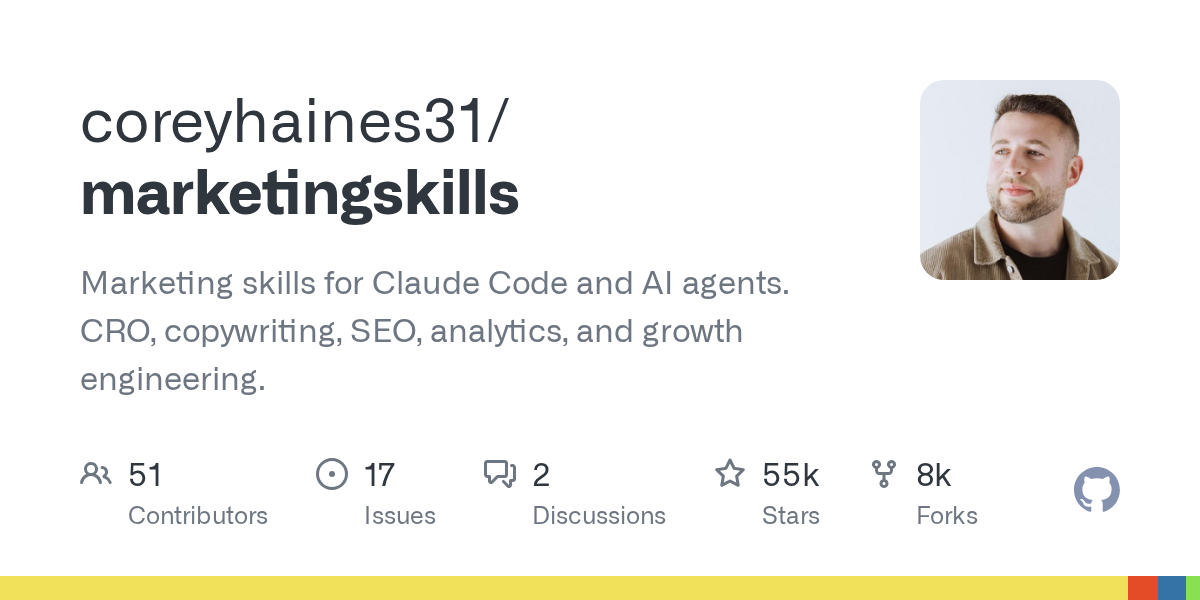
Marketing Skills for AI Agents should be evaluated as a agent tool, not as a universal SEO platform. The verified repository description is: “Marketing skills for Claude Code and AI agents. CRO, copywriting, SEO, analytics, and growth engineering.” The distinction matters because a crawler, a structured-data library and an MCP connector solve different layers of the SEO workflow.
| Verified capability | Practical meaning |
|---|---|
| Works with Claude Code, Codex, Cursor, Windsurf and other agents that implement the Agent Skills specification. | Check the official setup and version before relying on it. |
| Offers several installation paths, including a CLI, Claude Code plugin, Codex plugin, repository copy and submodule. | Treat integrations as separate trust and cost boundaries. |
| The core library is free; optional partner integrations and connected marketing accounts remain separate services with their own permissions and costs. | Benchmark the behavior on a representative site or account. |
Current GitHub evidence snapshot
The table below was captured on 19 October 2026. “Latest” means recent repository activity in this review, while “hot” is a blend of attention and activity. Neither term is a quality guarantee.
| Evidence | Observed | How to interpret it |
|---|---|---|
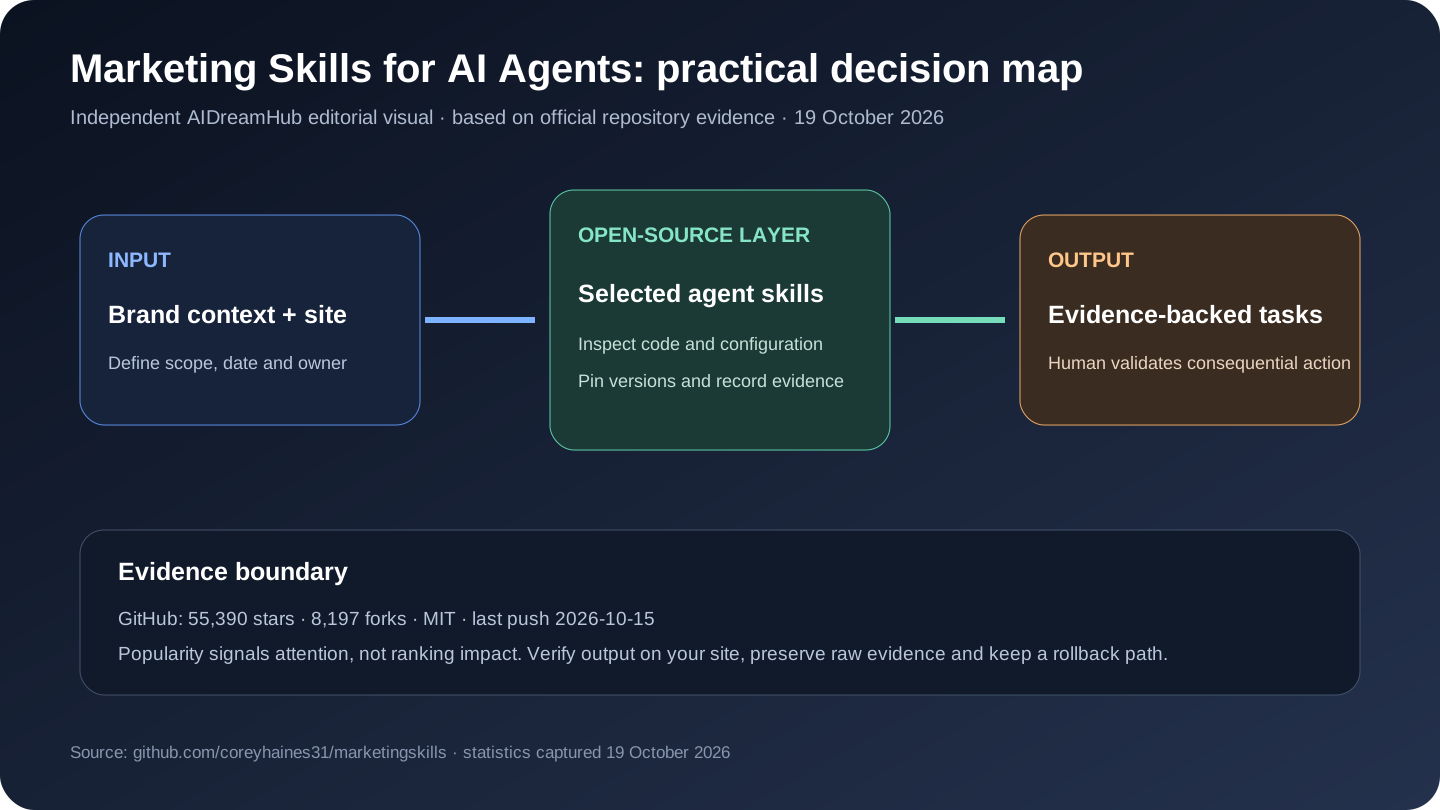
| Repository activity | 55,390 stars · 8,197 forks | Community attention and reuse signal; not proof of SEO outcomes |
| Last push | 2026-10-15 | Recent code activity; inspect releases and breaking changes before production |
| License | MIT | Confirm obligations for distribution, SaaS use and modifications |
| Primary stack | JavaScript | Indicates the likely maintenance skills, not feature completeness |
Best-fit workflows
Best fit: technical marketers and founders who want repeatable, inspectable playbooks inside the coding agent they already use.
- Run a technical and on-page SEO review with a consistent checklist.
- Keep positioning, audience and evidence rules in a shared project context.
- Combine SEO findings with copy, CRO and analytics follow-up instead of handing work between disconnected prompts.
Practical starting point: Install only the skills needed for the first workflow, create the product-marketing context, connect one read-only data source, and require a human to approve edits or publishing.
Limitations, security and operating cost
- Skills are instructions and procedures, not an independent SEO dataset; live metrics require separately connected tools.
- A large library can create overlap and contradictory advice unless a team selects a small approved subset.
- Any agent with filesystem or account access needs least-privilege credentials, review gates and a clear rollback path.
Open source removes one form of lock-in, but it does not remove engineering time, model or API charges, browser/proxy costs, data-provider terms, authentication work, backups or upgrade risk. Map every external service and every write-capable action before production use.
Marketing Skills for AI Agents compared with alternatives
| Option | Choose it when | Trade-off |
|---|---|---|
| Claude SEO | a deeper Claude-specific SEO audit system | more SEO depth, less cross-agent portability |
| SEO Skill | first-party GSC, GA4 and Bing data through CLI/MCP | stronger data access, narrower marketing scope |
| Manual SOPs | teams with strict governance and no agent runtime | more control, more coordination work |
The comparison is task-based, not a claim that one product is universally better. A narrow library may outperform a suite inside its framework, while a mature commercial crawler may be cheaper than maintaining an open tool at large scale.
A seven-step evaluation before adoption
- 1. Define one decision and a bounded test set before installing or connecting accounts.
- 2. Pin the repository revision or release and record the configuration used.
- 3. Verify several outputs against the live page, source console or another independent tool.
- 4. Separate deterministic observations from scores, estimates and model-written recommendations.
- 5. Measure false positives, missing coverage, runtime and provider cost on a realistic sample.
- 6. Use least-privilege credentials; require approval for edits, submissions, purges or publishing.
- 7. Keep raw exports and a rollback plan so the result can be audited after an update.
Our independent take
Its real advantage is composability, not the number of files: one shared context can stop SEO, copy and CRO agents from optimizing toward different audiences. That is also the decision boundary: keep the tool if it produces reproducible evidence and reduces work on a real site; reject it if the team mainly receives more scores, prose or issue volume without clearer decisions.
Frequently asked questions
Is it really open source?
The GitHub API reported MIT on 19 October 2026. Review the repository's license file and dependency licenses for the exact rights and obligations. A connected cloud API or hosted service can have separate terms even when the client code is open.
Does GitHub popularity mean it improves rankings?
No. Stars and forks indicate attention and reuse, not ranking lift, data accuracy or suitability for a particular site. Use a controlled evaluation with Search Console, analytics and manually verified output.
Who is it best for?
Marketing Skills for AI Agents is best suited to technical marketers and founders who want repeatable, inspectable playbooks inside the coding agent they already use. It is a poor fit when the team cannot operate its runtime, verify its evidence or own the permissions it requests.
What should be tested first?
Use one representative workflow: Run a technical and on-page SEO review with a consistent checklist. Record inputs, raw output, time, failures and any external cost, then compare with the team's current method.
Can it replace a commercial SEO suite?
Usually only for a defined slice of work. Open-source workflow and audit tools rarely include the same proprietary backlink index, historical SERP coverage, support organization, permissions and polished client reporting as a mature paid suite.
How to Use Marketing Skills for AI Agents: Quick Start
This workflow is condensed from the project's official README and documentation. Run it first on a test site, test property or local environment; check the linked source again when versions change.
Prerequisites
- Node.js with npx available
- A compatible coding agent such as Codex, Claude Code, Cursor or Windsurf
- A project folder where shared marketing context can be stored
Install and run
# Inspect the available skills
npx skills add coreyhaines31/marketingskills --list

# Install the SEO-oriented skills for Codex
npx skills add coreyhaines31/marketingskills --skill seo-audit ai-seo schema -a codex
First-use workflow
- Run the list command before installing the full library.
- Install only the SEO skills required for the first project and explicitly select the target agent.
- Create or complete the product-marketing context with audience, positioning, competitors and evidence rules.
- Ask the agent to audit one URL, then review the cited evidence before expanding to the whole site.
How to confirm it worked
The target agent can discover the installed skills and produces an audit that refers to the project's product-marketing context rather than generic advice.
Before production use
Keep connected marketing accounts read-only at first. The repository notes that partner integrations and live data services are separate trust, permission and cost boundaries.
Official Quick Start source: coreyhaines31/marketingskills README.
Sources reviewed
- Official GitHub repository
- Official README
- Official releases
- Commit history
- Official project website or documentation
- Repository license
Editorial review updated 19 October 2026. Repository statistics, documentation, dependencies and hosted-service terms can change. Verify the linked official sources before installation, procurement or deployment.