What OpenSEO actually is
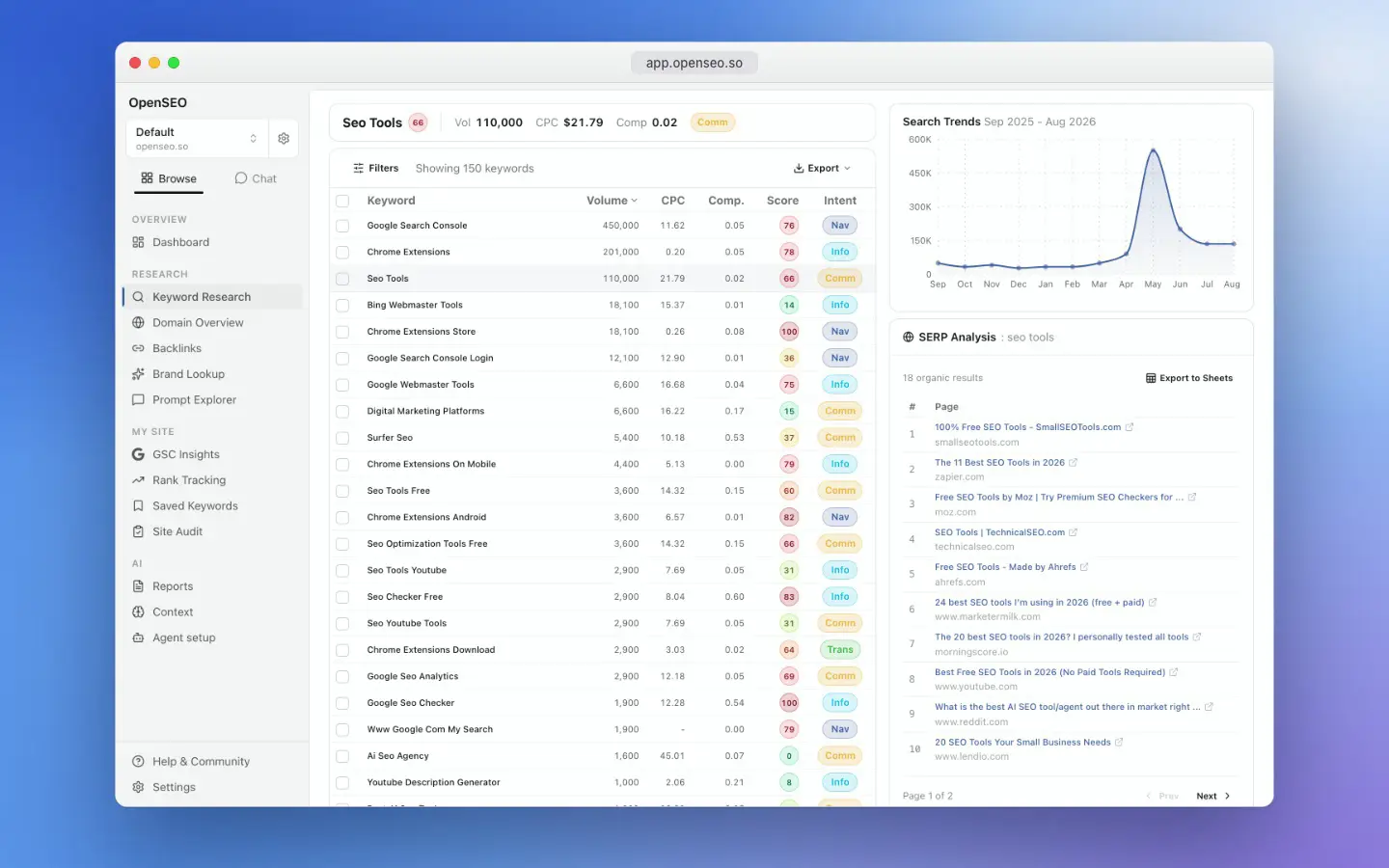
OpenSEO is an MIT-licensed SEO application that combines keyword research, live SERP inspection, rank tracking, competitor and backlink research, technical site audits, Google Search Console data and AI-search visibility. It can be used in the hosted web app, connected to compatible AI clients through MCP, or deployed from source. The project was created in 2026 and is moving quickly; on 19 October 2026 its public repository showed roughly 24,000 stars, 3,200 forks and a release published five days earlier. Those numbers show attention and active maintenance, not proof that its data is more accurate than a mature suite.
The useful mental model is not “Ahrefs for free.” OpenSEO is a workflow and control layer over external data—principally DataForSEO, first-party Search Console records, and its own crawler. Its distinctive value is that the same project context can be used from a clean web UI, an MCP-connected agent and reusable Agent Skills. A founder can research a topic, save candidates, ask an agent to inspect the SERP, turn the findings into a report and revisit the decision later without rebuilding context from chat history.
That design is attractive to technical marketers and small teams that want inspectable code, lower fixed fees and automation. It is less convincing for a large agency that needs a decade of proprietary historical data, mature permissions, standardized client reporting and predictable support. The right comparison is therefore not feature-count versus feature-count; it is control and automation versus dataset maturity and operational burden.
Capability and evidence snapshot
| Area | What OpenSEO provides | Decision note |
|---|---|---|
| Keyword research | Ideas, volume, difficulty, CPC, intent and live SERPs | Data-provider estimates; validate commercial fit |
| Rank tracking | Saved keywords and scheduled position checks | Cost grows with keywords and frequency |
| Competitors and backlinks | Domain footprints, ranking rows and backlink/referring-domain overview | Useful triage, not a proprietary index |
| Site audit | Crawler signals plus optional Lighthouse findings | Cloudflare JavaScript rendering needs paid Workers |
| AI visibility | Prompt research, mentions, citations and scheduled checks | A sampled observation, not a universal AI ranking |
| First-party data | Search Console performance and URL inspection | Strongest source for your own verified properties |
| Agent access | MCP tools, project context, reports and Agent Skills | Keep approval around writes and publishing |
| Deployment | Hosted, Docker or Cloudflare | Different security and maintenance boundaries |
Why MCP changes the workflow
OpenSEO's strongest differentiation is the loop between data and action. MCP exposes keyword metrics, SERPs, ranking rows, backlink summaries, Google Business data, Search Console performance, URL inspection, AI-answer research and project context. Skills add repeatable decision logic. This can make an agent useful without giving it unrestricted browser access or asking it to invent metrics.
The boundary still matters: an MCP tool returning a row does not decide whether the keyword fits the business, whether a competitor is comparable or whether an AI citation is durable. Human review remains necessary before saving targets, changing pages or publishing reports. Treat saved project context as business data, scope API keys narrowly and review any write-capable workflow.
Hosted or self-hosted: the real architecture
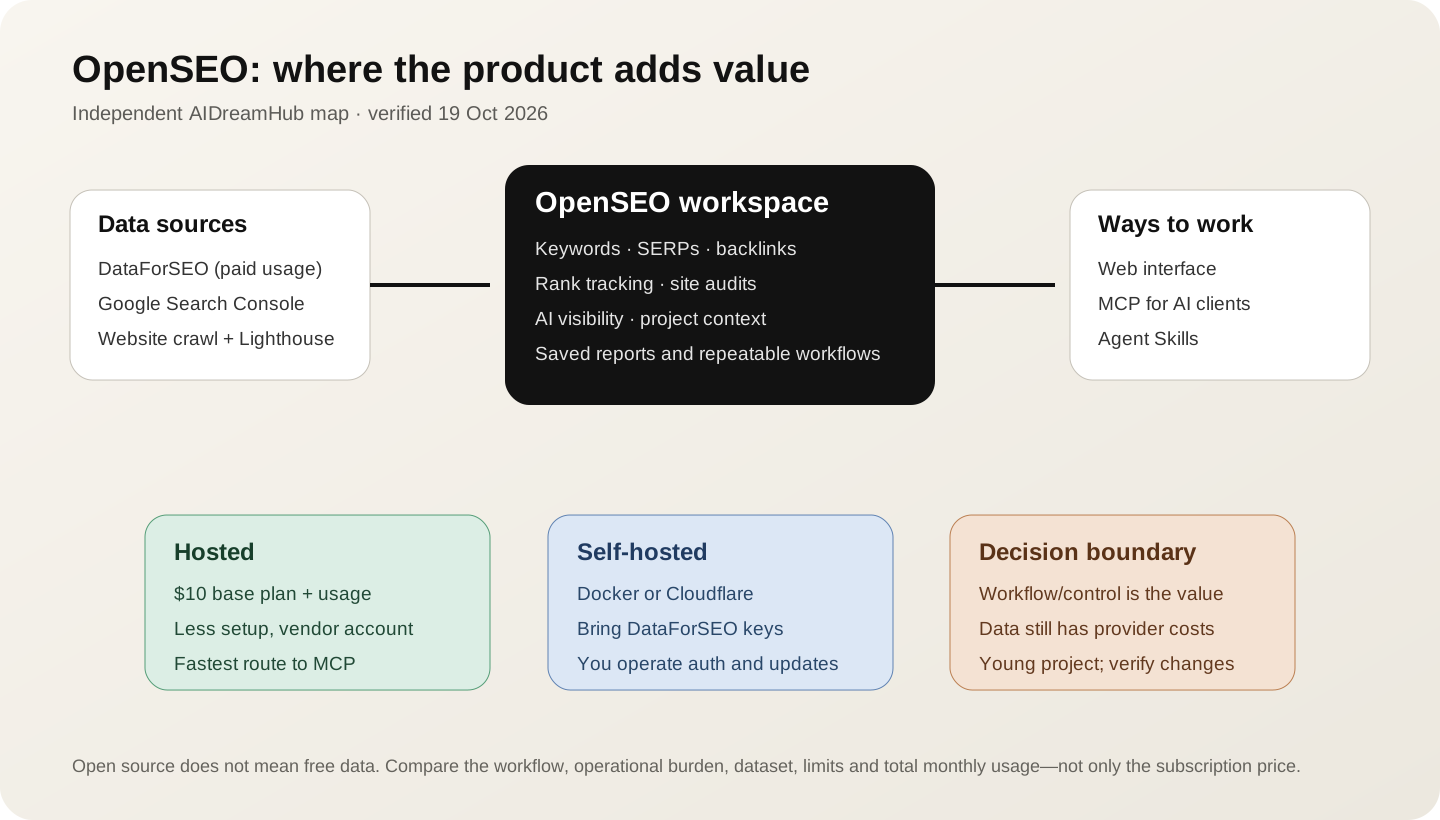
The hosted service is the simplest path: account, billing, OAuth and the public MCP endpoint are managed. Self-hosting gives more control over code and storage but does not make the system zero-maintenance. Docker runs with AUTH_MODE=local_noauth; the official documentation says to keep it private or place it behind your own authenticated reverse proxy. Cloudflare deployment provisions D1, KV, R2 and an Access login gate, but requires a Cloudflare account, a payment method for R2 activation and more operational familiarity.
Data still leaves the application when external services are used. Keyword, SERP, backlink and AI-visibility requests go to DataForSEO; optional prompt-generation features can use OpenRouter; Search Console access reaches Google. Self-hosting changes who operates the application and where its database lives—it does not automatically make every research request local. Map each provider, key, retention policy and user permission before using client or regulated data.
Pricing and total cost
As checked on 19 October 2026, the hosted Base Plan starts at $10 per month, includes $10 of monthly usage, and allows top-ups. Search Console data and previously fetched data do not consume those credits. The pricing page estimates typical unit costs, but a team's bill depends on keyword result depth, backlink checks, tracked keywords, audit size, AI prompts and schedule frequency.
Self-hosting removes the hosted subscription but requires a DataForSEO account and pays that provider directly. Add infrastructure, backups, authentication, updates and troubleshooting to the calculation. The repository says hosted data calls include a 28% markup; that can matter at volume, but staff time often costs more than the markup for a small team. Run a one-month workload sample before choosing purely on headline price.
Best-fit use cases
Best fit: founders, technical SEO consultants, developer-marketers and small agencies that want an affordable workspace plus agent automation; teams already using ChatGPT, Claude or Codex; and developers who want to inspect or extend the application instead of accepting a closed roadmap.
Concrete jobs include building a prioritized keyword list with live SERP evidence, comparing a small set of competitors, pairing Search Console decline data with URL inspection, running a migration audit, tracking a focused keyword set, checking brand citations across AI answers, and saving an evidence-backed report for a client or product team.
It is not automatically the best choice for enterprise portfolio reporting, very large crawls, exhaustive backlink forensics, legal-grade access controls or teams that require a single vendor to own data quality and support. OpenSEO can be part of that stack, but its low price should not be confused with enterprise completeness.
Limits, security and maintenance
- Data dependency: much of the competitive dataset comes from DataForSEO. OpenSEO improves access and workflow; it does not own an Ahrefs-scale web index.
- Operational security: local Docker authentication is disabled by design. Never expose the default container directly to the internet. Use a private network or an authenticated proxy, rotate provider keys and keep backups.
- Fast product change: the repository is young and releases frequently. Pin container versions for production, read release notes and test MCP clients after upgrades.
- Usage variability: scheduled rank checks, deep SERPs, backlinks, audits and AI-answer collection can consume credits. Preview costs and set project-level budgets.
- Method limits: search volume, difficulty, traffic estimates and AI-visibility observations are estimates or samples. Validate important decisions against Search Console, analytics and actual conversions.
OpenSEO compared with the alternatives
| Option | Best when | Tradeoff / reviewed price |
|---|---|---|
| OpenSEO | You want open code, MCP, flexible automation and usage-based SEO data | $10/mo hosted base or self-host; provider and operating costs remain |
| Ahrefs | Backlink/keyword index depth, historical research and established workflows matter | Lite $129/mo; closed platform with plan limits |
| Semrush | A broad marketing suite, client reporting and team processes matter | SEO $139/mo; Starter with MCP $199/mo on the reviewed monthly page |
| Screaming Frog | Deep, configurable desktop technical crawling is the primary job | Free to 500 URLs; £199/year paid; not an all-in-one research workspace |
| DataForSEO direct | You are building a custom product or pipeline and can own the engineering | Pay-as-you-go raw APIs; maximum control, maximum implementation work |
Independent review updated 19 October 2026. Prices, repository statistics, release status and provider features change; verify the linked official pages before purchase or deployment.
A practical evaluation workflow
- Choose one site and one decision, such as finding ten realistic pages to publish—not “do all SEO.”
- Create the project context: audience, offer, countries, competitors, conversion pages and writing constraints.
- Connect Search Console when available, then verify which metrics are first-party and which are third-party estimates.
- Run a small keyword and SERP sample; check relevance, locale, device and cost before expanding.
- Test the same workflow in the web UI and over MCP. Require approval before an agent saves data or publishes a report.
- Run a site audit on a bounded crawl and manually verify several reported issues, including false positives.
- Compare one representative month with Ahrefs, Semrush, Screaming Frog or direct DataForSEO on data coverage, effort and total cost.
- If self-hosting, secure access, pin a release, back up the database and document upgrade and key-rotation procedures.
Frequently asked questions
Is OpenSEO really open source?
Yes. The public repository uses the MIT License, which permits use, modification and distribution subject to the license notice. DataForSEO, OpenRouter, Google and hosted OpenSEO remain separate services with their own terms and charges.
Is OpenSEO free?
The source code is free to use, but SEO data and infrastructure are not necessarily free. Hosted OpenSEO starts at $10 per month with included usage. Self-hosting requires your own DataForSEO credentials and may incur Cloudflare, server, backup and maintenance costs.
Can OpenSEO replace Ahrefs or Semrush?
For focused keyword, competitor, backlink, audit, tracking and agent workflows, it may replace a meaningful part of a small team's stack. It does not automatically match the proprietary indexes, historical depth, enterprise controls, reporting breadth or support organization of the established suites.
Does OpenSEO work with ChatGPT, Claude and Codex?
Yes. Its hosted MCP endpoint supports compatible clients, and the documentation includes setup for ChatGPT, Claude, Cursor and Codex. OAuth is convenient for interactive use; personal API keys are intended for headless or CI workflows and should be treated as sensitive credentials.
Can I self-host OpenSEO safely?
Yes, with deliberate setup. Docker's documented local mode has no application authentication, so keep it private or add an authenticated proxy. The Cloudflare route adds an Access gate and is the recommended path for internet-facing or team use.
Where does OpenSEO get its data?
Competitive keyword, SERP, backlink and AI-visibility workflows rely largely on DataForSEO. It also uses first-party Google Search Console connections and an application crawler for site audits, with optional Lighthouse checks.
Who should choose Screaming Frog instead?
Choose Screaming Frog when the primary job is deep, configurable technical crawling on a desktop and you do not need an integrated keyword, backlink, rank-tracking or agent workspace. The free version crawls up to 500 URLs; the paid license removes that limit and adds advanced features.
Sources reviewed
- OpenSEO official site
- OpenSEO GitHub repository
- OpenSEO releases
- MIT license
- OpenSEO pricing
- OpenSEO MCP documentation
- Docker self-hosting guide
- Cloudflare self-hosting guide
- OpenSEO site-audit documentation
- DataForSEO pricing
- Ahrefs pricing
- Semrush pricing
- Screaming Frog pricing
Independent review updated 19 October 2026. Prices, repository statistics, release status and provider features change; verify the linked official pages before purchase or deployment.