
Cursor
Built to make you extraordinarily productive, Cursor is the best way to code with AI.
ai-codingfree
4460
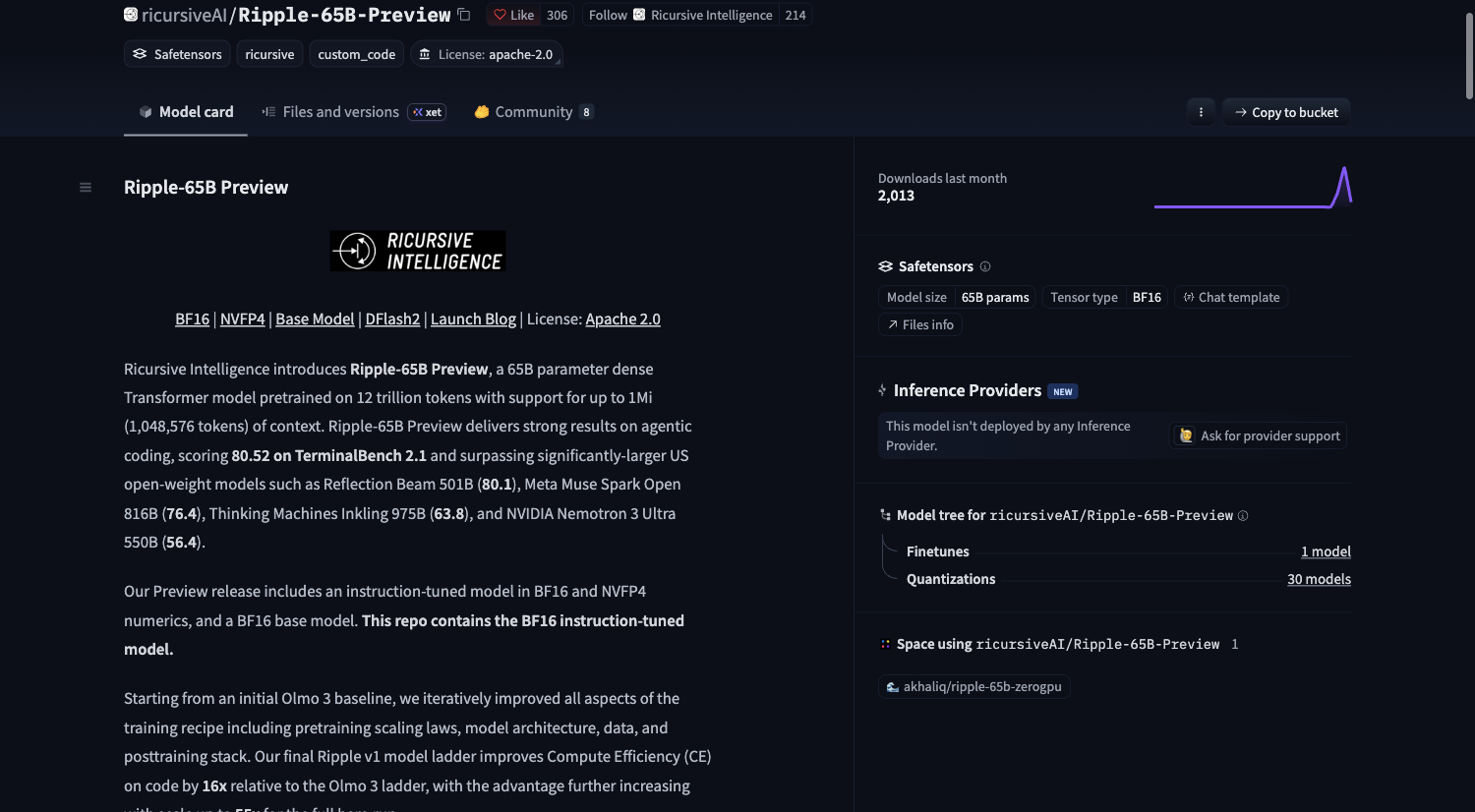
Ripple-65B Preview is Ricursive Intelligence’s dense open-weight text model for coding agents. Review serving choices, benchmark conditions, memory arithmetic and tool-result validation.
0
Views
0
Likes
Nov 2026
Added
huggingface.co
Website
A quick visual look at Ripple-65B Preview before you visit the official site.
Editorial Review
Research checked 6 November 2026. Publisher claims and third-party trials are identified separately; this page is not an AIDreamHub hands-on benchmark.
Ripple-65B Preview is a 65B dense Transformer from Ricursive Intelligence, with post-training focused on agentic coding. The release includes instruction-tuned BF16 and NVFP4 variants and a separate base model. The linked BF16 repository is not interchangeable with the quantised release or a hosted endpoint.
It can be considered as the model behind a repository or operations agent. The surrounding system must still supply tools, repository state, permissions, execution and tests. A model score alone does not give it a safe shell or prove a pull request is correct.
Official project page captured by AIDreamHub; not a locally run product.
The publisher reports about 80.5 on Terminal-Bench 2.1 and 76.5 on SWE-bench Verified. It also explains that comparison values mix official reports and in-house measurements and that harness choices affect results. That makes the table useful evidence to investigate, not a universal ranking across all agents.
The current card describes up to 1Mi context, or 1,048,576 tokens. Supported context length does not mean that length is economical or equally effective on every runtime. Test retrieval and truncation behaviour at realistic lengths instead of sending a whole repository by default.
For a small pilot, a hosted endpoint can separate model evaluation from local serving work. GMI documents an OpenAI-compatible chat endpoint and model identifier; the example below uses an environment variable for its key. Do not send private code without reviewing the provider’s data handling and your organisation’s permissions.
For local use, choose the exact BF16 or NVFP4 package and follow the release’s compatible serving instructions. Inspect custom code before trusting it. Pin revisions, begin with a short context and capture tool traces, tests and resource usage. We did not run local inference or reproduce the launch scores.
curl https://api.gmi-serving.com/v1/chat/completions -H "Content-Type: application/json" -H "Authorization: Bearer $GMI_API_KEY" --data '{"model":"gmicloud/Ripple-65B-Preview","messages":[{"role":"user","content":"Explain the failing test before proposing a patch."}],"max_tokens":800}'GMI’s launch-week report describes small bug-fix repositories and a simulated incident workflow with traps and a human approval gate. It includes a single 100-agent run and repeated smaller runs. These are the serving provider’s measurements on its own endpoint, not proof of equivalent local performance or arbitrary production-code success.
The transferable lesson is its grading method: external tests determined whether a fix worked, while the model’s own summary had no grading weight. Approval was enforced by the tools. A few prompt-injection trials do not establish general immunity, so keep permissions and validation outside the model.
As an illustrative lower-bound calculation, 65 billion parameters at two bytes each are about 130 GB of weight data; ideal four-bit storage is about 32.5 GB. These are decimal arithmetic estimates, not measured deployment requirements. Quantisation metadata, activations, runtime buffers and context state add overhead.
Do not convert a DGX Spark example into a promise for any laptop, or a datacentre throughput number into single-user latency. Record prompt size, concurrency, quantisation, time to first token and accepted-task cost together. Longer context can change the dominant bottleneck.
| Quantity | What it describes | Not a guarantee of |
|---|---|---|
| BF16 estimate | About 130 GB raw weights | Complete machine RAM requirement |
| Four-bit estimate | About 32.5 GB ideal weight storage | A 32 GB GPU running the full workload |
| 1Mi context | Advertised supported window | Cheap or accurate million-token requests |

Start with a fixed failing test in a disposable repository. Require the change, test output and final diff, then include a no-change task, an invalid tool response and a denied operation. Keep summaries separate from observed state. For operations, require a matching human approval before any production mutation.
Compare Ripple with your current model on the same tools, task set and budget, and compare deterministic scripts for work that does not need reasoning. Count retries and rejected patches. An endpoint that generates code quickly can still be expensive if people must repair its outputs.
| Test | Acceptance | Reject when |
|---|---|---|
| Bug fix | Locked regression test passes on the patch | The model merely says done |
| Permissions | Denied action produces no mutation | Prompt text bypasses the gate |
| Comparison | Same tasks, tools and budget | Different harnesses are treated as equal |
The release is Apache-2.0-labelled, while hosting, integrations and source-code rights remain separate. Hosted pricing and limits can change; verify the selected endpoint rather than baking launch-week rates into a long-term cost promise.
The best first decision is whether this model improves accepted work in your existing execution loop. Only then decide whether local serving economics justify the hardware and maintenance. Our hand drawing explains capacity planning; it is not a performance chart or model result.
The ideal raw-weight arithmetic is about 32.5 GB in decimal units before metadata, buffers and context. It is not a fit guarantee. Use the release’s hardware-specific instructions and measure the actual quantised runtime with headroom.
No. A model and an agent harness are different components, and the publisher notes comparison and reproducibility limits. Evaluate your own repositories, tool contracts and acceptance tests at a fixed budget instead of extending a single leaderboard to all work.
No. The executor should enforce permission, validate arguments and verify the resulting artifact or system state. Provider demos that respected approval used an actual tool-side gate; model compliance alone is not the safety guarantee.
Visit the official website to get started
Have an AI tool to share?
Get your product in front of people actively exploring AI tools.
Submit Your ToolBuilt to make you extraordinarily productive, Cursor is the best way to code with AI.
GitHub Copilot is GitHub’s AI coding assistant across IDEs, GitHub.com, pull requests, CLI workflows, code review, and agentic development. It is best for developers and teams that want AI help inside existing repositories while keeping review, tests, and governance in the workflow.

Trae is your helpful coding partner. It offers features like AI Q&A, code auto-completion, and agent-based AI programming capabilities.

MarsCode is an AI coding assistant and IDE-style development tool for code completion, explanation, debugging, and code generation. Current official metadata also points to Trae AI IDE, so the page should explain the product carefully instead of treating it as a static legacy listing.