
Wan2.6
Wan is an AI creative platform. It aims to lower the barrier to creative work using artificial intelligence, offering features like text-to-image, image-to-image, text-to-video, image-to-video, and image editing.
video-generationfree
4700
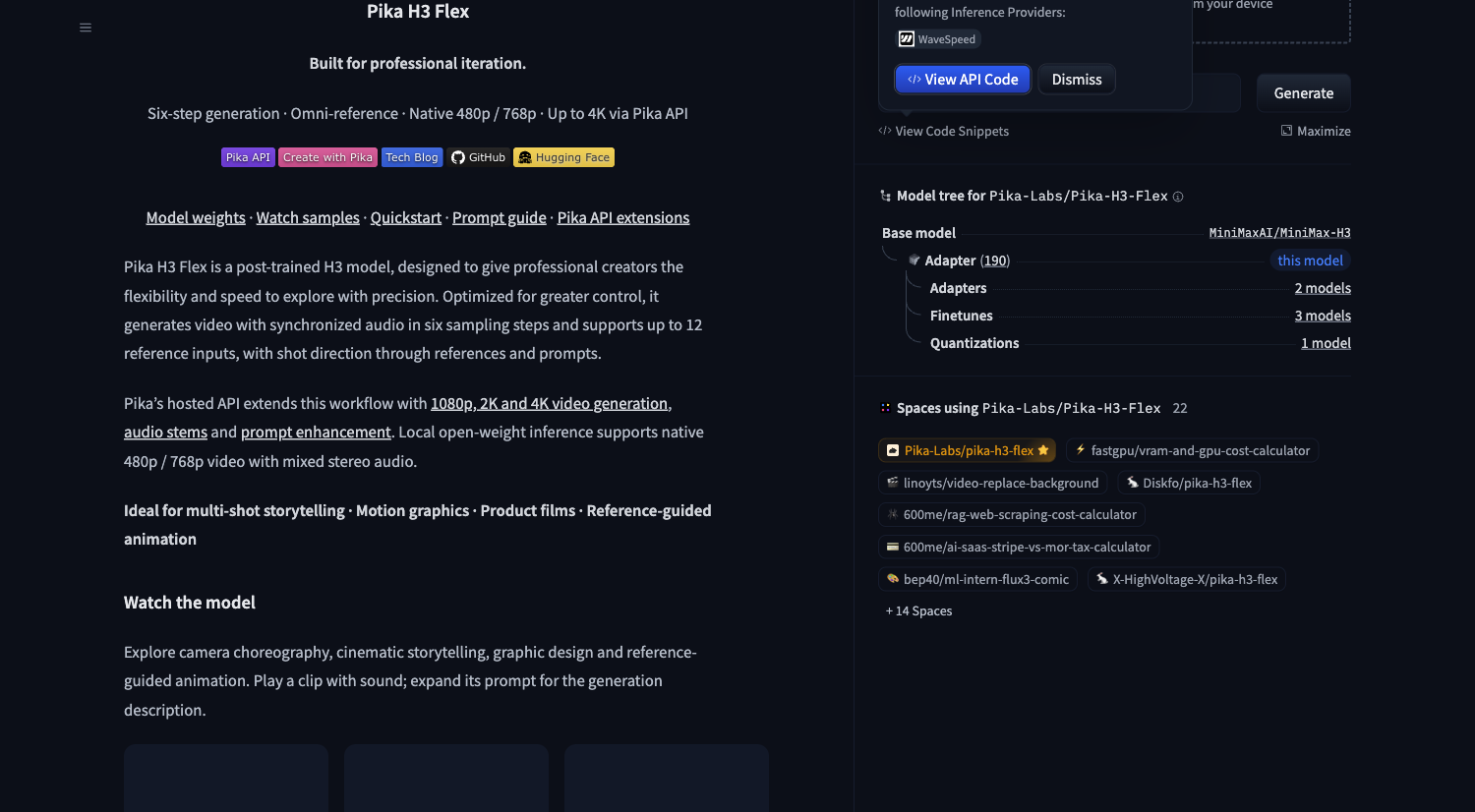

Pika H3 Flex generates video with synchronised audio using MiniMax-H3-derived adapters. Compare local reference modes, verified hardware shapes and separate hosted extensions.
2
Views
0
Likes
Nov 2026
Added
huggingface.co
Website
A quick visual look at Pika H3 Flex before you visit the official site.
Editorial Review
Research checked 6 November 2026. Publisher claims and third-party trials are identified separately; this page is not an AIDreamHub hands-on benchmark.
Pika H3 Flex is a model-and-inference release built around MiniMax-H3 with two adapters: FL2VA for text and endpoint frames, and Ref2VA for multimodal references. It targets short video with synchronised stereo audio. Access to downloadable code and weights does not include cloud compute or the Pika hosted service.
The useful production experiment is a narrow shot: one permitted product reference, restrained motion, a defined sound brief and a clear rejection rule for changed packaging. Multi-reference conditioning is a control mechanism, not proof of perfect identity or physical consistency.
Official project page captured by AIDreamHub; not a locally run product.
The local package documents 480p and 768p buckets, requested integer durations of 5–15 seconds, 24 fps, and 32 kHz stereo audio in MP4. Actual duration follows a frame grid rather than matching every requested second exactly. It uses six generator evaluations with a specific schedule; an arbitrary six-step sampler is not equivalent.
Ref2VA permits up to 9 images, 3 videos and 3 standalone audio references, with 12 files total and additional duration limits. Those are input limits, not qualification of every maximum-size combination. Hosted upscaling, audio stems and prompt enhancement are separate services; do not advertise native local 4K or stem export based on those API features.
The official CLI is named pika-h3-pro. Its documented setup uses Python 3.12, a compatible NVIDIA driver, pinned dependencies and package patches. System prerequisites include Git, patch, FFmpeg and compiler support. Follow the repository’s pip, Conda or Docker recipe rather than mixing versions from another video stack.
The short command example below uses a repository-supplied prompt. Start with one simple request, save MP4 and JSON metadata, then change one condition at a time. Prompt files are read verbatim; a hosted prompt-rewriting service is not required. We did not run GPU generation or a product-consistency test.
git clone https://github.com/Pika-Labs/Pika-H3-Flex.git
cd Pika-H3-Flex
python -m pip install -r requirements.txt
python tools/apply_diffusers_patches.py
python -m pip install --no-deps -e .
pika-h3-pro --help
pika-h3-pro --task t2va --prompt-file examples/prompts/t2va.txt --resolution 480p --aspect 16:9 --duration 5 --seed 42 --output outputs/sample.mp4The hardware document qualifies representative H100 80GB cases and says a request uses one GPU; exposing more GPUs does not shard that request. Default 480p/5-second sampling measured roughly 66–69 GiB allocated. An offloaded 768p/15-second example measured about 29–32 GiB during sampling and around 94 GiB host memory, including cache.
These are publisher measurements, not minimum GPU specifications: encoders, VAEs and other stages have separate requirements. The document asks for at least 211 GB of base components plus about 5.5 GB for both adapters, with extra staging space. A third-party verdict explicitly calls itself research-based, not hands-on; it is not independent throughput validation.
| Resource | Documented evidence | Planning consequence |
|---|---|---|
| GPU | Representative H100 80GB tests | Check your exact request shape |
| CPU offload | Large host-RAM and transfer demand | Do not infer a small-GPU guarantee |
| Storage | 211 GB base + about 5.5 GB adapters | Leave dependency and staging headroom |
Use the same image, prompt, duration and aspect ratio when comparing modes. Check first, middle and last frames for labels, shape, hands and shadows, then listen for unwanted speech, music and sync errors. Keep failures and record total generation plus repair time per accepted clip.
For an ad, exact product identity can be a hard gate rather than a weighted aesthetic score. If the model changes a logo, composite the original product or choose a controlled editing route. A high-resolution upscale cannot repair an invented design detail.
| Gate | Reject when | Next action |
|---|---|---|
| Identity | Label or silhouette changes | Simplify motion or preserve original layer |
| Audio | Unwanted voice or wrong timing | Revise sound brief and review track |
| Delivery | Wrong dimensions, duration or rights | Inspect actual file and service terms |

Compare local Flex when you have suitable compute and need reproducible artifacts, hosted Pika when managed generation is preferable, and an editor when an existing clip needs controlled finishing. Use an identical delivery requirement; provider credits, local GPU time and editing labour are different cost units.
The adapters follow the MiniMax H3 Community License; the inference code’s Apache-2.0 license does not replace the weight terms. Check input media rights and third-party component notices. The illustration explains reference and sound coordination, not an actual Pika output.
The released package documents one GPU per request. Additional GPUs can run independent processes but do not automatically shard or accelerate a single generation. Check future releases separately instead of assuming a generic multi-GPU launcher adds that capability.
No. Reported sampling allocations omit other stages, and offload increases host memory and transfer demand. The published examples are representative H100 tests, not a minimum-hardware certificate. Qualify the complete request on your intended machine.
The documented native buckets are 480p and 768p. Higher-resolution draft-to-video endpoints are a separate hosted extension. State the route, account terms and processing stage rather than presenting hosted upscaling as a local model capability.
Visit the official website to get started
Have an AI tool to share?
Get your product in front of people actively exploring AI tools.
Submit Your ToolWan is an AI creative platform. It aims to lower the barrier to creative work using artificial intelligence, offering features like text-to-image, image-to-image, text-to-video, image-to-video, and image editing.

Sora was OpenAI's video-generation product. Its web and app experiences ended on April 26, 2026, and its API is scheduled to end on September 24, 2026. This guide explains export, migration, and replacement decisions.

KLING AI is Kuaishou’s AI video and image creation platform for text-to-video, image-to-video, start/end-frame generation, motion control, camera movement, image generation, and creative asset production for social, advertising, and storytelling workflows.

Hailuo AI is MiniMax's AI video platform for text- and image-guided short-video generation. This guide covers current Hailuo 2.3 models, prompting, credit and API evaluation, alternatives, rights, and production quality control.