About Hailuo AI
海螺视频工具 - 创新的AI视频生成器和提示词工具,可以将您的想法转化为精美的AI视频。只需一段文字,即可借助尖端的AI技术,在短时间内创作出引人入胜的视觉作品。现在就用海螺视频释放您的创造力吧。
Key Features
- Powerful AI technology
- User-friendly interface
- Efficient workflow integration
- Continuous updates and improvements
Use Cases
Hailuo AI is an excellent tool in the AI Video Creation category, suitable for all users who need AI assistance.
How to evaluate the creative workflow
Hailuo AI should be evaluated against a real user job rather than a polished demonstration. Judge the product by the complete path from source material to an export you can actually publish. Generation quality matters, but so do editability, consistency, rights, watermarking, queue time, credits, and the ability to reproduce a result.
Checks that create useful evidence
- Test the same brief with several prompts or references and compare subject consistency, motion or timing, text accuracy, artifacts, and adherence to composition or style constraints.
- Check supported input and export formats, resolution, duration, stems or layers, project history, private mode, watermark behavior, and whether edits require a full regeneration.
- Read the current plan and license for commercial use, client work, advertising, resale, training data, voice or likeness consent, and ownership of uploaded and generated media.
- Calculate the effective cost of an accepted result, including discarded generations, upscaling, extensions, retries, download tiers, and final work in another editor.
Recommended trial workflow
Begin with a production brief that specifies audience, format, duration or dimensions, visual or audio references, brand constraints, and delivery rights. Generate alternatives, select on structure, refine weak sections, export at the required quality, and complete a human rights and artifact review before publishing.
Important limitations
Outputs can vary between runs and may contain anatomy, continuity, speech, typography, timing, or audio defects. A subscription's commercial-use label does not clear third-party trademarks, copyrighted characters, music, voices, faces, or confidential source material.
How to compare alternatives
Compare one leading generator, one editor-first product, and the manual production workflow the tool is meant to replace. A tool with slower generation may still be cheaper if it offers better control, layers, stems, consistency, or fewer discarded outputs.
FAQ
Can the output be used commercially?
Only after checking the current plan, license, source-asset rights, and local law. Keep generation records and obtain consent for identifiable voices, faces, client assets, or protected source material.
How should output quality be tested?
Use the same brief, references, dimensions, duration, and acceptance criteria across competing tools. Count usable results rather than judging a curated gallery or the first attractive sample.
Does it replace a professional editor or creator?
Usually not. It can shorten ideation and first-pass production, while final selection, correction, continuity, mixing, typography, rights review, and brand judgment remain human work.
Source and freshness note
This evaluation framework was reviewed on 25 July 2026. The link below is the website currently stored for this listing; it may be an official product page, repository, app-store entry, regional page, or third-party service. Confirm ownership and current terms before signing in, paying, installing software, or uploading data.
Current Hailuo model and access context
Hailuo AI is the consumer video product associated with MiniMax. MiniMax reported Hailuo 2.3 as its current video generation generation in late 2025, while its API documentation also lists a faster MiniMax-Hailuo-2.3-Fast option. Do not assume every Hailuo interface exposes the same model, resolution, duration, reference controls, or credit rate.
- Typical workflow: start from text or an image, specify subject motion and camera direction, generate a short clip, then extend or assemble shots in an external editor.
- Production test: compare prompt adherence, body and object physics, facial consistency, camera motion, texture stability, and the number of usable frames near cuts.
- Cost test: record model name, seconds, resolution, credits, queue time, failed jobs, watermark, and whether retries are refunded.
- Rights test: confirm commercial terms and obtain permission for reference faces, voices, brands, client images, and copyrighted source material.
Community reports about queue time and plan value vary sharply over time, which is another reason to run a small current test instead of relying on older reviews.
Current sources
Current Hailuo model context
Hailuo AI is MiniMax's creator-facing video product, while MiniMax also exposes video generation through its developer platform. MiniMax's current documentation lists Hailuo 2.3-family video models and a faster MiniMax-Hailuo-2.3-Fast option for API workloads. The exact model, duration, resolution, prompt controls, reference inputs, credit rate, queue priority, watermark, and commercial terms can differ between the Hailuo web product, mobile experiences, API, region, and plan.
Record the model name shown for every test. “Hailuo result” is not a reproducible label when the service can route between quality, fast, or updated versions.
| Decision | Choose for | Measure | Do not assume |
|---|---|---|---|
| Text-to-video | Creating a shot when no approved starting frame exists | Subject, scene, action sequence, camera, style, and usable seconds | A detailed prompt guarantees every requested event |
| Image-to-video | Animating an approved character, product, keyframe, or composition | Reference identity, geometry, framing, motion, and background stability | The model will preserve all details in the source image |
| Quality-oriented model | Hero shots and difficult motion where iteration cost is acceptable | Accepted-output rate and correction effort | The most expensive option wins every shot type |
| Fast model/API | Previews, higher-volume testing, and latency-sensitive pipelines | P50/P95 queue and generation time, quality loss, and failure rate | Fast means the same price or parameters on every surface |
| Traditional edit | Fixing timing, crop, stabilization, color, audio, or an already usable clip | Minutes to accepted result | Regeneration is cheaper than deterministic editing |
A practical Hailuo prompting workflow
- Define one shot. Write the subject, action, environment, camera behavior, duration, and final state. Split unrelated beats into separate shots.
- Choose the strongest control input. Use image-to-video when identity or composition matters; remove motion blur or pose cues that contradict the requested movement.
- Prioritize motion language. State who moves, how they move, camera movement, speed, sequence, and what should remain still.
- Generate a small controlled set. Change one variable at a time and retain the prompt, model, settings, source image, cost, and result.
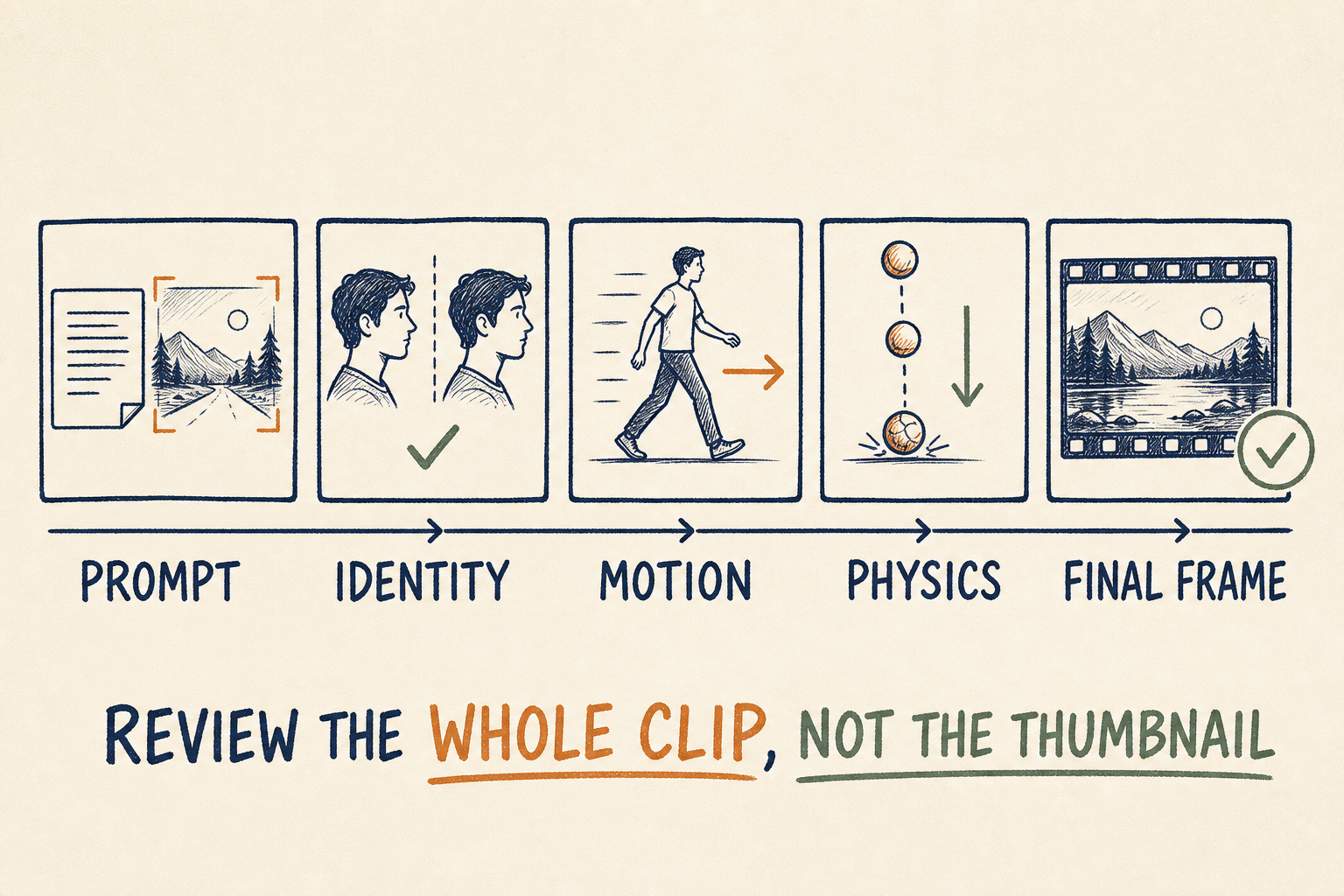
- Review frame by frame. Inspect the start, action peak, cuts, hands, faces, object contact, background, text, and final frames.
- Finish outside the generator. Trim unstable frames, stabilize, color-correct, add approved sound, captions, and assemble shots in an editor.
Quality scorecard for real projects
| Dimension | Review question | Evidence to record |
|---|---|---|
| Prompt adherence | Are required subjects, actions, order, setting, and camera behavior present? | Requirements passed per clip |
| Identity consistency | Does a person, character, product, outfit, or logo remain stable? | First drift time and rejection reason |
| Motion | Are body, object, cloth, hair, water, and camera movements temporally coherent? | Usable continuous seconds |
| Physics and contact | Do weight, gravity, collisions, grasping, shadows, and reflections make sense? | Visible defect count and severity |
| Composition | Does framing remain usable for the intended crop and edit? | Safe area and crop result |
| Operational quality | How often do jobs fail, time out, queue too long, or consume credits without a usable result? | Failure rate, queue percentiles, and refunds |
Credits, plans, and API economics
Do not compare Hailuo with another service using only advertised credits per generation. Convert each test into cost per accepted shot. Include every variant, failed job, discarded clip, extension, upscale, download, external editing, storage, and reviewer minute. Record whether a failed or blocked job consumes credits and whether a retry is refunded.
For the API, verify the current model identifier, price unit, supported inputs, resolution, duration, async job contract, polling or webhook flow, result lifetime, rate limits, concurrency, cancellation, moderation responses, retention, and regional endpoint. A prototype that submits one successful job does not demonstrate reliable batch operation.
Hailuo compared with other video paths
| Alternative | Potential advantage | Compare on |
|---|---|---|
| Runway Gen-4.5 | Integrated generation, editing, Agent, Workflows, and developer platform | Motion, editing, usable-shot cost, API operations, and rights |
| Kling AI | Different video models, reference controls, and motion profile | Identity, duration, queue, region, credits, and current model access |
| Adobe Firefly Video | Creative Cloud workflow and enterprise-oriented governance | Generation quality, plan credits, editing integration, and legal requirements |
| ComfyUI/open video model | Local graph control, model choice, and workflow ownership | Hardware, speed, license, node security, and maintenance |
| Conventional production | Direct control of actors, products, cameras, releases, and continuity | Total schedule, revision cost, predictability, and rights |
Rights and safety review
- Obtain permission for reference faces, voices, performances, client footage, product images, logos, copyrighted characters, artwork, and music.
- Check Hailuo and MiniMax terms for the exact product, plan, country, and intended commercial distribution; do not inherit assumptions from another AI tool.
- Keep confidential or unreleased material out of the service until retention, training, access, and deletion terms are approved.
- Review generated people for deceptive or harmful implications, and follow local disclosure, advertising, election, and platform rules.
- Maintain provenance: source assets, consent, prompt, model, generation date, edits, music and voice licenses, and human approval.
Frequently asked questions
Who makes Hailuo AI?
Hailuo AI is associated with MiniMax, which also provides developer APIs and model documentation. Confirm that links and billing belong to the official Hailuo or MiniMax domain before signing in or paying.
What is the current Hailuo video model?
MiniMax documentation currently lists Hailuo 2.3-family video models, including a Fast API option. The web product may expose models and settings differently, so record the exact selector shown.
Should I use text-to-video or image-to-video?
Use text-to-video for open visual exploration. Use image-to-video when an approved subject, product, character, or composition must anchor the shot, then prompt primarily for motion and camera behavior.
How should Hailuo cost be compared?
Calculate credits and human effort per accepted shot, not per generated clip. Include failures, variants, unusable frames, finishing, and queue delays.
Can Hailuo clips be used commercially?
Commercial use depends on the current service terms, plan, input rights, content, region, and distribution. Verify official terms and retain permission records rather than relying on a general review.
Is Hailuo a replacement for a video editor?
No. Generation creates or animates source shots; trimming, pacing, sound, captions, color, compositing, stabilization, and delivery still benefit from a normal editing workflow.
Current sources
- Official Hailuo AI video interface
- MiniMax video-generation API guide
- MiniMax video model pricing and units
- MiniMax video API reference
- MiniMax model and company updates
- MiniMax terms of service
Last reviewed July 25, 2026. Model names, web and API controls, credits, pricing, queue policies, resolution, duration, regions, and rights terms can change; verify the current official Hailuo and MiniMax documentation.