
Status update: Sora is no longer an active consumer video product. OpenAI states that the Sora web and app experiences were discontinued on April 26, 2026, while the Sora API is scheduled to be discontinued on September 24, 2026. Anyone arriving here to create a new Sora account should treat this as a migration page, not a current product recommendation.
Sora was OpenAI's text- and image-guided video-generation system. It helped establish a new level of public interest in generative video and later added a dedicated creation experience, storyboards, remixing, and model updates including Sora 2. Those historical capabilities still matter when understanding exported projects or comparing past results, but they should not be confused with current availability.
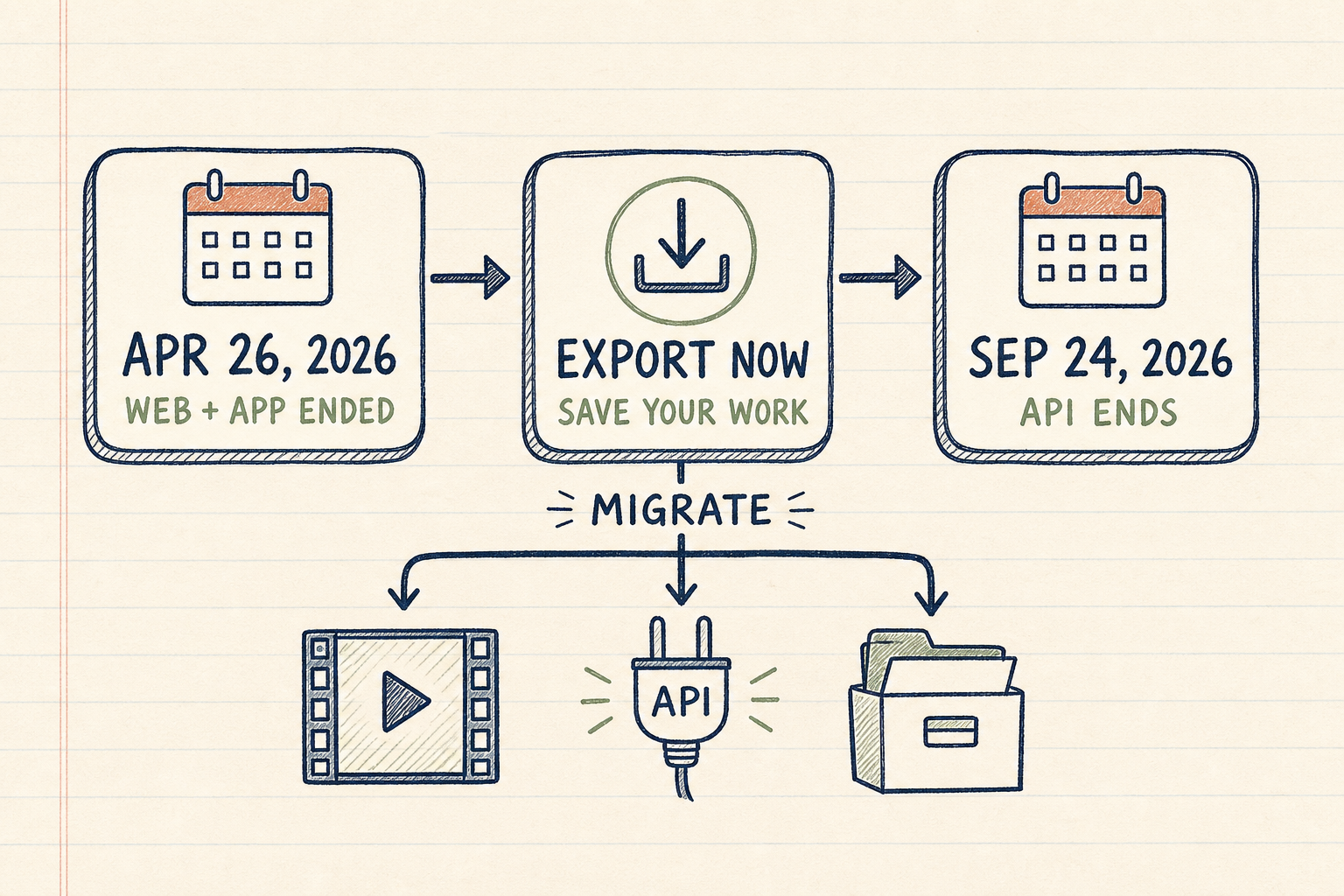
What changed and what users should do now
The most urgent action is to preserve work. OpenAI directs former Sora users to the Sora sunset export page and recommends exporting content as soon as possible. The export is prepared asynchronously and delivered through an email notification. OpenAI also warns that, after the discontinuation and any final export window, data associated with Sora use will be permanently deleted.
- Start the official export. Use the sunset page while the export path is available. Do not assume that a project visible in an old browser tab is safely archived.
- Inventory local outputs. Locate downloaded source images, prompts, storyboards, generated clips, edited masters, captions, audio, project notes, and license or client-approval records.
- Verify the archive. Check that exported files open, durations and resolutions are intact, and filenames can be connected back to projects.
- Create durable metadata. Store prompt, date, aspect ratio, model or product version when known, edit history, rights notes, and the intended campaign or owner.
- Replace production dependencies. If a workflow calls the Sora API, map each endpoint, input, output, timeout, retry, webhook, safety response, and cost assumption before selecting a replacement.
Sora status at a glance
| Surface | Current status | Required action | Deadline or risk |
|---|---|---|---|
| Sora web experience | Discontinued | Use the official sunset export path for remaining account data | Ended April 26, 2026 |
| Sora mobile app experience | Discontinued | Archive outputs and move active projects to another editor or generator | Ended April 26, 2026 |
| Sora API | Available only during the sunset period | Stop new integration work, test a replacement, and migrate production traffic | Scheduled to end September 24, 2026 |
| Purchased ChatGPT/Sora credits | Subject to current OpenAI credit guidance | Review the official account guidance; OpenAI says eligible credits can be used for Codex | Do not assume they transfer to another video provider |
| Created content and project data | Deletion risk after the final export window | Export now, validate the archive, and keep redundant backups | Availability of a later export window is not guaranteed |
How to choose a Sora replacement
The best replacement depends on the job Sora performed. A creator generating a few social clips needs a different product from a studio running an API pipeline. Avoid choosing from a highlight reel alone: evaluate consistent characters, prompt adherence, motion, camera control, editability, queue reliability, moderation behavior, provenance tools, and the cost of usable—not merely generated—seconds.
| Need | Evaluate first | Candidate category | Migration trap |
|---|---|---|---|
| Fast browser-based ideation | Prompt adherence, iteration speed, image references, storyboard controls, download options | Runway, Kling, Hailuo, Adobe Firefly Video, or another current creator product | Assuming the advertised model is available on every plan or region |
| Programmatic video generation | Stable API, async job model, webhooks, rate limits, moderation responses, retention, support | A provider with a documented production API and clear deprecation policy | Porting the request body but ignoring different failure and billing semantics |
| Commercial brand production | Usage rights, training-data position, indemnity options, team controls, provenance, review workflow | Enterprise-oriented creative platforms and approved model vendors | Using a consumer plan for client work without validating terms |
| Local or open workflow | Hardware, model licenses, node compatibility, reproducibility, security maintenance | ComfyUI and supported open video-model workflows | Underestimating GPU, storage, setup, and custom-node maintenance |
| Editing existing Sora clips | Timeline editing, upscaling, interpolation, captioning, color and audio tools | A conventional NLE plus focused AI enhancement tools | Regenerating a usable clip when a normal edit would preserve continuity |
API migration checklist
Teams using the API should work backward from September 24, 2026. The goal is not only to make another provider return a video. The replacement must behave predictably inside the surrounding product.
Assign a named owner for archive export, vendor selection, engineering cutover, legal review, and customer communication. Define a rollback point and a final acceptance test before moving production traffic. A migration is complete only when old credentials, scheduled jobs, dashboards, documentation, and user-facing references have also been removed or updated.
- Request mapping: document text prompts, image inputs, duration, aspect ratio, resolution, seed or variation behavior, and unsupported parameters.
- Job lifecycle: compare submission, polling, cancellation, webhook signatures, expired results, retry safety, and duplicate-job handling.
- Output contract: validate codecs, containers, frame rate, dimensions, audio presence, metadata, download lifetime, and storage transfer.
- Safety behavior: test the same policy edge cases. Different vendors may block, transform, or silently omit requests in different ways.
- Identity and rights: re-check rules for faces, public figures, minors, copyrighted characters, brands, reference images, and commercial use.
- Reliability: measure queue time, failure rate, timeout rate, and recovery during both normal and peak demand.
- Economics: calculate cost per accepted clip, including failed generations, discarded variants, storage, egress, upscaling, and human review.
- Cutover: run providers in parallel, record comparison results, freeze new Sora-specific features, then remove credentials and dead code after migration.
A practical evaluation scorecard
| Dimension | Suggested test | Record |
|---|---|---|
| Prompt adherence | Use 20 representative prompts with fixed required objects, actions, camera moves, and exclusions | Requirements satisfied per clip |
| Temporal stability | Inspect faces, hands, logos, backgrounds, and object geometry frame by frame | Usable seconds before visible failure |
| Reference consistency | Generate several shots from the same approved character or product reference | Reviewer consistency score and rejection reason |
| Operations | Submit jobs at normal and peak times and deliberately trigger invalid requests | P50/P95 queue time, errors, retries, cancellations |
| Cost | Create the same final deliverable with each candidate | Total spend divided by accepted deliverables |
| Rights and governance | Review terms with the intended inputs, users, geography, and distribution channel | Approved, restricted, or requires legal review |
Preserving a usable Sora archive
A folder of MP4 files is not a complete production archive. Use a consistent project directory containing final and source clips, prompt text, input images, thumbnails, captions, audio, edit project files, and a small metadata document. Record who supplied each reference and whether it may be reused. Keep an untouched exported copy and a working copy. For business-critical work, maintain backups in separate systems and test restoration.
Do not upload the entire archive to a replacement vendor without reviewing its data terms. Previous consent to use an image in Sora does not automatically authorize sending it to every future model provider. Reconfirm rights for people, client assets, unreleased products, confidential material, and licensed music or artwork.
Historical context: what Sora demonstrated
Sora helped make longer, more coherent text-to-video generation visible to a broad audience. Later product iterations emphasized creation workflows rather than a single prompt box, including ways to guide shots, remix results, and work with image inputs. Sora 2 also represented OpenAI's continued research into video and audio generation. Those contributions are useful context, but they do not change the product decision today: a discontinued interface should not be recommended as though a new user can sign up and depend on it.
Frequently asked questions
Can I still use the Sora website or app?
No. OpenAI says the web and app experiences were discontinued on April 26, 2026. The sunset page is for export and transition guidance, not a continuation of the original creation product.
When does the Sora API end?
OpenAI's current notice gives September 24, 2026 as the API discontinuation date. Production users should complete testing and cutover before that date rather than planning a last-day migration.
How do I export Sora content?
Use sora.chatgpt.com/sunset, request the export, and watch for the completion email. After downloading, open and inventory the files instead of treating the existence of a ZIP archive as proof that everything is preserved.
Will OpenAI keep my Sora data?
OpenAI says data associated with Sora use will be permanently deleted after discontinuation and the final export period. Export promptly and keep your own backups.
What is the closest Sora replacement?
There is no universal one-to-one replacement. Compare current services using your own prompts, reference assets, target duration, API needs, rights requirements, and cost per accepted clip. Runway, Kling, Hailuo, Adobe and open ComfyUI workflows represent different operating models.
Should an existing integration keep adding Sora features?
No. Freeze new Sora-specific development, preserve only necessary maintenance, and direct engineering effort to replacement testing, compatibility work, archive export, and cutover.
Official and supporting sources
- OpenAI Help Center: what to know about the Sora discontinuation
- Official Sora sunset and export page
- OpenAI: Sora 2 historical product announcement
- OpenAI Sora 2 system card
- Runway official help center
- ComfyUI official documentation
Last reviewed July 25, 2026. The deadlines above come from OpenAI's current discontinuation notice; verify the official notice before making a time-sensitive migration decision.