Independent verdict: OpenSERP is an MIT-licensed, self-hosted browser-rendered SERP API for Google, Bing, Yandex, Baidu, DuckDuckGo and Ecosia, with page extraction for automation. Its strongest fit is developers who need inspectable SERP collection and accept the operational burden of browser automation. The main adoption mistake would be to treat an open repository or a high star count as proof that its recommendations, data or scores are correct for every site.
Self-hosted SERP access trades vendor markup for engineering uncertainty; failure detection is as important as successful parsing.

What OpenSERP actually does
OpenSERP should be evaluated as a data tool, not as a universal SEO platform. The verified repository description is: “Self-hosted SERP API for AI, SEO & automation. Browser-rendered Google, Bing, Yandex, Baidu, DuckDuckGo and Ecosia search with page extraction 🎉” The distinction matters because a crawler, a structured-data library and an MCP connector solve different layers of the SEO workflow.
| Verified capability | Practical meaning |
|---|---|
| Runs searches through browser automation and exposes structured results over an API. | Check the official setup and version before relying on it. |
| Multi-engine support is useful for international research and for workflows that cannot rely on one commercial SERP provider. | Treat integrations as separate trust and cost boundaries. |
| Search engines actively change markup and anti-automation controls, so self-hosting transfers reliability, proxy and compliance work to the operator. | Benchmark the behavior on a representative site or account. |
Current GitHub evidence snapshot
The table below was captured on 19 October 2026. “Latest” means recent repository activity in this review, while “hot” is a blend of attention and activity. Neither term is a quality guarantee.
| Evidence | Observed | How to interpret it |
|---|---|---|
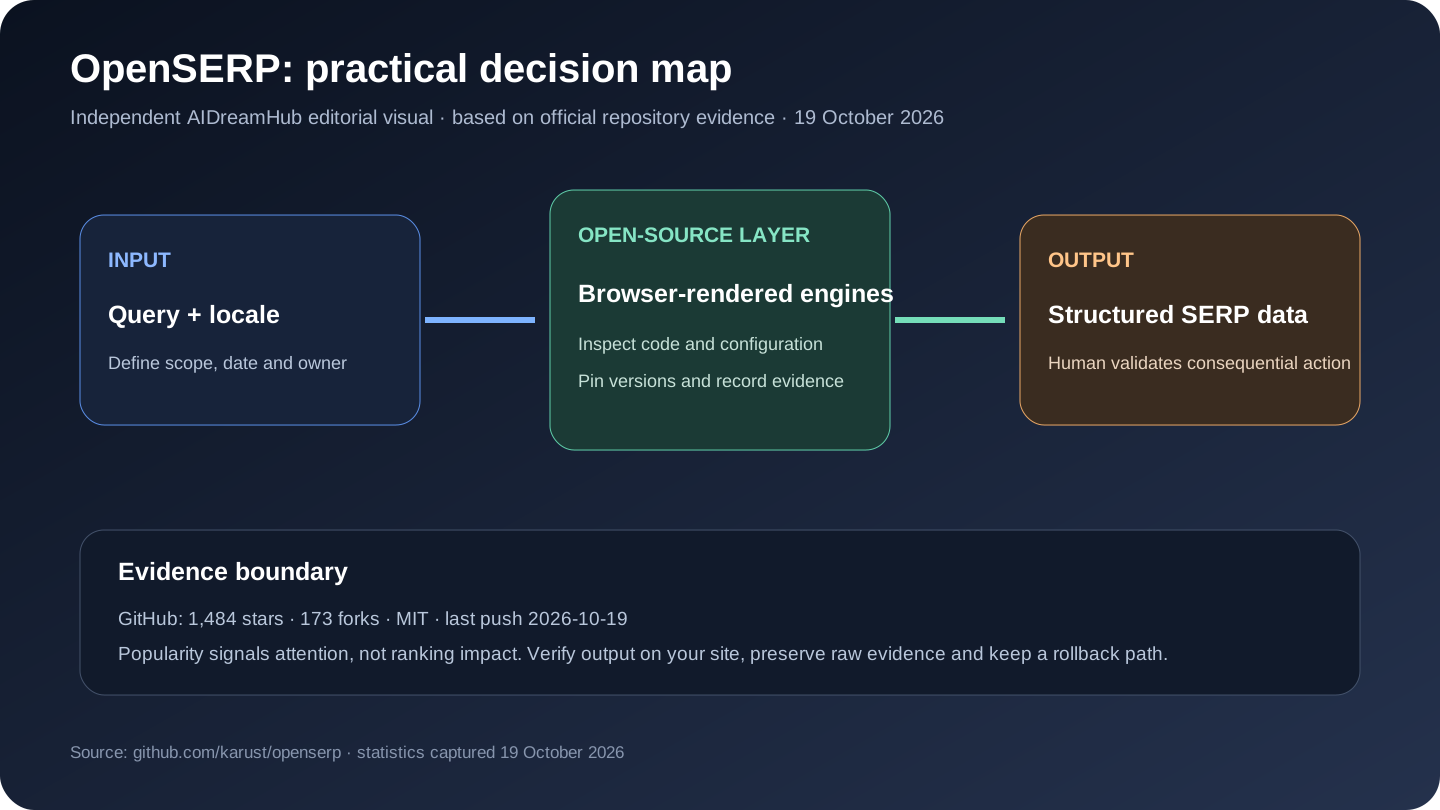
| Repository activity | 1,484 stars · 173 forks | Community attention and reuse signal; not proof of SEO outcomes |
| Last push | 2026-10-19 | Recent code activity; inspect releases and breaking changes before production |
| License | MIT | Confirm obligations for distribution, SaaS use and modifications |
| Primary stack | Go | Indicates the likely maintenance skills, not feature completeness |
Best-fit workflows
Best fit: developers who need inspectable SERP collection and accept the operational burden of browser automation.
- Collect small, scheduled SERP samples for internal research.
- Compare result composition across several engines and locales.
- Feed live result URLs and snippets into a controlled SEO pipeline.
Practical starting point: Start at low volume, record engine, locale, device and timestamp, detect challenge pages explicitly, and benchmark cost and failure rate against a managed SERP API.
Limitations, security and operating cost
- Blocking, CAPTCHA, consent pages and personalization can distort or stop collection.
- Terms, local law and search-engine policies must be reviewed before automated use.
- A result page snapshot is not search volume, click behavior or a durable rank.
Open source removes one form of lock-in, but it does not remove engineering time, model or API charges, browser/proxy costs, data-provider terms, authentication work, backups or upgrade risk. Map every external service and every write-capable action before production use.
OpenSERP compared with alternatives
| Option | Choose it when | Trade-off |
|---|---|---|
| DataForSEO or SerpApi | managed infrastructure and predictable schemas | paid and closed, less operational work |
| Playwright scripts | small custom experiments | maximum flexibility, more maintenance |
| Search Console | performance on sites you own | first-party clicks, no competitor SERPs |
The comparison is task-based, not a claim that one product is universally better. A narrow library may outperform a suite inside its framework, while a mature commercial crawler may be cheaper than maintaining an open tool at large scale.
A seven-step evaluation before adoption
- 1. Define one decision and a bounded test set before installing or connecting accounts.
- 2. Pin the repository revision or release and record the configuration used.
- 3. Verify several outputs against the live page, source console or another independent tool.
- 4. Separate deterministic observations from scores, estimates and model-written recommendations.
- 5. Measure false positives, missing coverage, runtime and provider cost on a realistic sample.
- 6. Use least-privilege credentials; require approval for edits, submissions, purges or publishing.
- 7. Keep raw exports and a rollback plan so the result can be audited after an update.
Our independent take
Self-hosted SERP access trades vendor markup for engineering uncertainty; failure detection is as important as successful parsing. That is also the decision boundary: keep the tool if it produces reproducible evidence and reduces work on a real site; reject it if the team mainly receives more scores, prose or issue volume without clearer decisions.
Frequently asked questions
Is it really open source?
The GitHub API reported MIT on 19 October 2026. Review the repository's license file and dependency licenses for the exact rights and obligations. A connected cloud API or hosted service can have separate terms even when the client code is open.
Does GitHub popularity mean it improves rankings?
No. Stars and forks indicate attention and reuse, not ranking lift, data accuracy or suitability for a particular site. Use a controlled evaluation with Search Console, analytics and manually verified output.
Who is it best for?
OpenSERP is best suited to developers who need inspectable SERP collection and accept the operational burden of browser automation. It is a poor fit when the team cannot operate its runtime, verify its evidence or own the permissions it requests.
What should be tested first?
Use one representative workflow: Collect small, scheduled SERP samples for internal research. Record inputs, raw output, time, failures and any external cost, then compare with the team's current method.
Can it replace a commercial SEO suite?
Usually only for a defined slice of work. Open-source workflow and audit tools rarely include the same proprietary backlink index, historical SERP coverage, support organization, permissions and polished client reporting as a mature paid suite.
How to Use OpenSERP: Quick Start
This workflow is condensed from the project's official README and documentation. Run it first on a test site, test property or local environment; check the linked source again when versions change.
Prerequisites
- Docker, or Go for a native installation
- A machine allowed to make the planned search requests
- A review of search-engine terms and local automation rules
Install and run
docker run --rm -p 127.0.0.1:7000:7000 karust/openserp:latest serve -a 0.0.0.0 -p 7000

# First request: return the first responding engine
curl "http://127.0.0.1:7000/mega/search?engines=bing,google&text=golang+vs+rust&extract=1&mode=any"
First-use workflow
- Run the prebuilt container bound to 127.0.0.1 so it is not exposed publicly by default.
- Send the documented mega-search request with a small query.
- Inspect engines_requested, engines_responded, engines_failed and requested_at in the response.
- Set locale, device, cache and proxy behavior explicitly before rank-tracking experiments.
How to confirm it worked
The API returns structured results and clearly reports which engines succeeded or failed instead of silently treating a challenge page as a valid SERP.
Before production use
Pin a container version, rate-limit callers and detect CAPTCHA or consent pages. Self-hosting transfers proxy, blocking, policy and reliability work to the operator.
Official Quick Start source: karust/openserp README.
Sources reviewed
- Official GitHub repository
- Official README
- Official releases
- Commit history
- Official project website or documentation
- Repository license
Editorial review updated 19 October 2026. Repository statistics, documentation, dependencies and hosted-service terms can change. Verify the linked official sources before installation, procurement or deployment.