Independent verdict: Next SEO is an MIT-licensed TypeScript library of JSON-LD components for Next.js, covering many Schema.org patterns while standard metadata is handled by Next.js itself. Its strongest fit is Next.js teams that want typed, reusable structured-data components without hand-building JSON-LD strings. The main adoption mistake would be to treat an open repository or a high star count as proof that its recommendations, data or scores are correct for every site.
Next SEO is most valuable as a serialization layer. The ranking-sensitive work still happens upstream, where product, author and organization facts are modeled correctly.
What Next SEO actually does
Next SEO should be evaluated as a library tool, not as a universal SEO platform. The verified repository description is: “Next SEO is a plug in that makes managing your SEO easier in Next.js projects.” The distinction matters because a crawler, a structured-data library and an MCP connector solve different layers of the SEO workflow.
| Verified capability | Practical meaning |
|---|---|
| Supports JSON-LD components for articles, organizations, local businesses, products, events, datasets, jobs, breadcrumbs and other page types. | Check the official setup and version before relying on it. |
| Current documentation tells App Router users to rely on Next.js generateMetadata for ordinary title and meta tags. | Treat integrations as separate trust and cost boundaries. |
| Components accept a nonce for strict Content Security Policy setups where inline JSON-LD scripts would otherwise be blocked. | Benchmark the behavior on a representative site or account. |
Current GitHub evidence snapshot
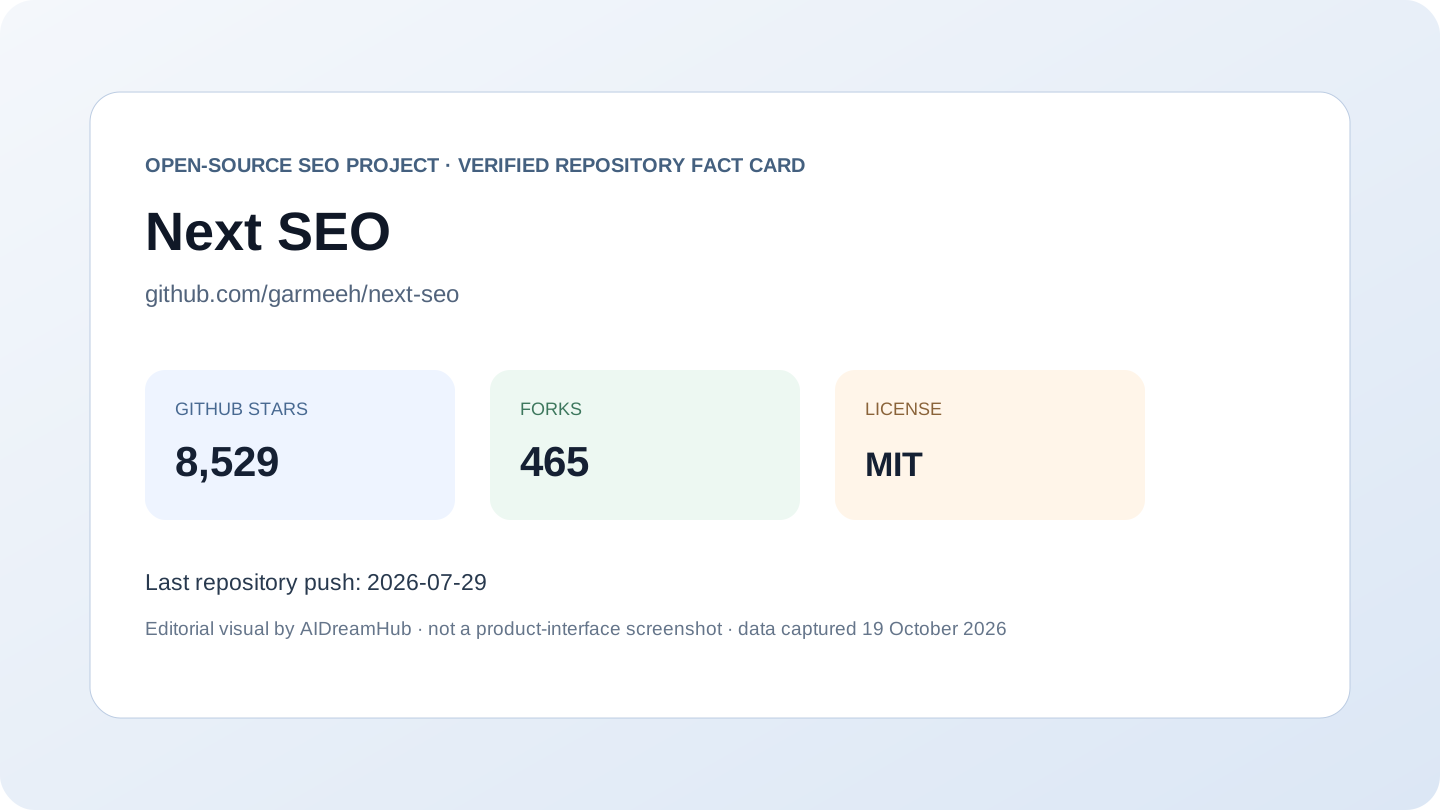
The table below was captured on 19 October 2026. “Latest” means recent repository activity in this review, while “hot” is a blend of attention and activity. Neither term is a quality guarantee.
| Evidence | Observed | How to interpret it |
|---|---|---|
| Repository activity | 8,529 stars · 465 forks | Community attention and reuse signal; not proof of SEO outcomes |
| Last push | 2026-07-29 | Recent code activity; inspect releases and breaking changes before production |
| License | MIT | Confirm obligations for distribution, SaaS use and modifications |
| Primary stack | TypeScript | Indicates the likely maintenance skills, not feature completeness |
Best-fit workflows
Best fit: Next.js teams that want typed, reusable structured-data components without hand-building JSON-LD strings.
- Generate page-specific JSON-LD from application data.
- Reuse organization, breadcrumb and product entities across templates.
- Keep CSP nonces and structured-data rendering inside reviewed React components.
Practical starting point: Model the real entity first, implement one supported page type, inspect rendered HTML, validate against Schema.org and Google tools, then monitor Search Console rather than assuming a rich result.
Limitations, security and operating cost
- The library generates markup; it cannot prove that page content supports the claims or qualifies for a rich result.
- Google supports only a subset of Schema.org features and can change eligibility rules.
- Version and router differences matter, so old tutorials can produce duplicate or obsolete metadata.
Open source removes one form of lock-in, but it does not remove engineering time, model or API charges, browser/proxy costs, data-provider terms, authentication work, backups or upgrade risk. Map every external service and every write-capable action before production use.
Next SEO compared with alternatives
| Option | Choose it when | Trade-off |
|---|---|---|
| Next.js Metadata API | standard titles, canonicals and social tags | built in, but not a full JSON-LD component catalog |
| Spatie Schema.org | PHP applications needing the full vocabulary | broader vocabulary, different ecosystem |
| Handwritten JSON-LD | small sites with one stable schema | zero dependency, more validation and maintenance work |
The comparison is task-based, not a claim that one product is universally better. A narrow library may outperform a suite inside its framework, while a mature commercial crawler may be cheaper than maintaining an open tool at large scale.
A seven-step evaluation before adoption
- 1. Define one decision and a bounded test set before installing or connecting accounts.
- 2. Pin the repository revision or release and record the configuration used.
- 3. Verify several outputs against the live page, source console or another independent tool.
- 4. Separate deterministic observations from scores, estimates and model-written recommendations.
- 5. Measure false positives, missing coverage, runtime and provider cost on a realistic sample.
- 6. Use least-privilege credentials; require approval for edits, submissions, purges or publishing.
- 7. Keep raw exports and a rollback plan so the result can be audited after an update.
Our independent take
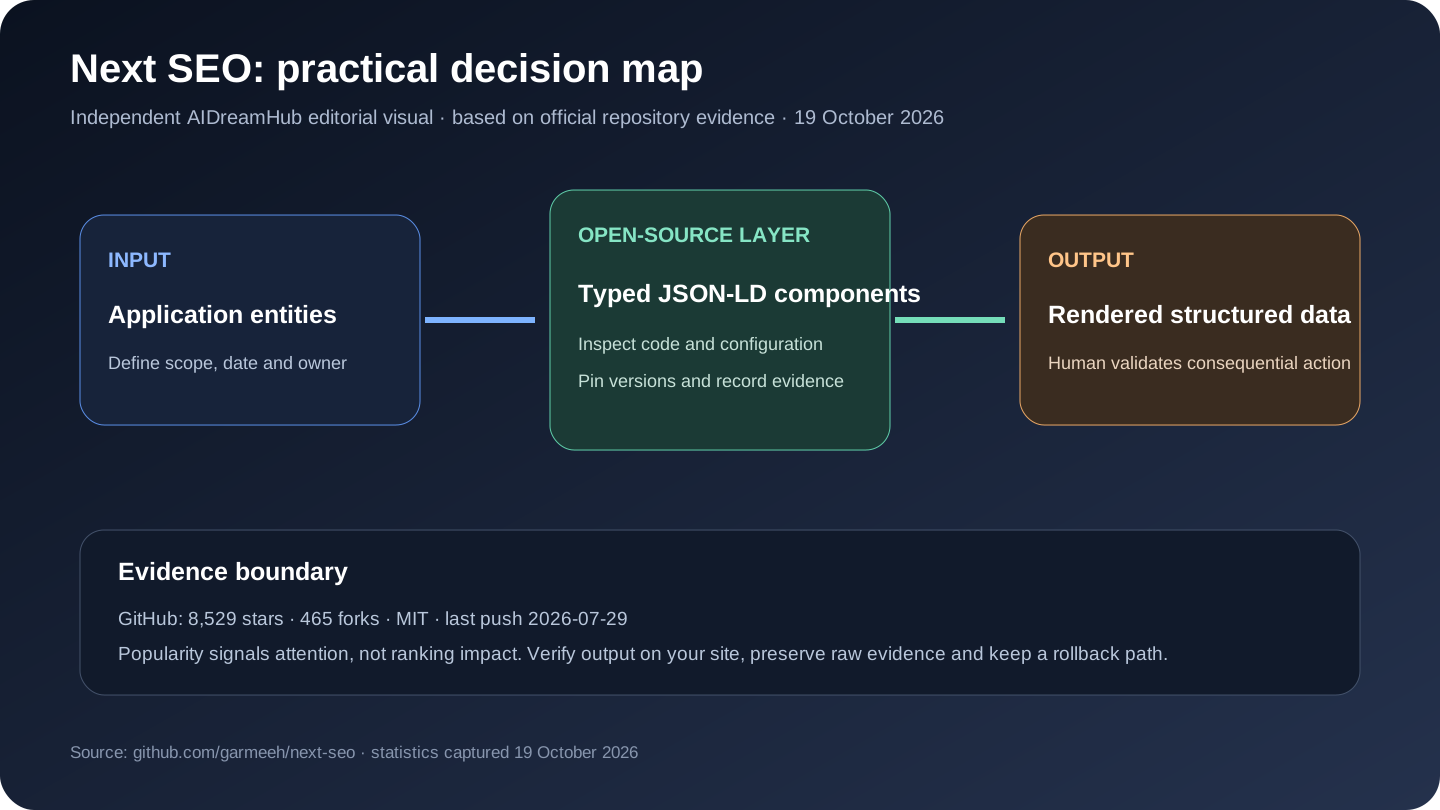
Next SEO is most valuable as a serialization layer. The ranking-sensitive work still happens upstream, where product, author and organization facts are modeled correctly. That is also the decision boundary: keep the tool if it produces reproducible evidence and reduces work on a real site; reject it if the team mainly receives more scores, prose or issue volume without clearer decisions.
Frequently asked questions
Is it really open source?
The GitHub API reported MIT on 19 October 2026. Review the repository's license file and dependency licenses for the exact rights and obligations. A connected cloud API or hosted service can have separate terms even when the client code is open.
Does GitHub popularity mean it improves rankings?
No. Stars and forks indicate attention and reuse, not ranking lift, data accuracy or suitability for a particular site. Use a controlled evaluation with Search Console, analytics and manually verified output.
Who is it best for?
Next SEO is best suited to Next.js teams that want typed, reusable structured-data components without hand-building JSON-LD strings. It is a poor fit when the team cannot operate its runtime, verify its evidence or own the permissions it requests.
What should be tested first?
Use one representative workflow: Generate page-specific JSON-LD from application data. Record inputs, raw output, time, failures and any external cost, then compare with the team's current method.
Can it replace a commercial SEO suite?
Usually only for a defined slice of work. Open-source workflow and audit tools rarely include the same proprietary backlink index, historical SERP coverage, support organization, permissions and polished client reporting as a mature paid suite.
How to Use Next SEO: Quick Start
This workflow is condensed from the project's official README and documentation. Run it first on a test site, test property or local environment; check the linked source again when versions change.
Prerequisites
- An existing Next.js project
- A supported Node.js package manager
- A page entity whose structured data can be verified from visible content
Install and run
npm install next-seo

# Minimal App Router example
import { ArticleJsonLd } from "next-seo";

export default function BlogPost() {
  return <ArticleJsonLd headline="Verified article title" />;
}
First-use workflow
- Install next-seo with npm, pnpm, yarn or bun.
- Use Next.js generateMetadata for standard title and meta tags; use Next SEO for JSON-LD components.
- Add one page-specific component such as ArticleJsonLd, OrganizationJsonLd or ProductJsonLd.
- Inspect the rendered script and validate the markup against Schema.org and the relevant Google documentation.
How to confirm it worked
The production HTML contains one valid JSON-LD block whose claims match content visible on the page, with no duplicate schema from legacy code.
Before production use
If the site uses a strict Content Security Policy, pass the matching nonce. Valid JSON-LD syntax does not guarantee rich-result eligibility.
Official Quick Start source: garmeeh/next-seo README.
Sources reviewed
Editorial review updated 19 October 2026. Repository statistics, documentation, dependencies and hosted-service terms can change. Verify the linked official sources before installation, procurement or deployment.