Midjourney is a subscription AI image platform for turning text and reference images into still images, then varying, editing or animating selected results. The current default image model is V8.2, released on July 24, 2026. Creation now happens on Midjourney's website as well as through its Discord bot; the product also includes personalization profiles, Moodboards, image and style references, a web Editor and five-second image-to-video generation.
The right way to evaluate Midjourney is not “Can it make a beautiful picture?” It often can. The harder question is whether a team can turn aesthetic exploration into an exact, reviewable and legally usable deliverable. Midjourney remains strongest as a taste engine: it finds compositions, lighting, texture and visual directions quickly. It is weaker as an unattended asset factory because it does not offer a general public API, is open by default, can drift during edits, and cannot guarantee exact text, identity, product geometry or exclusive rights.
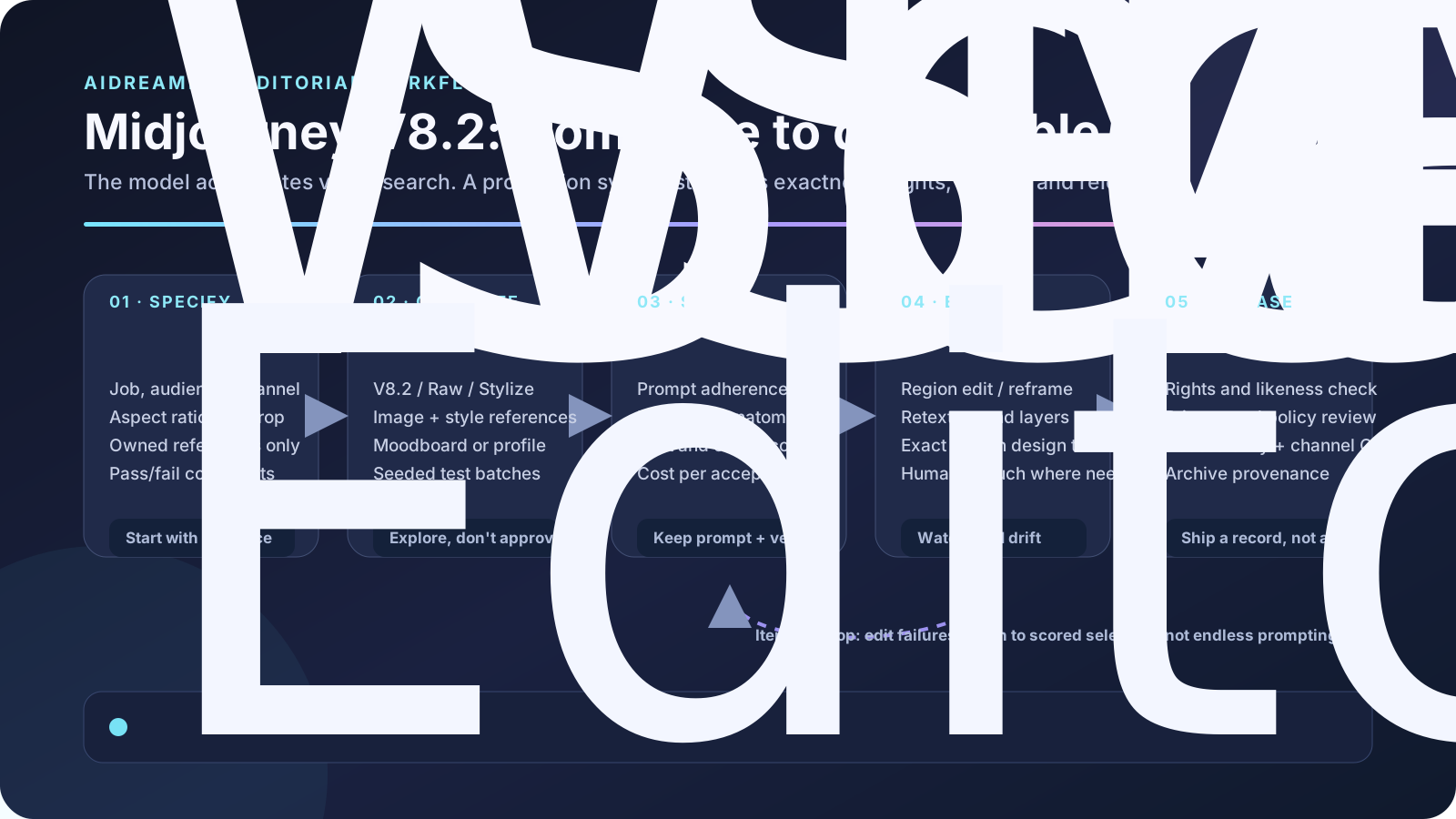
Current product snapshot
| Area | Verified position in August 2026 | What it means in practice |
|---|---|---|
| Default image model | V8.2 | Record the version with every approved asset; prompts can behave differently across versions. |
| Creation surfaces | Midjourney web app and official Discord bot | The website is no longer a gallery-only companion, but Discord remains a supported workflow. |
| Image resolution | V8.1/V8.2 support standard and native HD generation; official docs describe HD as 2K | HD consumes more GPU time, and some edit operations currently return to a lower-resolution path. |
| Editing | Region editing, Pan, Zoom Out, layers, Smart Select and Retexture | The Editor currently uses V6.1 functionality even with V8.2 images, so style/detail drift needs review. |
| Personal style | Personalization profiles, Moodboards and Style References | These guide aesthetic direction; they do not lock a brand system or character identity. |
| Video | Image-to-video clips start at five seconds; SD and plan-dependent HD options | Useful for concept motion and social tests, not a full timeline editor or high-resolution production suite. |
| API | No general public API; unauthorized automation and third-party apps are prohibited | Choose another provider when server-side generation, queues, audit logs or application integration are required. |
| Visibility | Open by default; Stealth is limited to Pro and Mega | Do not upload confidential product, campaign or client material without checking the complete visibility path. |
The important V8.2 insight: generation and editing are not one model
Midjourney's documentation says V8.2 is the default generation model, but its web Editor currently uses V6.1 functionality. That distinction is easy to miss and explains a common production surprise: a strong V8.2 concept can lose texture, anatomy, typography or style when a team inpaints, pans or restructures it. Native HD images can also be downscaled by current inpainting or outpainting operations before being upscaled again.
Treat the model boundary as a version change, not as a harmless Photoshop-like edit. Before editing, save the original, prompt, model, seed where relevant, personalization or Moodboard ID and reference set. After every edit, compare the requested region and untouched regions. If the correction is small and exact—price text, a product label, a logo, a legal line or a single object—traditional compositing may preserve the approved image better than another generative pass.
| Operation | Good use | Failure to inspect | Safer control |
|---|---|---|---|
| Variation / Remix | Explore adjacent compositions | Identity, object count and scene layout change | Score the whole frame again; do not assume inheritance. |
| Vary Region / Editor | Replace a local object or repair an area | Edges, lighting or untouched details drift | Difference-check against the source and keep the original. |
| Pan / Zoom Out | Change crop or add environmental context | Perspective breaks or repeated structures appear | Test final channel crops, not only the expanded master. |
| Retexture | Apply a new material or visual language | Structure remains but brand and factual details change | Use only when global reinterpretation is intended. |
| Layers | Arrange owned references before regeneration | Flattening bakes errors into a new generated image | Keep the deterministic layered source outside Midjourney. |
| Video animation | Pitch motion, ambience or a short social test | Warping, unintended motion and continuity failure | Use one- or two-video batches first; approve frame and motion separately. |
Where Midjourney earns its place
Concept art and campaigns. Art directors can test cinematic, illustrative or editorial directions before committing photography, 3D or design time. Moodboards, Style References and Personalization express taste that is difficult to encode in a prompt, while approved type, color, logo and layout remain downstream.
Editorial, social and motion pitches. A human editor can select, disclose and finish a synthetic illustration. Five-second animation can test camera energy and ambience. Review faces, anatomy, cultural symbols and resemblance; use another system for frame-accurate timing, dialogue sync, persistent characters or high-resolution delivery.
Weak-fit jobs. Exact logos, multilingual posters, data visualization, precise pack shots, evidence images, automated generation at scale and confidential prototypes need deterministic design, 3D, photography or an image API with explicit enterprise controls.
A repeatable workflow for teams
- Write acceptance criteria. Define audience, channel, crop, required and forbidden objects, reference rights, brand boundaries and disclosure.
- Create a test matrix. Hold the brief constant while varying V8.2/Raw, Stylize, references, Moodboard or Personalization. Seeds aid experiments; they do not save a style.
- Generate economical batches. Use Draft or standard jobs for search and HD/video only after a direction survives review. Track GPU minutes per accepted asset.
- Score candidates. Check adherence, anatomy, object count, text, brand fit, similarity, crop and editability. Record rejection reasons.
- Edit with a regression check. Compare corrected and untouched regions. Add exact type, logos, prices and legal copy in deterministic software.
- Review rights and policy. Confirm reference, likeness and trademark permission and whether the result could mislead.
- Archive provenance. Save prompt, version, settings, reference origins, output and human edits—not only the final JPEG.
Pricing, GPU time and access
Midjourney lists four automatically renewing subscriptions and a 20% annual discount when the year is paid upfront. There is no standing free tier in the plan comparison. Prices and limits can change, so use the live plan page and checkout as the purchasing authority.
| Plan | Monthly list price | Fast GPU time | Relevant boundary |
|---|---|---|---|
| Basic | $10 | 3.3 hours (200 minutes) | No Relax Mode and no Stealth; suitable for a short evaluation. |
| Standard | $30 | 15 hours | Unlimited Relax images and HD video in Fast Mode; no Stealth. |
| Pro | $60 | 30 hours | Stealth plus Relax images and SD video; required tier for companies above the stated revenue threshold. |
| Mega | $120 | 60 hours | Higher concurrency and queue limits for heavy individual use. |
Extra Fast GPU time is listed at $4 per hour. Video burns time much faster than images: the official video guide lists a default four-result SD batch at eight GPU minutes and an HD batch at 26 minutes, while one-result batches reduce that cost. Budget from the number of approved deliverables, expected retries, edits and video experiments—not from the subscription headline.
Comparison: choose by the bottleneck
| Option | Best fit | Advantage over Midjourney | Trade-off |
|---|---|---|---|
| Midjourney V8.2 | Aesthetic search, art direction, mood and high-impact visual concepts | Deep taste controls, community discovery and a distinctive iterative workflow | No public API; privacy and deterministic production need extra process. |
| OpenAI GPT Image 2 / ChatGPT Images | Conversational editing, instruction-heavy images, text and application integration | Official API plus chat-based revision and flexible production surfaces | Different visual behavior and usage economics; evaluate style on your own brief. |
| Adobe Firefly | Creative Cloud teams, brand governance and enterprise procurement | Photoshop/Illustrator integration, Content Credentials and qualifying IP terms | Its aesthetic may need more art direction; plan and indemnity conditions matter. |
| Ideogram | Typography-led posters, graphic design and structured image workflows | Strong focus on rendered text, layout and API-oriented production | Still proof every character and assess output rights. |
| Local diffusion / ComfyUI | Private, reproducible or deeply customized pipelines | Model, node, data and infrastructure control; can run without a hosted gallery | Hardware, security, model licensing, updates and safety become your responsibility. |
| Human designer, illustrator or photographer | Exact systems, accountable authorship, long-lived identity and sensitive work | Intent, negotiation, provenance and deterministic source files | More time and budget; AI can still assist references and rough exploration. |
Editorial judgment: Midjourney is often the best first room for discovering what a campaign could feel like, but it is rarely the only room needed to publish. If the bottleneck is taste, start here. If the bottleneck is exact copy, API scale, privacy, provenance or brand governance, start with the tool built around that constraint.
Commercial use, privacy and policy boundaries
Paid plans include broad commercial usage under current terms. A business grossing more than $1 million USD per year must use Pro or Mega for company use. This plan rule does not make every output copyrightable, unique or clear of trademark, publicity and other third-party rights.
The service is open by default. Work from direct messages or private Discord servers may still appear on Explore without the correct Stealth workflow. Stealth is Pro/Mega only, and shared Discord channels remain visible. Uploaded images are stored; hiding an upload is not deletion, and it can remain linked to prompts.
The Privacy Policy treats prompts and uploaded media as personal data used to provide, maintain and improve the service. Remove client identifiers, confidential prototypes, unconsented faces and sensitive data. Confidential buyers should obtain current answers on retention, training, subprocessors, deletion and incidents.
Community rules require SFW use and restrict harmful manipulation, deception and political campaigning even in private jobs. They also prohibit unauthorized automation and third-party apps. Avoid unofficial “Midjourney API” wrappers without explicit authorization and a verifiable data model.
Evaluation scorecard
| Measure | How to test | Release threshold example |
|---|---|---|
| Prompt adherence | Count required objects, relations and exclusions on 30 fixed prompts | All critical constraints pass; no hidden manual reinterpretation. |
| Text accuracy | Character-by-character review in every target language | 100% for public copy; otherwise replace with editable type. |
| Brand fit | Blind review against a written rubric and approved examples | Agreement across at least two qualified reviewers. |
| Edit locality | Compare requested and untouched regions after every generative edit | No material regression outside the mask. |
| Consistency | Repeat controlled character, product and environment prompts | Identity-critical attributes remain within the defined tolerance. |
| Cost and speed | GPU minutes and human minutes per accepted asset | Beats the selected alternative on total—not generation-only—cost. |
| Rights risk | Reference provenance, similarity, likeness and trademark review | No unresolved high-risk input or output. |
| Channel quality | Mobile crop, print proof, compression, alt text and disclosure | Passes the actual destination, not only the Midjourney gallery. |
FAQ
What is the current Midjourney model?
V8.2 is the default as of August 20, 2026. It was released July 24 with changes to aesthetics, quality and Personalization. Record the version because a prompt can change materially across models.
Can I use Midjourney without Discord?
Yes. Subscribers can create, organize, edit and animate on midjourney.com. The official Discord bot remains supported; check account and privacy behavior for the chosen surface.
Does Midjourney offer an official API?
Not generally. Community Guidelines say rare exceptions require explicit grants and automated interaction is prohibited. Server-side products should use an authorized image API.
Can Midjourney images be used commercially?
Paid plans include general commercial usage. Companies above $1 million annual revenue need Pro or Mega. Contract rights do not resolve copyrightability, trademarks or likeness rights.
Are Midjourney creations private?
Not by default. Stealth is Pro/Mega only and needs the correct web or private Discord workflow; shared channels remain visible. Review retention and data use separately.
Is Midjourney good at text inside images?
It can render short Latin-alphabet phrases in double quotes, but official guidance favors short text. Proof every character and add legal, price, URL and translated copy later.
Why can a V8.2 image change during editing?
The current Editor uses V6.1 functionality. Treat an edit as cross-model regeneration: save the original and compare the whole frame, including outside the mask.
Which plan fits professional work?
Pro is the starting point when Stealth or the revenue rule applies. Standard costs less but lacks Stealth; Mega adds capacity. Also assess retention, review and lack of API.
Sources reviewed
- Midjourney official Version guide — V8.2 status and compatibility
- Midjourney V8.2 release announcement — July 24, 2026
- Official Creating on Web guide
- Official Editor guide — tools and V6.1 editing boundary
- Official Personalization guide
- Official Moodboards guide
- Official Video guide — duration, resolution and GPU cost
- Official plan and pricing comparison
- Official commercial-use explanation
- Midjourney Terms of Service
- Midjourney Privacy Policy
- Midjourney Community Guidelines — content and automation rules
- Tom's Guide 2026 hands-on AI image generator comparison
- 2026 architecture image-generation evaluation — limits of stylistic and element fidelity
- Midjourney emblem media provenance — Wikimedia Commons CC0 record; trademark rights still apply
Last independently reviewed August 20, 2026. Models, plan prices, GPU allowances, usage terms and policy rules can change. Verify the linked official pages and checkout before purchase or publication.