Cursor
Built to make you extraordinarily productive, Cursor is the best way to code with AI.
ai-codingfree
4450
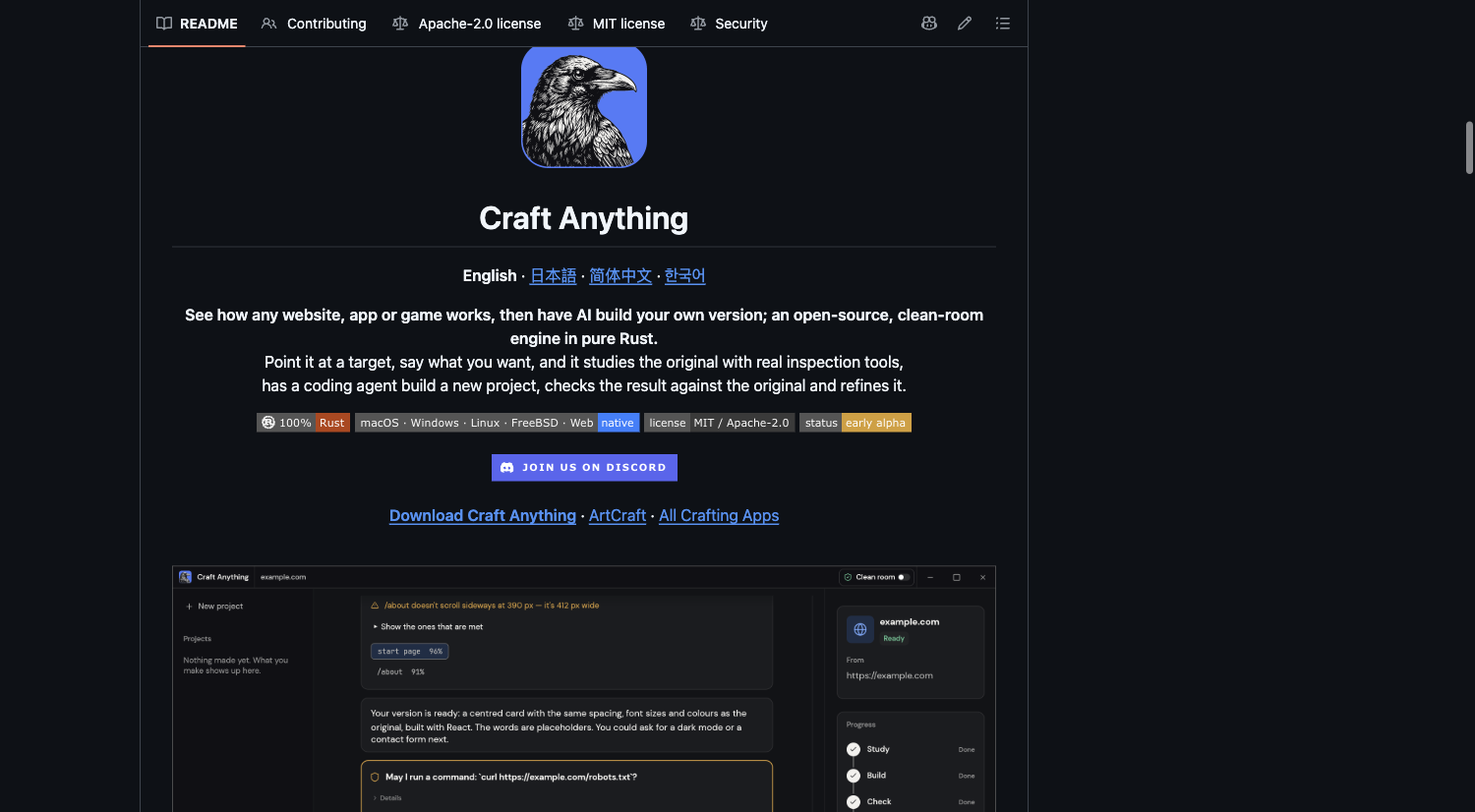

Craft Anything is an early-alpha inspection and rebuilding workbench for websites, apps and games, combining a Rust engine, coding agents and iterative checks.
1
Views
0
Likes
Nov 2026
Added
github.com
Website
A quick visual look at Craft Anything before you visit the official site.
Editorial Review
Research checked 6 November 2026. Publisher claims and third-party trials are identified separately; this page is not an AIDreamHub hands-on benchmark.
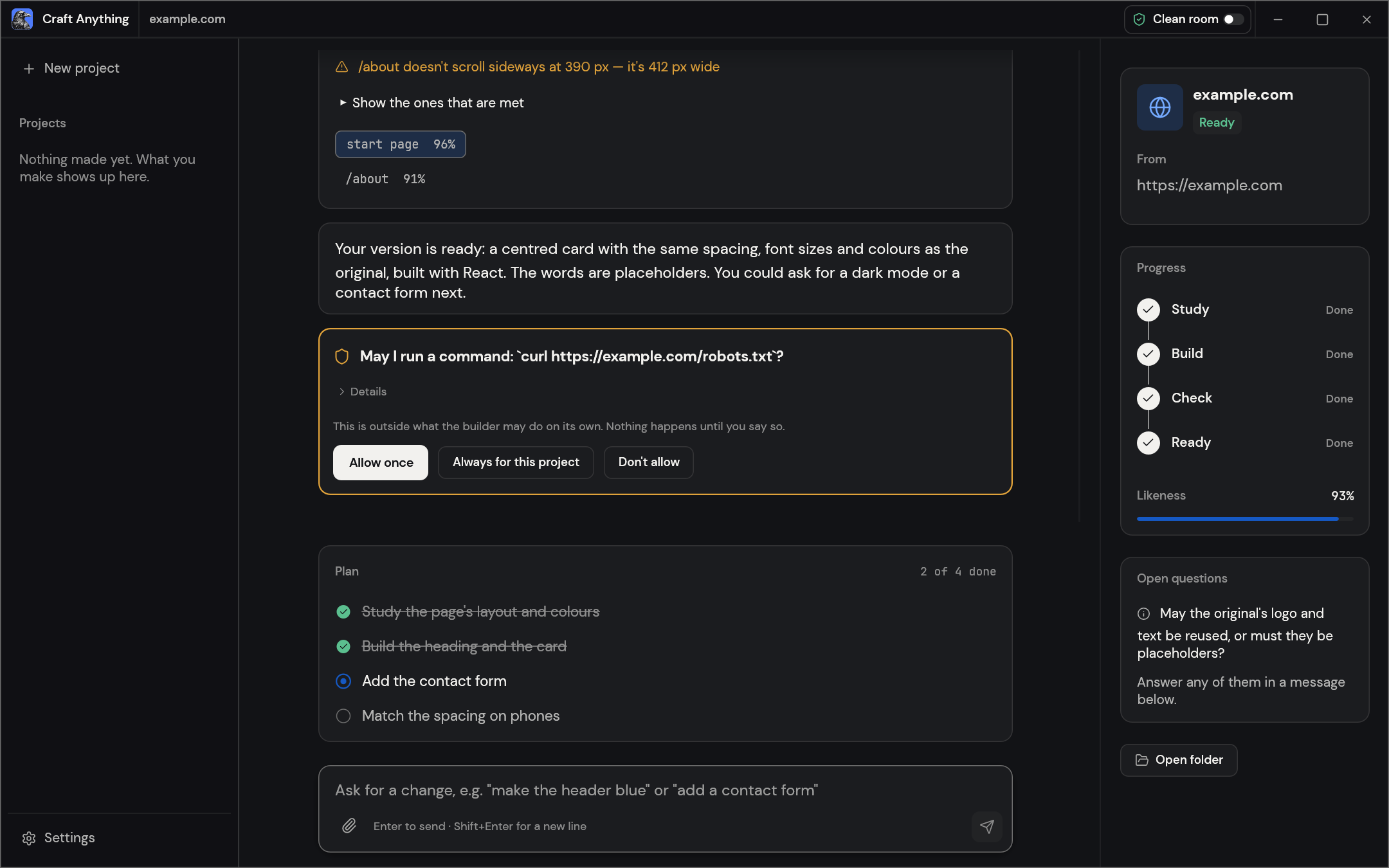
Craft Anything, from ArtCraft/storytold, studies an existing website, application or game and asks a coding agent to create a new implementation. Its Rust engine is exposed through a desktop workbench, CLI and MCP. The product is an early alpha, not a guarantee that a link becomes a complete, legally cleared replacement.
It is useful for an authorised migration prototype: map visible screens, recreate a bounded flow and keep comparison evidence beside the new project. A source repository or a requirements document can still be a better starting point when you already own the implementation. Inspection is a means of discovering requirements, not a reason to ignore known ones.
Official project page captured by AIDreamHub; not a locally run product.
Default clean-room mode works from permitted observable material and refuses tools that inspect internals. Deep mode enables broader code and file inspection. The README explicitly says clean room does not isolate the operating system: the builder still acts with its own permissions. Dependency installation can execute package scripts even when inspection itself is restricted.
Use only targets you own or may examine, and separate your own text, imagery and branding from reference behaviour. A visible interaction is not permission to republish another company’s assets. Start the builder in a disposable workspace without personal credentials, and approve package or shell operations deliberately.
The documented source build requires Rust 1.97 or newer; Linux desktop builds have additional system libraries. Install the CLI, run doctor, and confirm an installed coding agent is signed in. The commands below follow the repository, but were not executed for this editorial review.
Choose one public, authorised route and describe the required new stack and behaviour. Keep the generated project and its capture, checks and evidence folders. Approve the plan before extending the scope. Do not begin with authenticated customer workflows or assume an agent adapter marked implemented has been verified with a real account.
git clone https://github.com/storytold/craft-anything.git
cd craft-anything
cargo install --path apps/craft-anything-cli
craft-anything-cli doctor
craft-anything-cli rebuild https://example.com "Recreate this website"The status document distinguishes live runs, scripted stand-ins and incomplete integrations. It reports website comparisons at multiple widths, while app and game checks can rely on builds, screenshots or the generated game’s own self-test. Those are different kinds of evidence. A successful build does not prove a checkout flow, physics system or accessibility behaviour.
A visual-similarity percentage is a project-specific diagnostic, not an independent product-quality score. Test the interactions the migration must preserve: invalid form submissions, deep links, keyboard focus and mobile layouts can fail even when the first screen looks close. Keep those results beside the visual comparison.
For an illustrative legacy booking site, list route coverage, navigation, validation, empty states and mobile behaviour before generation. Compare the same viewport and state, then run real acceptance tests on the new application. Keep visual mismatch, missing behaviour and copied assets as separate rejection reasons.
Limit the first delivery to a demonstrable flow. An attractive start page can conceal broken deep links or form errors. Require a reviewed source diff, dependency inventory and reproducible start/build instructions, not only a final screenshot.
| Check | Accept when | Reject when |
|---|---|---|
| Route coverage | Required pages and states are mapped | Only the homepage was checked |
| Behaviour | Navigation and forms pass tests | Build success substitutes for interaction tests |
| Rights and assets | Content is owned or permitted | Reference branding is copied blindly |
Compare Craft Anything with manual requirements plus a coding agent when the old system is already documented. Compare a focused UI-review skill when the application works and only design needs attention. Its distinctive value is the inspection–build–check record, not replacing every frontend or migration tool.
A service can add discovery interviews, mobile acceptance and a clear list of excluded features. Those are stronger deliverables than a generic pixel-similarity promise, particularly for applications whose important behaviour is not visible in a screenshot.
| Route | Best fit | Remaining work |
|---|---|---|
| Craft Anything | Inspection-led rebuilding prototype | Permissions, behaviour and deployment QA |
| Requirements + coding agent | Known owned source and specifications | Define tests and review implementation |
| Focused UI review | Working product with visual problems | Preserve data and interactions |
The repository offers MIT OR Apache-2.0 for its own code. That does not grant rights to the target application or the generated project’s dependencies. Building can incur your coding-agent and optional image-service costs; inspection and paid model usage are different budgets.
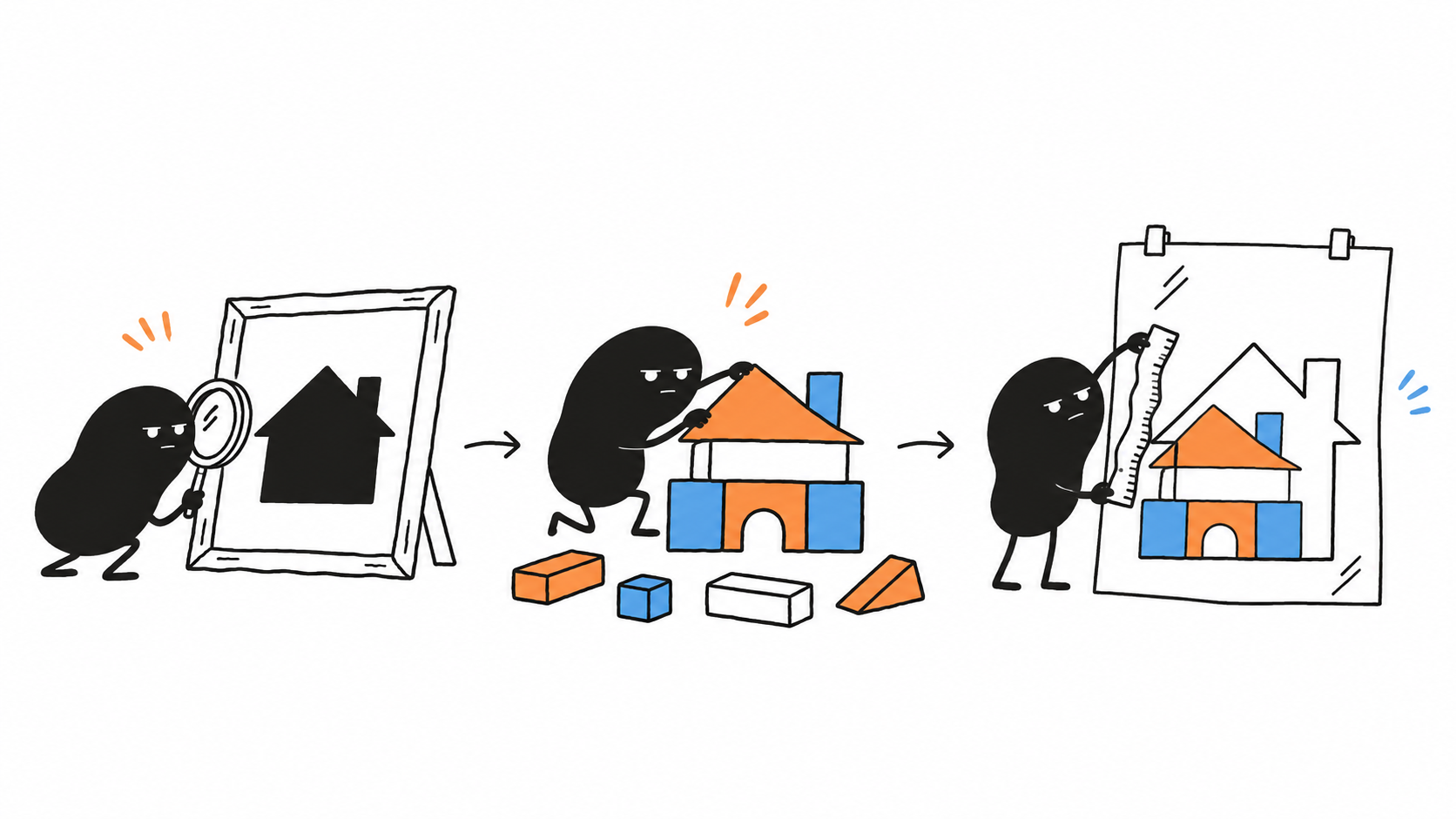
Keep the alpha label visible in procurement decisions. Evaluate the exact agent adapter, OS and release, record failures, and prefer the current English status notes when translations lag. Our illustration explains observation and reconstruction; it is not a Craft Anything output.
No. It constrains which evidence the engine exposes, not what the operating system permits. The coding agent and dependency scripts can still read, write or execute according to their own permissions. Use isolation and explicit approvals separately.
No. Check required routes, interactive states, forms, accessibility and responsive behaviour directly. The status document distinguishes visual checks, successful builds and self-reported game tests; none alone proves the original business workflow was preserved.
It is an early-alpha workbench for a bounded inspection and rebuilding loop. It can support a prototype, but requirements, rights, data migration, security, deployment and final acceptance still need accountable people.
Visit the official website to get started
Have an AI tool to share?
Get your product in front of people actively exploring AI tools.
Submit Your ToolBuilt to make you extraordinarily productive, Cursor is the best way to code with AI.
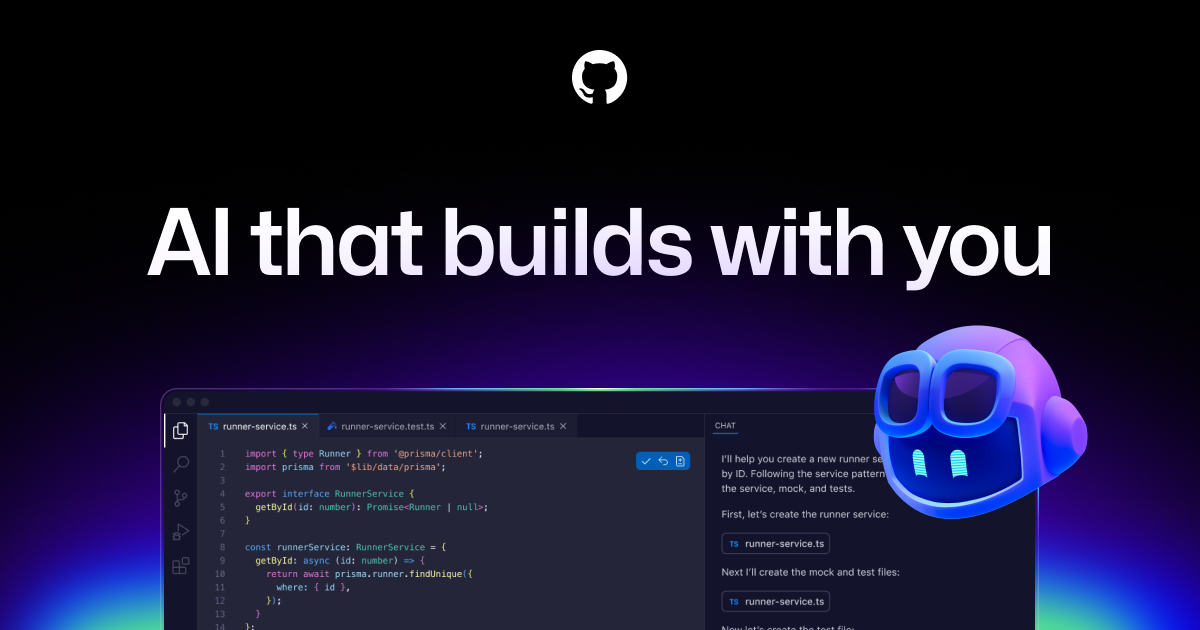
GitHub Copilot is GitHub’s AI coding assistant across IDEs, GitHub.com, pull requests, CLI workflows, code review, and agentic development. It is best for developers and teams that want AI help inside existing repositories while keeping review, tests, and governance in the workflow.
Trae is your helpful coding partner. It offers features like AI Q&A, code auto-completion, and agent-based AI programming capabilities.

MarsCode is an AI coding assistant and IDE-style development tool for code completion, explanation, debugging, and code generation. Current official metadata also points to Trae AI IDE, so the page should explain the product carefully instead of treating it as a static legacy listing.