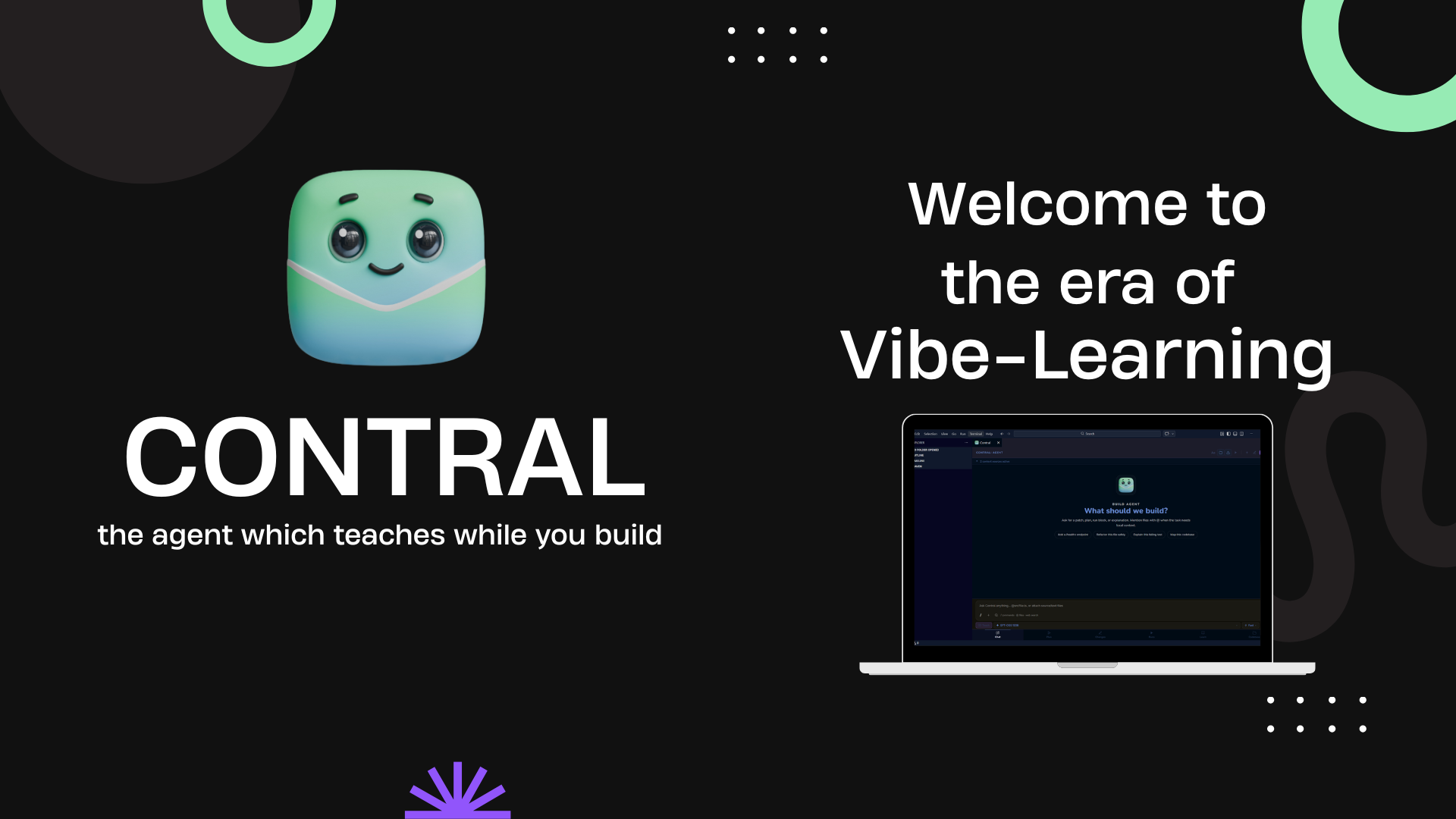
Contral combines an AI coding agent with a teaching layer. It can watch edits from tools such as Cursor, GitHub Copilot, Claude Code, Codex CLI, Cline, Aider, Continue, OpenCode and Windsurf, then generate line-linked explanations, codebase tours and follow-up questions. It is available as an extension for VS Code-compatible editors and as a standalone IDE built on Eclipse Theia.
The premise is valuable: shipping AI-generated code is not the same as understanding it. But generated explanations can be confidently wrong, overly local or disconnected from production constraints. Contral is most effective when it creates retrieval practice and review evidence—not when learners passively read another model output.
Two products in one evaluation
| Surface | What it adds | Primary evaluation risk |
|---|---|---|
| Editor extension | Auto-teaching after edits by several agents, selection teaching and codebase tours | File observation, extension permissions, compatibility and learning-card noise |
| Standalone IDE | Integrated agent, terminal, modes, curriculum and deeper teaching workflow | Larger trust boundary and migration from existing editor controls |
| Build Agent | Reads/writes repository and runs commands | AI coding accuracy, permissions and external tool access |
| Learn Mode | Curriculum, challenges, projects and “boss exams” | Java is advertised as available now; other languages may be marketing/roadmap content |
| BYOK | Connects Anthropic, OpenAI, OpenRouter and compatible providers using OS keychain | Provider retention, spend and endpoint governance remain separate |
| MCP/skills | Configurable tools and reusable capabilities per workspace | Tool servers can expand file, command, network and account authority |
“Explains every line” is not the right success metric
Line-by-line explanations help novices decode syntax, but software behavior emerges from data flow, state, dependencies, concurrency, deployment and organizational conventions. Too many micro-explanations can increase reading without building a mental model. Select explanations around decisions: why this boundary exists, what invariant it protects, what alternatives were rejected and how failure appears.
After each agent change, require the learner to answer before revealing the card: What changed? Why is it needed? What inputs break it? Which test proves it? What security or performance cost was introduced? Contral’s “Prove” concept—micro-challenges and defense drills—is more educationally important than automatic prose.
| Learning level | Evidence of understanding | Weak proxy |
|---|---|---|
| Recall | Names the API, pattern or language rule without hints | Recognizes an explanation after reading it |
| Prediction | Predicts output and failure before running code | Says the implementation “makes sense” |
| Transfer | Applies the concept in a different file or problem | Copies the same generated pattern |
| Debugging | Finds a seeded defect using logs/tests | Asks the same agent to fix its code |
| Design defense | Explains tradeoffs and rejected alternatives | Repeats generic best-practice language |
| Maintenance | Changes code correctly one week later without the explanation | High number of cards viewed |
A rigorous trial design
- Choose one small repository and three representative tasks: feature, bug and refactor.
- Give participants a pre-test covering the concepts likely to appear.
- Run the same tasks with Contral teaching enabled and with the normal coding-agent workflow.
- Require a written change summary, threat analysis and test plan before code review.
- Inject one subtle defect and measure independent debugging time.
- Repeat a related task after seven days without access to original cards.
- Compare correctness, review time, retention and total model cost—not self-reported confidence alone.
Agent modes and approval boundaries
The extension page describes Fast, Plan, Deep and Recursive modes. Plan mode begins read-only, proposes files and steps, then requires approval; it says writes offer Apply/Skip and commands need approval. Recursive mode uses a Generator–Critic–Revisor loop. Self-critique can catch issues, but models share blind spots and more iterations increase cost and diff size.
| Mode | Good use | Guardrail |
|---|---|---|
| Fast | Small reversible edits with clear tests | Restrict paths and inspect every diff |
| Plan | Greenfield or cross-file change requiring alignment | Review assumptions and forbidden files before approval |
| Deep | Complex diagnosis or architectural reasoning | Demand citations to repository evidence and runnable validation |
| Recursive | Hard bounded problem where independent revision helps | Iteration/token ceiling and external tests, not self-score alone |
| MCP/skills | Approved tools and repeatable workflows | Least privilege, pinned server and confirmation for side effects |
Privacy: local-first does not mean local-only
The March 13, 2026 Privacy Policy says Contral does not collect source code, project files, prompts, conversations, filenames, directory structures, clipboard contents, screenshots or keystrokes as telemetry. With consent, it collects usage and LLM-call metadata; declining still allows aggregate feature counts. It also creates a one-way hardware-derived device identifier for fraud/abuse detection.
The Terms call the product local-first: code is processed on the machine, while minimum context needed for completions and teaching is transmitted. The Privacy Policy names NVIDIA NIM, OpenAI and OpenRouter as inference providers and says prompts go to them using API-only access with no training. Therefore, code context can leave the machine even if Contral does not store the full repository. Verify the provider selected, exact context sent, retention controls, region and enterprise agreement.
| Data | Published handling | Buyer check |
|---|---|---|
| Source files | Not collected as telemetry or stored on Contral servers | Inspect outbound inference payload for snippets/context |
| Prompts/conversations | Not collected as telemetry; prompts go to selected providers | Provider retention/training and BYOK endpoint |
| Usage telemetry | Consent-based metadata, retained 90 days | Confirm default consent UI and deletion behavior |
| Usage snapshots | Retained for two years | Fields, aggregation and employee/account linkage |
| Device identifier/IP | Used for abuse prevention | Corporate device/privacy impact and objection process |
| Billing | Plan/status retained; payment details handled externally | Contral documents conflict: Privacy says Dodo, Terms says Razorpay |
The payment-processor inconsistency is material. The current Privacy Policy names Dodo Payments, while Terms dated March 21, 2026 name Razorpay. Confirm the actual checkout processor and applicable privacy/merchant terms before purchase.
Security and extension governance
An editor extension that observes AI edits, scans repositories, stores keys and can run an agent is privileged software. Review Marketplace/Open VSX publisher identity, extension permissions, auto-update behavior, content security policy and incident response. The site says mandatory updates can ship with one-click install; enterprises may need version pinning and staged validation instead.
- Use a test profile and non-sensitive repository for first installation.
- Store BYOK keys in the operating-system keychain, but use project-specific low-limit credentials.
- Do not allow terminal commands, MCP writes or repository mutations without explicit confirmation.
- Block production secrets and environment files from agent context.
- Inspect network destinations and verify custom endpoints before entering credentials.
- Require protected branches, tests, dependency scanning and human review outside Contral.
Product licensing and code ownership
The licenses page says Contral IDE, extension and website are proprietary closed-source software. The standalone IDE is a fork of Eclipse Theia, whose open-source components retain their licenses, while Contral’s teaching engine, modes, curriculum and backend are proprietary. The Terms say users retain ownership of code they write or generate, but remain responsible for review, testing and suitability.
That ownership statement cannot guarantee that generated code is novel or free of third-party license obligations. Run normal provenance and dependency checks. A teaching explanation may incorrectly describe a copied or generated snippet’s licensing status.
Pricing and refund checks
The homepage currently advertises a limited 50% discount with Pro “from $9.99/month annually,” while the pricing page did not expose plan details in our unauthenticated review. Terms describe Free, Pro, Pro+ and Teams, monthly or annual renewal, and inclusive taxes. Verify quotas, model access, BYOK limits, team controls, full annual charge and renewal price at checkout.
The Terms offer a narrow refund window: request within seven days and have less than three hours of cumulative paid-feature use. At three hours or after seven days, refunds are unavailable; annual plans are not partially refunded. Run the evaluation promptly and retain usage evidence.
Alternatives
| Option | Best fit | Tradeoff versus Contral |
|---|---|---|
| Contral | Contextual explanations and challenges around live agent edits | Proprietary product and generated-teacher reliability |
| GitHub Copilot | Broad enterprise coding assistance and editor integration | Less structured teaching/retention focus |
| Cursor | Integrated agent-first development | Learning evidence is not the central workflow |
| Codecademy / freeCodeCamp | Structured fundamentals and exercises | Less specific to the learner’s production repository |
| Exercism | Practice, tests and community mentoring | Slower than in-editor generation, stronger deliberate practice |
| Human mentor + code review | Architecture, tacit context and accountable feedback | Scarce time and higher cost; best paired with tooling |
Frequently asked questions
Does Contral work only in its own IDE?
No. It offers a standalone IDE and an extension for VS Code-family editors, including Cursor, Windsurf and VSCodium.
Does it support every programming-language curriculum?
The homepage says Java is available now and more languages are coming based on demand. General code explanations may cover more languages than the structured curriculum.
Is source code uploaded?
The policy says it is not collected or stored as telemetry, but minimum context is sent to the selected inference provider for AI responses.
Is Contral open source?
No. Its authored product layers are proprietary; the IDE is based on open-source Eclipse Theia and other credited libraries.
Can explanations replace code review?
No. They are model output. Tests, security review, repository evidence and human accountability remain necessary.
How should learning success be measured?
Use prediction, debugging, transfer and delayed retention—not cards viewed or immediate confidence.
Primary sources
- Official product overview
- Official extension features and supported editors
- Official Privacy Policy, March 13, 2026
- Official Terms of Service, March 21, 2026
- Official product and third-party licensing statement
- Visual Studio Marketplace for publisher/version verification
- Eclipse Theia project
- NIST AI Risk Management Framework
Last reviewed July 25, 2026. Product modes, curricula, prices, processors and provider routes may change; verify the installed extension, checkout and current policies.