About Amazon CodeWhisperer
A code writing assistant developed by Amazon
Key Features
- Powerful AI technology
- User-friendly interface
- Efficient workflow integration
- Continuous updates and improvements
Use Cases
Amazon CodeWhisperer is an excellent tool in the AI Coding Assistant category, suitable for all users who need AI assistance.
How to evaluate this developer tool
Amazon CodeWhisperer should be evaluated against a real user job rather than a polished demonstration. Use it when its supported runtime, model providers, deployment surface, and permission model match the way your team already builds and reviews software. A good demo is not enough: test it against a real repository, data set, or production-like workload.
Checks that create useful evidence
- Confirm the current repository, license, maintenance status, release cadence, supported platforms, and whether the listed website is still the canonical project.
- Test installation from a clean environment and record required runtimes, GPU or memory needs, API keys, network access, and services started in the background.
- Inspect what code, prompts, files, telemetry, and secrets leave the machine. For agents, check approval boundaries before shell commands, edits, browser actions, or external messages.
- Measure task success, latency, token or infrastructure cost, failure recovery, logs, reproducibility, and the amount of human review still required.
Recommended trial workflow
Start with one bounded task and a disposable branch or sandbox. Capture the input, configuration, model/version, output, tests, and failure mode. Expand to team use only after the result is repeatable and the permission, audit, and rollback paths are understood.
Important limitations
Open-source availability does not guarantee active maintenance, secure defaults, stable APIs, or production support. Hosted versions may collect different data than self-hosted versions. Model quality, provider limits, and dependency updates can change results without a visible change to the tool's interface.
How to compare alternatives
Compare at least one simpler library or deterministic workflow, one adjacent open-source project, and one managed service. The best alternative is the option that meets the same task with less operational burden—not merely the product with the closest marketing category.
FAQ
Is this ready for production use?
Treat production readiness as a property of the exact version and deployment, not the project name. Verify maintenance, tests, security controls, observability, failure recovery, upgrade policy, and performance on your own workload.
What should a proof of concept measure?
Measure successful task completion, human correction time, latency, total model or infrastructure cost, data exposure, failure rate, and whether another engineer can reproduce the result from the recorded configuration.
When is a simpler tool better?
Prefer a smaller library or deterministic workflow when the task is stable, errors are expensive, permissions are broad, or the team cannot operate another model-serving or agent layer.
Source and freshness note
This evaluation framework was reviewed on 25 July 2026. The link below is the website currently stored for this listing; it may be an official product page, repository, app-store entry, regional page, or third-party service. Confirm ownership and current terms before signing in, paying, installing software, or uploading data.
CodeWhisperer is now part of Amazon Q Developer
AWS states that all CodeWhisperer features moved to Amazon Q Developer. The old name remains in documentation, extension identifiers, and searches, but new evaluations should use the Amazon Q Developer product, plans, IDE support, security guidance, and service terms.
Amazon Q Developer goes beyond inline code suggestions. AWS documents conversational development help, code understanding and transformation, console-error diagnosis, and questions about AWS resources and costs. Feature availability varies by IDE, command line, AWS console context, identity setup, region, and plan.
Migration and security checks
- Replace obsolete CodeWhisperer onboarding links with current Amazon Q Developer documentation.
- Confirm which AWS identity, account, repository, and telemetry context the assistant can access.
- Review generated code, dependency changes, infrastructure actions, and security scans in CI rather than treating an IDE suggestion as approval.
- Keep extensions current and validate enterprise controls, content policies, data handling, and administrator settings for the chosen tier.
Current sources
Critical status update: the IDE product is moving to Kiro
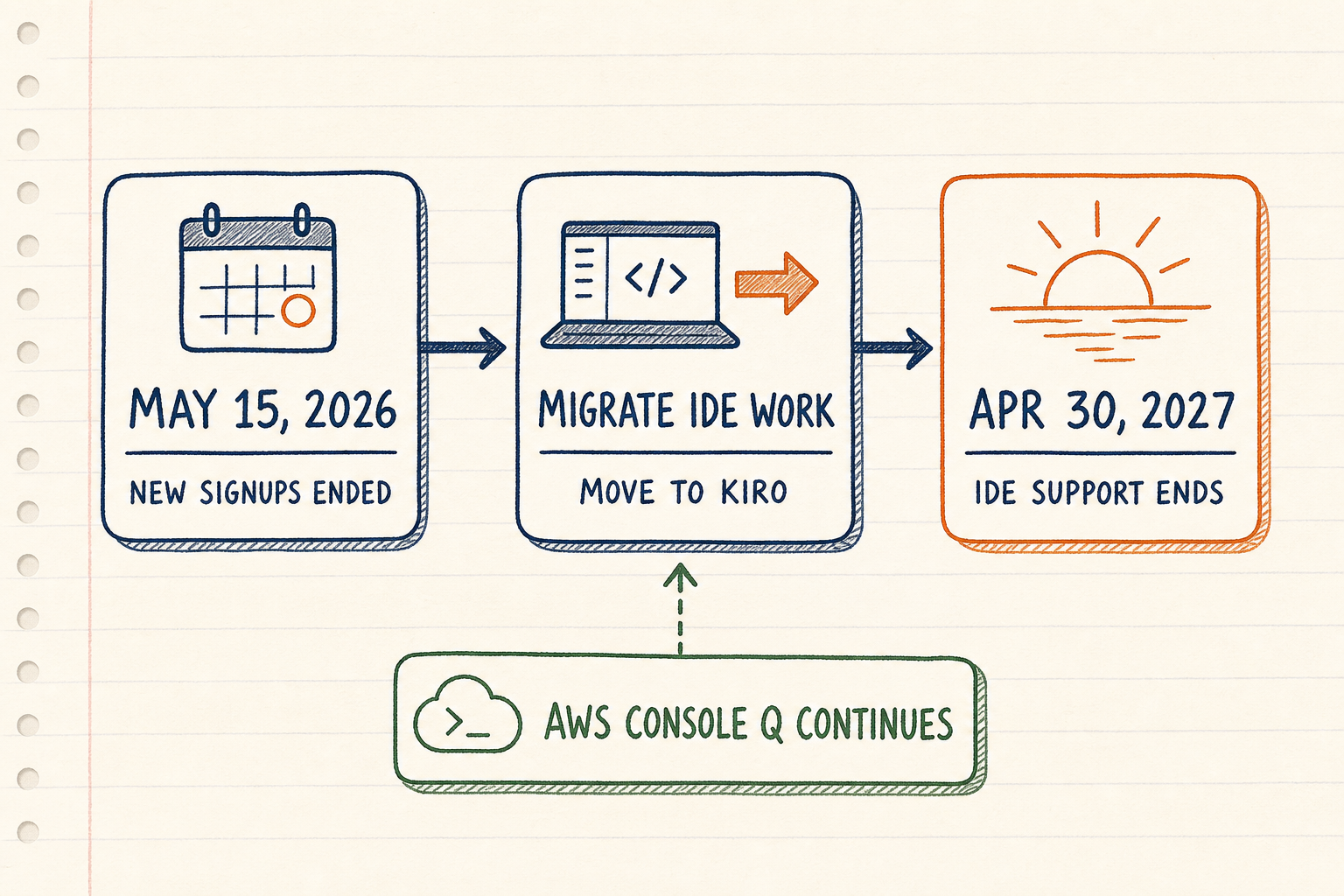
AWS announced on April 30, 2026 that Amazon Q Developer IDE plugins and paid subscriptions will reach end of support on April 30, 2027. New Q Developer Free Tier account creation through Builder ID in IDE plugins and new paid subscription creation were blocked starting May 15, 2026. Existing eligible customers can continue using the plugins during the transition, and active Pro subscriptions can add users under the conditions AWS describes.
AWS recommends moving IDE development work to Kiro, its agentic IDE and CLI for spec-driven development. This sunset also affects code transformation delivered through Q Developer IDE plugins. AWS says Q Developer in the AWS Management Console, AWS documentation and marketing sites, Console Mobile, and supported Slack or Microsoft Teams experiences is not part of this IDE sunset.
| Surface | 2026 status | Action | Key date |
|---|---|---|---|
| New Q Developer IDE Free accounts | New signups closed | Evaluate Kiro rather than designing new onboarding around Q IDE plugins | May 15, 2026 |
| New Q Developer paid subscriptions | New subscription creation closed | Review Kiro plans and existing-account eligibility | May 15, 2026 |
| Existing Q Developer IDE plugins | Transition support | Inventory usage, test Kiro, migrate rules/tools/workflows, and complete cutover | Support ends April 30, 2027 |
| IDE code transformation | Included in IDE sunset | Complete work or evaluate AWS Transform alternatives | Ends with plugin support |
| Q in AWS Management Console and first-party AWS experiences | Continues | Evaluate separately under current IAM, plan, and regional controls | Not part of announced IDE sunset |
| Legacy CodeWhisperer name | Capabilities moved to Amazon Q Developer | Update bookmarks, training, procurement, and product references | Already migrated |
What Amazon Q Developer still does
Amazon Q Developer remains AWS's conversational assistant for understanding, building, extending, and operating AWS applications. In continuing AWS surfaces it can answer architecture and documentation questions, help with AWS SDK and CLI code, discuss resources and costs where authorized, diagnose common console errors, and support interactions in approved chat applications. These capabilities should not be confused with a guarantee that the retiring IDE plugins remain a good new investment.
A practical Q-to-Kiro migration plan
- Inventory every surface. Separate IDE plugins, Q CLI, transformations, GitHub review, Console Q, chat apps, and documentation usage. The announcement affects them differently.
- Identify account and identity paths. Record Builder ID, IAM Identity Center, Pro subscriptions, AWS accounts, Regions, managed policies, administrators, and renewal dates.
- Export operational knowledge. Preserve project rules, custom agents, prompts, MCP servers, context configuration, allowed tools, transformation history, and team documentation.
- Pilot Kiro on representative repositories. Compare plan/spec workflow, edits, tests, terminal behavior, model access, latency, cost, and permission controls.
- Move transformations deliberately. Complete current Java or .NET work or validate the applicable AWS Transform service; do not assume histories and artifacts migrate automatically.
- Update governance. Review new product terms, data controls, telemetry, administrator settings, IP terms, and support instead of copying Q approval unchanged.
- Remove old dependencies. Before April 30, 2027, update onboarding, marketplace links, CI, scripts, screenshots, internal docs, budgets, and support playbooks.
Permission and code safety
A coding agent can read project context, edit files, propose or run shell commands, and interact with configured tools. AWS documentation says Amazon Q agentic coding can update files directly and may run commands it considers low risk. The application or IDE approval screen is not a substitute for repository controls.
- Use a clean branch or worktree, protect main branches, and require CI and code review.
- Keep cloud credentials, production secrets, signing keys, customer data, and destructive commands outside the agent's default reach.
- Review diffs, generated tests, dependency changes, infrastructure templates, migrations, and command output before acceptance.
- Validate every AWS action through IAM least privilege, organization policies, resource ownership, region restrictions, and change management.
- Assume repository text, issues, documentation, command output, and MCP content can contain prompt injection.
Identity and data-control choices
| Area | Question to answer | Evidence |
|---|---|---|
| Authentication | Is the user signed in with Builder ID, IAM Identity Center, an IAM principal, or another Kiro identity? | Documented account and administrator ownership |
| Repository access | Which files, sibling repositories, terminals, tools, and secrets can the assistant reach? | Permission test in a controlled project |
| Training/service improvement | Does the selected tier use content for service improvement, and is an opt-out required? | Current AWS FAQ and organization setting |
| Telemetry and logs | What code, prompts, commands, errors, and identifiers are collected and retained? | Product documentation, configuration, and contract |
| Generated code | Who reviews correctness, security, license risk, and operational impact? | Pull request owner, CI gates, and approval record |
| AWS resources | Can Q see or affect resource and cost data under the current IAM session? | IAM policy and CloudTrail/operational review where applicable |
How to evaluate Kiro against alternatives
| Option | Potential advantage | Compare carefully |
|---|---|---|
| Kiro | AWS-recommended successor for spec-driven IDE and CLI development | Migration fit, account path, models, tools, permissions, plans, and repository workflow |
| Claude Code | Agentic terminal workflow with strong codebase reasoning | Cloud/AWS context, permissions, model cost, enterprise controls, and IDE preferences |
| Cursor | Integrated AI-first editor and broad coding workflow | Editor migration, privacy mode, model routing, indexing, and team administration |
| Gemini CLI | Open-source terminal agent and Google model ecosystem | Repository performance, sandboxing, authentication, quotas, and cloud alignment |
| GitHub Copilot | GitHub and common IDE integration across completion, chat, agents, and review | Plan, model access, enterprise policies, repository context, and accepted-task cost |
| Q in AWS Console | AWS-specific resource, architecture, documentation, support, and cost context | It solves a different job from a repository coding agent |
Evaluation scorecard
- Task success: representative issues completed correctly with tests and required documentation.
- Review effort: minutes to understand, correct, test, and approve the change.
- Permission safety: unauthorized file, command, secret, network, or AWS action attempts.
- Migration coverage: project rules, agents, tools, MCP, prompts, transformations, identities, and team workflows moved or retired.
- Reliability: timeout, tool, command, edit conflict, and incomplete-task rates.
- Accepted-change cost: subscription/model usage plus engineering review and migration effort per merged result.
Frequently asked questions
Is Amazon CodeWhisperer still a separate product?
No. AWS moved CodeWhisperer capabilities into Amazon Q Developer. Current evaluations should use the present Amazon Q, Kiro, and AWS Transform documentation rather than legacy CodeWhisperer onboarding.
Is Amazon Q Developer being completely discontinued?
No. AWS announced end of support for Q Developer IDE plugins and paid subscriptions, while Q in AWS Console and other named first-party AWS experiences continues.
Can a new developer sign up for the Q IDE plugin?
AWS says new Free Tier account creation through IDE Builder ID and new paid subscription creation were blocked from May 15, 2026. Check current migration documentation for eligible existing access.
When does IDE support end?
AWS announced April 30, 2027 as the end-of-support date for Amazon Q Developer IDE plugins and paid subscriptions.
What should replace Q Developer in the IDE?
AWS recommends Kiro. Teams should still compare it with their repository, permission model, cloud context, plans, and alternative coding agents before standardizing.
Does Amazon Q generated code still need review?
Yes. AWS states users own and are responsible for code they write, including accepted suggestions. Review, test, scan, and approve generated changes like other code.
Current official sources
- AWS: Amazon Q Developer end-of-support announcement
- AWS: What is Amazon Q Developer?
- AWS Q Developer to Kiro migration guidance
- Amazon Q Developer FAQ, data, responsibility, and plans
- Amazon Q IDE agentic coding behavior
- Amazon Q in AWS apps and websites
- Kiro official product site
Last reviewed July 25, 2026. The migration dates and affected surfaces above follow AWS's April 30, 2026 announcement; verify the current AWS and Kiro documentation before procurement or cutover.