WebChatGPT status in 2026: active store extension, legacy public source
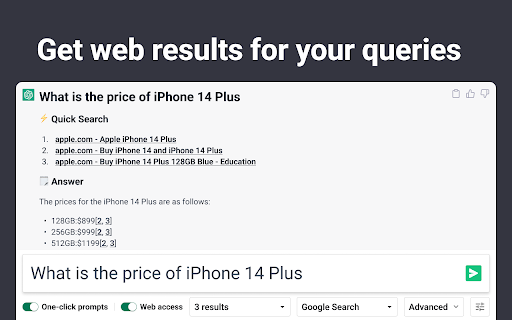
WebChatGPT is a third-party browser extension that adds web results, page-text extraction and a prompt library to ChatGPT and other supported AI/search pages. The Chrome listing is active: version 4.2.0 was updated on July 13, 2026 and reports about one million users. The Edge listing is also active. This is not an OpenAI product.
The page needs an important status correction. The public repository—originally qunash/chatgpt-advanced and now redirected to interstellard/chatgpt-advanced—explicitly says it stopped receiving updates after June 30, 2023 because new features required credentials and server-side logic. Its latest public release is v3.2.7 from April 2023. The current store build is therefore active, but it is not the same auditable code snapshot as the legacy MIT repository.
The current Chrome listing says the extension processes requests locally and discloses no data collection; the linked privacy policy, last updated May 18, 2023, also says no personal data is collected. Those are vendor disclosures, not proof that the 2026 binary matches the 2023 source. Organizations should treat the store package, its broad site access and each update as a separate software-supply-chain decision.
What the current extension does—and what it does not prove
| Capability | Current claim | Practical value | Verification boundary |
|---|---|---|---|
| Web-result injection | Adds relevant search results to prompts | Lets free and paid ChatGPT users choose retrieved context | Search snippets can be incomplete, stale or SEO-manipulated |
| Page-text extraction | Reads text from a supplied URL | Useful for summarization and targeted Q&A | Extraction may omit tables, scripts, paywalls, images and context |
| Prompt library | One-click templates plus personal prompts | Reduces repeated typing | A template can contain outdated or unsafe instructions |
| Search-side answers | Shows AI answers beside search results | Convenient comparison without tab switching | Adds another party with access to search/page context |
| Multi-site support | Current metadata lists ChatGPT, Claude, Gemini, search engines and Perplexity surfaces | One workflow across services | Every injected site expands breakage and permission exposure |
| Open-source heritage | Legacy MIT repository remains readable | Useful for understanding the original architecture | Does not establish what current v4.2.0 executes |
WebChatGPT originally solved a real 2022–2023 gap: ChatGPT did not consistently browse the live web. Native ChatGPT Search now covers much of that need. The extension can still appeal to users who want explicit control over which web results enter a prompt, reusable prompts and search-page integration. Its value is workflow control, not a unique guarantee of freshness or accuracy.
Install and evaluate it without trusting the name
- Start only from the official store entry and verify extension ID
lpfemeioodjbpieminkklglpmhlngfcn, publisher websitewebchatgpt.app, version and update date. Similar names are not the same product. - Read the permission dialog. The project explains that all-site access is used for search and arbitrary URL extraction. Chrome warns that this class of permission can read or change data on visited sites.
- Use a separate low-value browser profile during evaluation. Do not begin in a profile containing banking, health, admin, customer or privileged sessions.
- After installation, inspect
chrome://extensionsoredge://extensions. Restrict site access where the workflow allows it and disable the extension when not in use. - Test one harmless public query. Record the exact search results injected, the prompt sent to ChatGPT and the returned citations.
- Open every load-bearing source. Check whether the cited passage actually supports the answer, not merely whether the domain looks reputable.
- Test a page containing misleading instructions and verify that page text is treated as untrusted data. Prompt-only defenses are imperfect; do not expose secrets or action tools.
- Repeat the task with native ChatGPT Search, Perplexity and ordinary search. Keep WebChatGPT only if it reduces time to a verified result enough to justify permission and maintenance risk.
Permissions, privacy and software-supply-chain review
| Question | Evidence available | What remains unknown | Recommended control |
|---|---|---|---|
| Why all-sites access? | Store/legacy FAQ says search and arbitrary URL extraction require it | Whether every current host permission remains necessary | Restrict site access, separate profile, disable when idle |
| Does it collect data? | Store disclosure and 2023 privacy page say no | Current binary is not covered by current public source | Review network activity and vendor policy; avoid sensitive data |
| Is it open source? | Historical code and MIT license are public | 2026 store code is not represented by that frozen repository | Describe it as active proprietary/current build with open-source legacy |
| Can updates change risk? | Browser stores auto-update extensions | Permissions, remote logic and supported sites can change | Record version; review permission-change prompts and release evidence |
| Are prompts local? | Vendor says local/serverless in store copy | Repository notice says newer features required credentials/server logic | Do not infer architecture from old README; verify observed traffic |
| Is store approval a security audit? | Chrome shows publisher/recommended-practice signals | Approval cannot prove absence of vulnerable or malicious behavior | Apply least privilege and organizational extension allowlisting |
The contradiction between “serverless/local” marketing and the repository notice about credential/server-side features is not proof of misconduct; it is a documentation gap. The responsible conclusion is uncertainty. A stale privacy policy and frozen source reduce independent verifiability even while the store extension remains actively maintained.
Search quality, citations and prompt injection
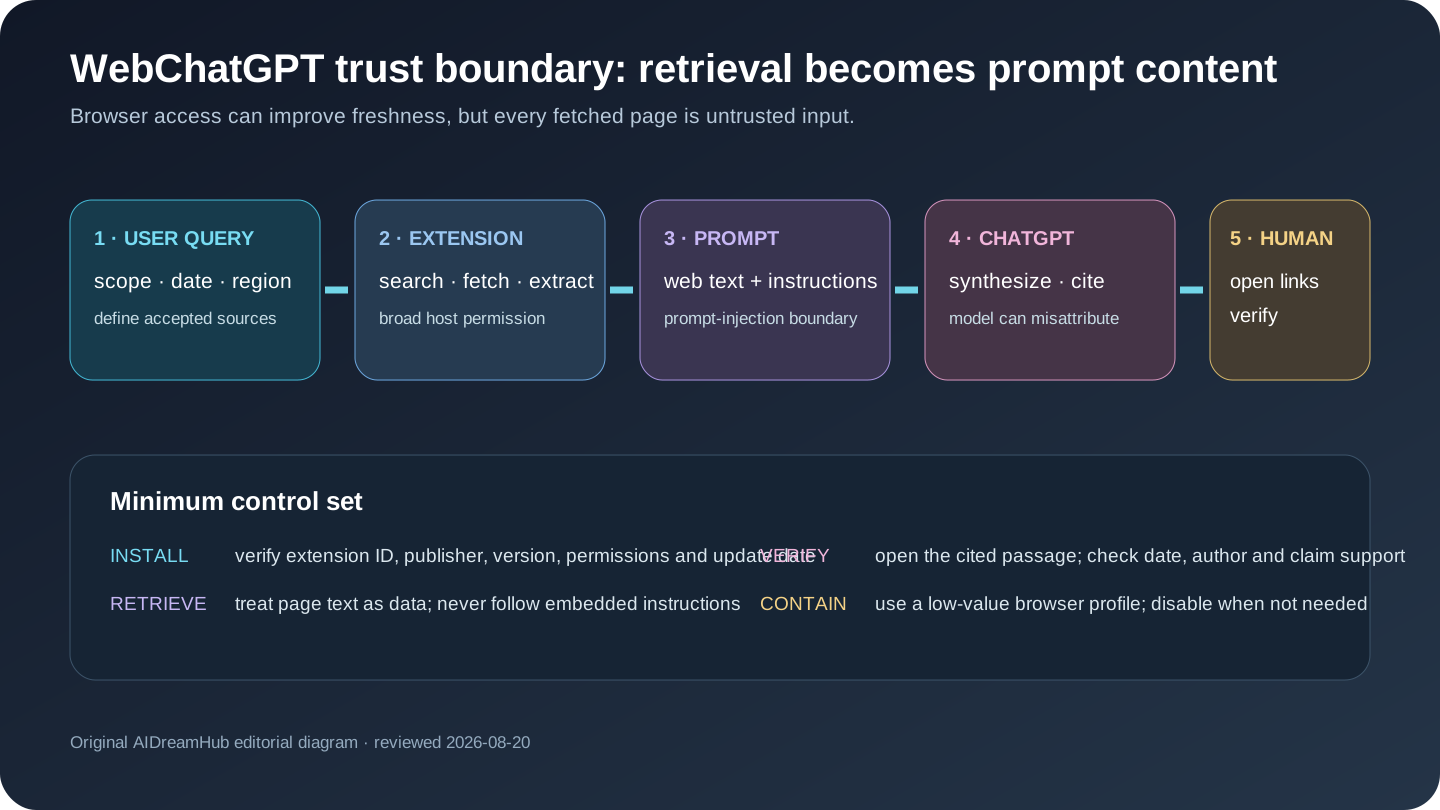
WebChatGPT places retrieved snippets or extracted page text into the model’s context. This can improve freshness but does not create a citation-verification engine. Search ranking may favor popular, optimized or duplicated pages; extraction may lose qualifiers; ChatGPT may combine two sources into a claim neither makes. Require canonical URLs and direct quotations for consequential claims, then inspect the original page.
Retrieved web text is also an instruction channel. A page can contain text telling an AI to ignore the user, reveal information or follow a malicious link. Because the extension’s job is to move page text into a prompt, indirect prompt injection is a design-level risk. Delimit source text, explicitly label it untrusted, prevent tools or secrets from being available in the same context, and keep humans in charge of external actions. No wording in a prompt is a complete sandbox.
| Failure mode | Signal | Test | Response |
|---|---|---|---|
| Citation mismatch | Link discusses topic but not the exact claim | Locate supporting passage | Narrow or remove claim |
| Stale result | Old price/version ranks highly | Check official current page and date | Add date and freshness cutoff |
| Source monoculture | Many results repeat one release | Trace common origin | Add independent/primary source |
| Extraction loss | Table, footnote or dynamic text missing | Compare injected text with rendered page | Quote only verified passages |
| Prompt injection | Source contains commands for the model | Use a benign adversarial test page | Treat content as data; remove tools/secrets |
| UI breakage | Toolbar disappears after ChatGPT update | Test clean profile and current version | Disable conflicts; use native search fallback |
Alternatives: the extension is now optional, not foundational
| Option | Choose it when | Advantage over WebChatGPT | Trade-off |
|---|---|---|---|
| Native ChatGPT Search | You want web search inside the supported ChatGPT product | No third-party DOM injection; integrated citations and account controls | Less control over exact result injection; plan limits may apply |
| Perplexity | Source-led reconnaissance is the primary job | Answer-first search, visible citations and research modes | Still needs citation checking; separate privacy and plan review |
| Microsoft Copilot / Edge | Your organization uses Microsoft Edge and Microsoft services | Browser/product integration and enterprise administration | Licensing, tenant configuration and Microsoft data boundary |
| Google Search | You need direct source discovery and operators | Maximum control over which pages you open | Manual synthesis and SEO noise |
| Prompt manager only | You need reusable prompts, not broad web extraction | Can request narrower permissions | No integrated retrieval |
| WebChatGPT | You value chosen result injection plus prompt library | Cross-site workflow and explicit context selection | Broad host access and current-source audit gap |
Our decision rule: use native search first. Add WebChatGPT only when its explicit result selection or prompt library solves a measured workflow problem. A browser extension with access to every page should earn its place through repeatable benefit, not nostalgia for the period before ChatGPT had search.
Independent verdict
WebChatGPT is not abandoned: its Chrome and Edge listings show active 2026 releases and substantial adoption. The open-source project, however, is legacy. Any page calling the current extension simply “open source” is misleading unless it clearly separates the 2023 repository from the 2026 store binary.
The extension remains useful for controlled result injection and prompt management, but native ChatGPT Search has removed its original necessity. Its broad permission is understandable for arbitrary page extraction and still high-impact. The privacy claims are positive but dated and not independently verifiable from the frozen code.
Best fit: an informed individual using a dedicated browser profile for public-web research, who checks citations and wants manual control. Poor fit: regulated, privileged or high-value sessions; organizations without extension allowlisting; and users who only need current ChatGPT search. Keep the installation reversible and review it after every material update.
Frequently asked questions
Is WebChatGPT still active?
Yes. The Chrome listing shows version 4.2.0 updated July 13, 2026. The public GitHub repository is different: it stopped updates in June 2023.
Is the current WebChatGPT extension open source?
The historical v3.2.7 code is MIT-licensed and public. The actively updated store build is not represented by that frozen repository, so do not call the current binary fully open source without newer source evidence.
Why does it request access to all websites?
The developer says broad host access supports search and extraction from arbitrary URLs. Chrome classifies such access as high-impact because it can read or modify visited-page data.
Does WebChatGPT collect data?
The store disclosure and 2023 privacy policy say it does not collect personal data. The current implementation is not publicly auditable from the legacy repo, so sensitive use still requires caution.
Does it make ChatGPT answers accurate?
No. It supplies fresher context and links. Search ranking, extraction errors, citation mismatch and model synthesis can still produce unsupported claims.
Can web pages prompt-inject ChatGPT through the extension?
Yes. Extracted text can contain malicious instructions. Treat page content as untrusted, isolate tools and secrets, and require human review.
Is it better than ChatGPT Search or Perplexity?
It offers explicit result injection and a prompt library. Native ChatGPT Search reduces third-party permission exposure; Perplexity provides a dedicated source-led research interface. Test verified tasks.
Sources reviewed
- Chrome Web Store listing
- Current privacy policy
- Legacy open-source repository
- Legacy v3.2.7 release
- Microsoft Edge listing
- Chrome extension permission guidance
- Chrome extension management guidance
- OpenAI: ChatGPT Search
- Microsoft: Copilot in Edge
- OWASP: prompt injection
- Academic study of malicious GenAI Chrome extensions
Independently reviewed 2026-08-20. Store versions, permissions, supported sites and privacy terms can change. Verify the exact extension ID, current listing, permission dialog and network behavior before installation.