HuggingChat in 2026: active, redesigned and no longer just a single-model demo
HuggingChat is Hugging Face's hosted chat application for interacting with open models. It is active in 2026: the public Chat UI repository continues to receive releases, including v0.10.0 in May 2026, and the live site presents an Omni router plus direct model selection. At review time the landing page displayed 134 models, but that count is a snapshot, not a guaranteed catalog. Models and providers rotate.
The important product change is architectural. HuggingChat is the hosted application at hf.co/chat; Chat UI is the Apache-2.0 SvelteKit codebase that powers it and can be self-hosted; Inference Providers is a routed API and billing layer spanning external inference companies; Inference Endpoints are dedicated deployments; and the model weights, licenses and cards belong to separate model repositories. “Open model” does not mean the hosted request stayed on your device, used one provider or carried one uniform privacy policy.
The live service requires a Hugging Face account to enter persistent chat functions. Its privacy notice says conversations are private, stored to provide history and not shared with model authors for training or research, with deletion available. That notice was last updated in April 2024. Current Inference Providers documentation separately says Hugging Face does not store routed request bodies or responses, retains debugging logs up to 30 days without user data or tokens, and directs users to each external provider's policy. Do not merge these statements into a broader promise than the documents make.
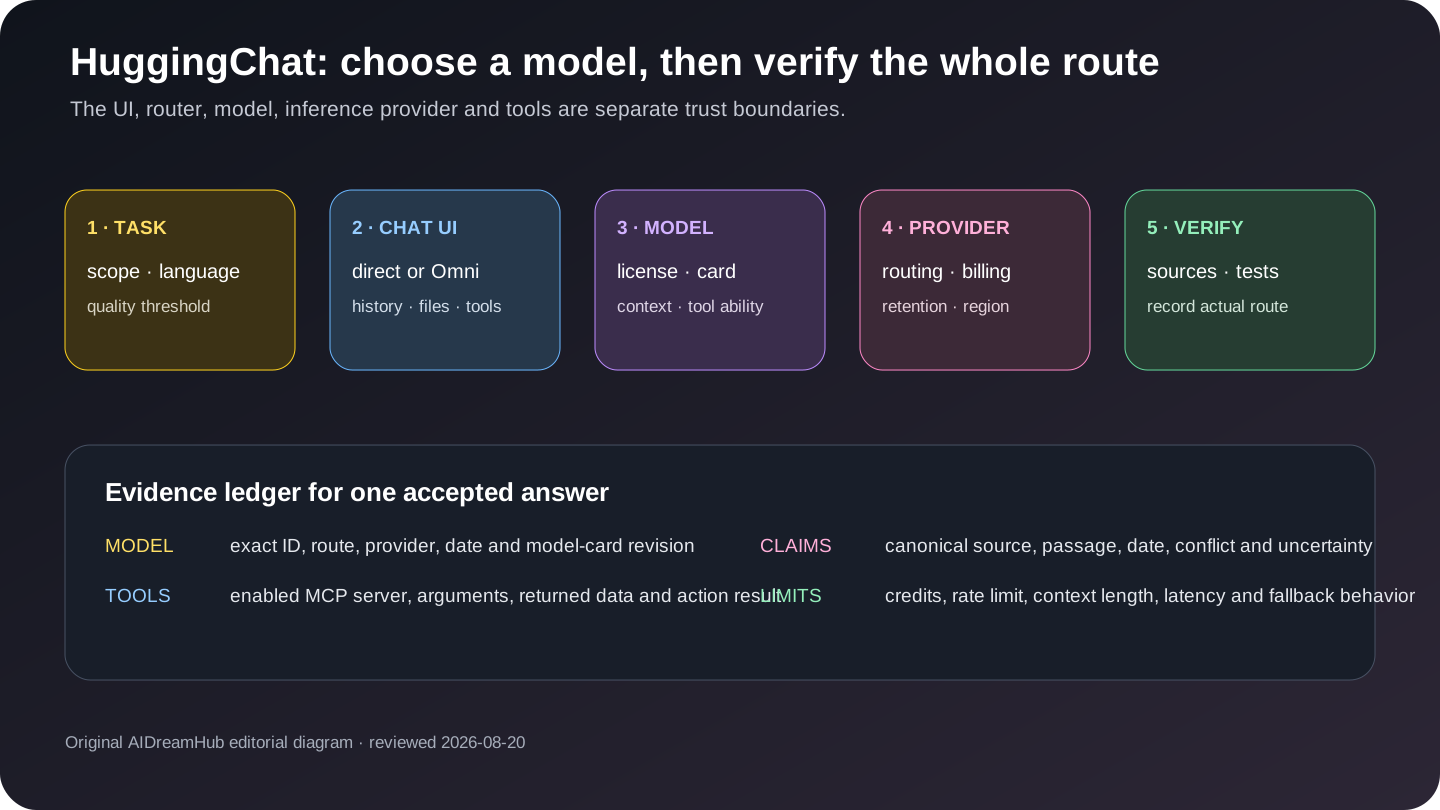
Five layers that pages commonly confuse
| Layer | What it is | What can change | Do not assume |
|---|---|---|---|
| HuggingChat | Hugging Face-hosted consumer chat interface | Available models, Omni policy, login flow, tools and limits | That every open model is available or locally executed |
| Chat UI | Open-source SvelteKit interface, database and tool/router code | Releases, configuration and supported OpenAI-compatible endpoints | That a self-hosted copy has Hugging Face's production settings |
| Inference Providers | Unified routing, authentication and billing over multiple providers | Provider, price, latency, context and availability | That the model developer served the request |
| Inference Endpoints | Dedicated managed deployment of a chosen model/container | Hardware, scaling, region, network exposure and hourly cost | That it is included with ordinary HuggingChat use |
| Model repository | Weights, card, license, training and evaluation disclosures | Revision, derivatives, license and deployment support | That an open-weight license guarantees accuracy, safety or privacy |
What HuggingChat is good at
HuggingChat is unusually useful for comparative exploration. Users can move beyond one vendor's house model, inspect model identities, try a direct model or let Omni choose a route, and follow links to the broader Hugging Face ecosystem. For developers, the same Chat UI can be self-hosted against Hugging Face's router, Ollama, llama.cpp, OpenRouter or another OpenAI-compatible endpoint. That makes it a practical reference implementation as well as a hosted app.
Its openness also creates work for the user. Models can differ sharply in language coverage, context size, refusal style, tool calling, vision support, reasoning controls and licensing. The exact serving provider can change cost, speed, retention terms and reliability even when the model name stays the same. Omni improves convenience but introduces an extra routing decision; for reproducible evaluations, select the exact model and record the actual route displayed by the UI.
| Task | Model selection signal | Minimum test | Failure to watch |
|---|---|---|---|
| General writing | Strong instruction following in target language | Three real prompts plus edit pass | Fluent but generic or culturally wrong prose |
| Coding | Repository language, tool ability and long-context support | Run tests on a bounded issue | Invented APIs or patches that do not compile |
| Document analysis | Context length and file/vision support | Known-answer questions across beginning and end | Silent truncation or missing tables |
| Web research | Search/MCP tool support and source display | Open every load-bearing citation | Links that do not support the claim |
| Structured actions | Reliable function calling and schema adherence | Dry-run with harmless tools | Wrong arguments or unapproved side effects |
| Sensitive domain | Documented evaluation plus expert review | Adversarial cases and abstention threshold | Confident advice outside intended use |
A model-selection and verification workflow
- Define the job before choosing the model. Record language, input size, modalities, required tools, latency, privacy boundary and what a passing answer means.
- Choose direct model selection for evaluation. Omni is convenient for daily exploration; a named model is better when results must be reproduced or compared.
- Open the model card. Check the exact repository and revision, license, intended and excluded uses, training disclosures, languages, evaluation method, known limitations and derivative status. Missing evidence is not positive evidence.
- Identify the serving route. Record HuggingChat/Chat UI version, actual model, inference provider, date and any fallback. The same model on two providers may differ in quantization, parameters, context or operational policy.
- Run a small task-specific suite. Include ordinary examples, edge cases, an impossible question, a multilingual case and a prompt that should trigger abstention. Score supported claims, not eloquence.
- Enable only necessary tools. Inspect each MCP server, authentication scope and action. Use read-only or test accounts, review arguments and require confirmation for external changes.
- Verify citations and outputs. Open canonical sources, locate the supporting passage, run generated code and compare calculations independently.
- Record limits and cost. Capture context length, rate limits, consumed credits, latency and provider failures. Repeat after catalog or model revisions.
Tools, web search and citations are separate capabilities
Current Chat UI supports MCP servers. A model decides which tool and parameters to call; Chat UI executes the request, displays the tool block and feeds results back. User-added MCP server details are stored in the browser, while an administrator may configure base servers. An optional setting can forward a signed-in user's Hugging Face token to an MCP server. That is powerful and high impact: verify the server owner, requested scopes, data destination and whether it can mutate repositories, files or other systems.
Tool support is model-specific. Configuration can advertise or force a tools capability, but a badge does not prove reliable argument generation. Test with read-only calls before enabling actions. Tool output is untrusted input and can contain prompt injection. A model can also call the correct tool with the wrong entity, date or scope. Human confirmation remains necessary for publication, purchases, code merges, account changes or messages.
Web retrieval does not automatically produce good citations. Search and scraped page text can be stale, manipulated or incomplete; the model may attach a relevant-looking URL to an unsupported sentence. Require canonical links and exact passages for consequential claims. When a chat has no retrieval tool enabled, treat apparently current facts or links as model-generated until verified.
| Risk | Why it appears | Evidence to capture | Control |
|---|---|---|---|
| Model substitution | Omni routing or fallback changes the backend | Actual model and provider metadata | Pin a model for evaluation; record fallbacks |
| Prompt/tool injection | External content becomes model context | Tool result and generated arguments | Isolate secrets; approve actions |
| Citation mismatch | Retrieval and synthesis are probabilistic | Exact source passage beside claim | Open and verify canonical source |
| Privacy boundary drift | UI, HF router and outside provider have distinct policies | Route, provider, settings and policy date | Avoid secrets; review every processor |
| Limit exhaustion | Credits, rate limits and provider capacity vary | Usage, latency and error logs | Budget alerts and fallback policy |
| Model-card overtrust | Cards are author-maintained and may be incomplete | Independent tests and revision hash | Treat card as disclosure, not certification |
Privacy, login, limits and billing
The hosted app authenticates through a Hugging Face account and stores conversation history so the user can return to it. The 2024 HuggingChat notice says conversations are not shared with model authors for research or training and can be deleted. This does not mean every self-hosted Chat UI instance follows that notice: its administrator chooses authentication, database, sharing settings, analytics and inference endpoint. A local UI pointed at a remote provider still sends prompts off the device.
For routed Inference Providers, current documentation says request bodies and responses are not stored by Hugging Face and debugging logs are retained for up to 30 days without user data or tokens. External providers retain responsibility for their own controls. Dedicated Inference Endpoints have a different deployment and billing model and official documentation says payloads/tokens are not stored, with logs kept for 30 days. High-risk organizations must verify contract, region, subprocessor, retention, access control and deletion rather than infer them from an “open” label.
Inference Providers pricing is usage-based and separate from an unlimited consumer-chat promise. At review time, official docs listed monthly credits of US$0.10 for free accounts, US$2 for PRO, and US$2 per Team or Enterprise seat, all subject to change; additional credits or provider billing may apply. HuggingChat can impose service or model-specific limits that are not the same as API credits. Check the live account, model listing and billing page before committing a workload.
HuggingChat compared with real alternatives
| Option | Best reason to choose it | Advantage over HuggingChat | Trade-off |
|---|---|---|---|
| ChatGPT | Integrated general assistant with mature creation and tool ecosystem | Consistent first-party product surface and support tiers | Less direct open-model comparison; proprietary service boundary |
| Claude | Long-form reasoning, writing and coding workflows | Cohesive model family and polished document work | Fewer direct model choices; availability and plan limits |
| Perplexity | Web research with citations is the primary job | Search-first interface and visible source loop | Still requires citation checking; not an open-model laboratory |
| HuggingChat | Explore and compare open models or study an open chat stack | Model choice, model cards and self-hostable Chat UI | More variability in quality, provider and limits |
| Local Chat UI + Ollama/llama.cpp | Data must stay on controlled hardware and models fit locally | Maximum infrastructure and retention control | Hardware, patching, backups, security and evaluation are your job |
| Dedicated Inference Endpoint | Need predictable deployment and organizational controls | Chosen model/hardware/network boundary | Separate hourly cost and operational configuration |
“Open versus closed” is too crude a buying question. Compare accepted-task quality, route transparency, data processors, license fit, tool safety, latency, correction time and total cost. HuggingChat wins when model diversity and stack transparency matter. It loses when a team wants one accountable model behavior, consolidated support or a turnkey governed workflow.
Independent verdict
HuggingChat's distinctive value is not that it is a free clone of ChatGPT. It is a living interface to an evolving open-model and inference ecosystem, and the Chat UI code provides a credible path to self-hosting. The 2026 Omni router makes the product easier to use while making route recording more important.
Best fit: technically curious users, developers, educators and teams evaluating open models with explicit tests. Poor fit: anyone who assumes every listed model has identical privacy, tools, citations or quality; regulated work without a reviewed deployment; and users who need a single stable vendor behavior more than model choice.
Our rule is: choose the route, not just the chatbot. Record the model, provider, tools, policy and evidence for each important result. Open weights increase inspectability and deployment choice; they do not remove inference infrastructure, data governance or human verification.
Frequently asked questions
Is HuggingChat still active?
Yes. The live service and public Chat UI repository were active at review time, with v0.10.0 released in May 2026 and the current site presenting Omni routing and direct model selection.
Is HuggingChat the same as the Hugging Face Inference API?
No. HuggingChat is the hosted interface. Chat UI is its open-source code. Inference Providers is a routed API/billing layer, while Inference Endpoints are dedicated deployments.
Are all HuggingChat models open source?
The service describes open models, but “open” varies by license and artifact availability. Inspect each exact model card and license; an open-weight model is not automatically unrestricted or reproducible.
Does HuggingChat run locally?
The hosted service does not mean local inference. You can self-host Chat UI against Ollama or llama.cpp, but any remote endpoint still receives prompts. Verify the configured base URL.
Does Hugging Face train on my conversations?
The HuggingChat privacy notice says conversations are private and not shared with model authors for training or research. Check its date and the policies of the actual inference route; self-hosted instances can be configured differently.
Does Omni always use the same model?
No. Omni is a routing alias that can select routes based on image, tool and default signals and use fallbacks. Select a direct model and record metadata when reproducibility matters.
Can HuggingChat browse the web or use tools?
Chat UI supports MCP tools and web-search configurations, but availability depends on the deployment and model. Tool results can be untrusted and actions need review.
Sources reviewed
- Live HuggingChat
- Chat UI documentation
- Chat UI GitHub repository
- Chat UI v0.10.0 release
- Inference Providers overview
- Inference Providers pricing
- Inference Providers security
- HuggingChat privacy notice
- MCP tools documentation
- LLM Router documentation
- Hugging Face model cards
- Inference Endpoints security
- Hugging Face Hub security
Independently reviewed 2026-08-20. The live model count, catalog, router, providers, credits, limits and privacy terms can change; verify the exact route and current documentation before sensitive or paid use.