Tableau Pulse review: an excellent last-mile metrics feed, not a substitute for analytics engineering
Tableau Pulse is a metrics-oriented consumption experience in Tableau Cloud. Teams define a measure, time dimension, filters, goals and metadata; people follow the resulting metrics; Pulse detects changes and drivers and delivers personalized summaries through Tableau Cloud, mobile, email or Slack. It is designed to answer ‘what changed in the KPIs I own?’ before a user opens a dashboard. It is not a new database, a general-purpose data agent, a dashboard authoring replacement or an automatic cure for inconsistent definitions.
The packaging matters. Tableau says Pulse is included with Tableau Cloud editions and Embedded Analytics solutions. The current pricing page lists Pulse in Standard and Enterprise, while the premium Cloud+ edition adds Tableau Agent in Tableau Cloud and Pulse. The single-metric Ask Q&A path can suggest and reveal pre-detected insights without an LLM. Cross-metric conversational exploration—previously called Enhanced Q&A or Discover and now being renamed Tableau Agent in Pulse—is a Tableau+ / Cloud+ capability. Do not price a basic Pulse digest and assume the premium agent is included.
This review is dated 20 August 2026. Tableau’s July 2026 release notes say the Pulse agent is powered by GPT-5.2 and that answers can include inline visualizations and citations. That is a current vendor release statement, not a permanent architecture guarantee. Model choice, names, entitlements and regional behavior can change. A procurement record should attach the live plan matrix and help pages, not repeat a demo slide.
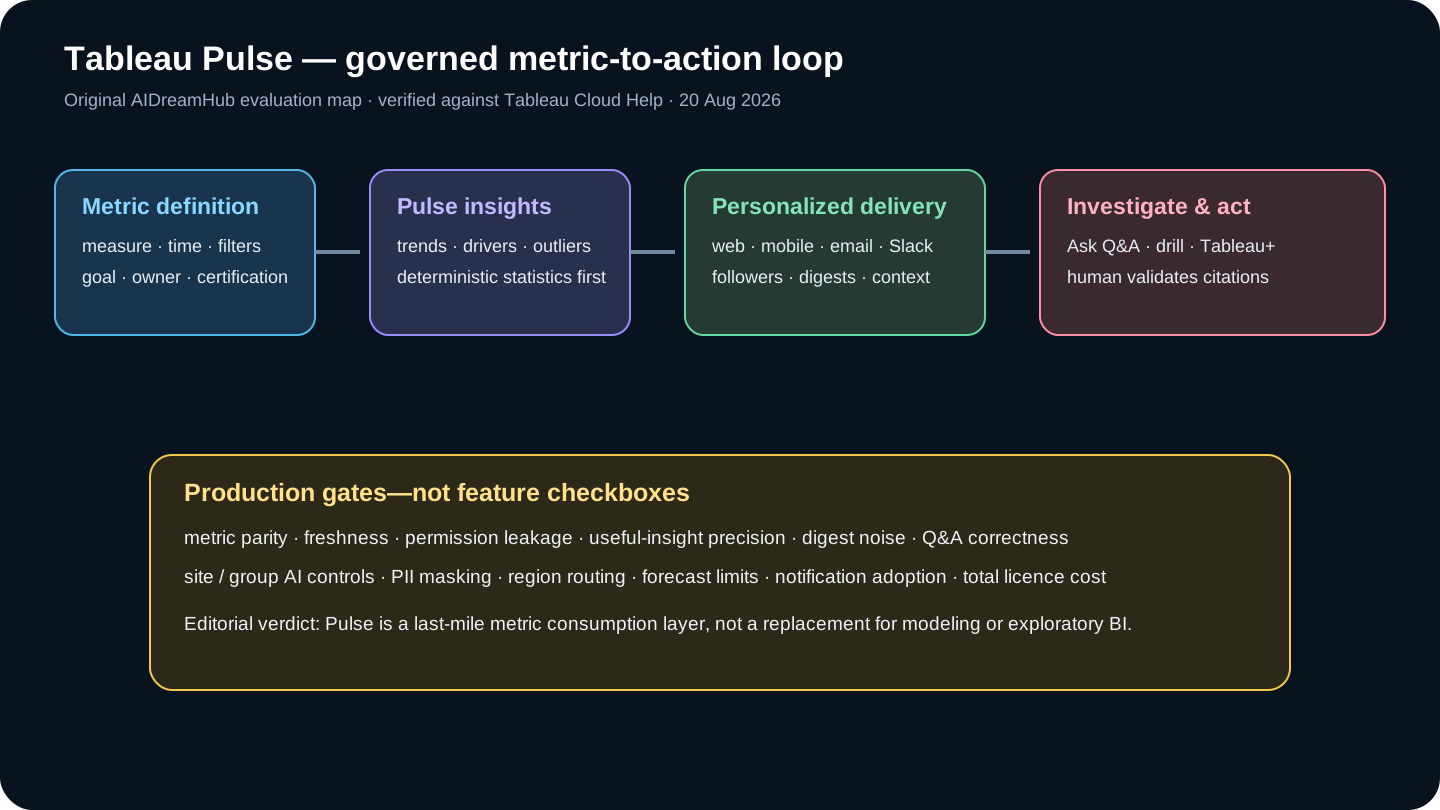
What Tableau Pulse is—and what it is not
| Layer | Purpose | Decision to verify |
|---|---|---|
| Metric definition | Measure, time dimension, filters, goals, insight settings and ownership | Does it reproduce the approved business definition? |
| Pulse metrics layer | Related metric instances for teams, filters and followers | Who may create, certify, edit or proliferate variants? |
| Insight detection | Statistical trends, drivers, outliers, thresholds, forecasts and correlations | Which insight types are plan-dependent and useful on our data? |
| Digests and feed | Personalized web/mobile/email/Slack consumption | Does delivery reduce dashboard hunting without creating noise? |
| Ask Q&A | Single-metric guided questions over pre-detected insights | It is always available; optional semantic matching can use AI |
| Tableau Agent in Pulse | Conversational exploration across grouped metrics, formerly Enhanced Q&A/Discover | Requires premium licensing and site enablement |
| Tableau authoring | Dashboards, calculations and broader visual analysis | Pulse does not replace workbook or semantic engineering |
| Embedded Pulse | Pulse components placed in another application | Validate identity, viewer permissions, filters and tenant isolation |
From a governed metric to a useful digest
A metric definition is the contract. Start with finance-approved revenue, margin, pipeline and retention definitions. Record aggregation, grain, fiscal calendar, time zone, currency, null treatment, late-arriving data, allowable filters, goal and accountable owner. Pulse can simplify creation, but simplicity increases the risk of near-duplicate metrics. Certification is valuable only when a review process and regression suite sit behind the badge.
Permissions are layered. Site settings control Pulse and generative-AI features; published-data-source authentication and permissions control what a person can view; a Create Metric Definitions capability and qualifying site role control definition authoring; definition settings control editors and goal owners. Tableau’s help also notes that viewers can create a new metric instance by changing allowed filters. Test whether this desirable self-service behavior produces uncontrolled variants, and design naming, tagging and cleanup rules.
Pulse’s strongest idea is delivery, not chat. A sales leader can follow pipeline by region, a support manager can follow resolution time and a product owner can follow activation. The system chooses relevant changes and sends a digest. Measure whether recipients understand the definition, open the evidence, make a decision and avoid separate spreadsheet reconciliation. An impressive summary with no changed behavior is notification theater.
A 30-day production evaluation
- Select one domain with 10–20 decision-relevant metrics and name business, data and security owners.
- Reproduce each metric against an approved finance or operations report across edge dates, currencies and filters.
- Configure definitions, goals, insight types, owners, certification and allowed filter dimensions; document every assumption.
- Create synthetic Viewer, Explorer, Creator, regional and embedded users; test view, create, edit, follow and inference boundaries.
- Replay at least 50 historical incidents and label which trends, drivers, outliers, correlations or forecasts should matter.
- Measure freshness, insight precision, missed material events, false alarms, digest opens, drill-through and action time.
- Test single-metric Ask Q&A separately from Tableau Agent in Pulse; score compatible-metric selection, citation and hallucination.
- Validate Slack, email, mobile, web and embedded delivery with quiet hours, ownership changes and departed users.
- Review PII masking, audit data, Data 360/Salesforce connection, regional routing, retention and incident-response evidence.
- Model three-year licence, implementation, governance and support cost; compare the same corpus with the realistic incumbent alternative.
- Canary one team, publish limitations and rollback criteria, then rerun tests after data, permission or platform changes.
Governance, AI, cost and operating limits
| Risk | Control | Evidence required |
|---|---|---|
| Wrong KPI | Certified definition and parity tests | Exact value/filter/grain match |
| Metric sprawl | Naming, owners, certification and cleanup | Duplicate/ownerless metric rate |
| Permission leakage | Synthetic roles and embedded tenant tests | Zero restricted values or inferred totals |
| Noisy insights | Historical event labels and thresholds | Useful precision and missed-event rate |
| Stale data | Freshness SLO and visible timestamp | Digest value matches source cutoff |
| Hallucinated answer | Bounded corpus, citations and human drill | Unsupported-claim and omission rate |
| Privacy/residency gap | Feature-level AI settings and data-flow review | Approved flow, region and retention record |
| Notification fatigue | Cadence, follow governance and user controls | Sustained opens and action rate |
| Premium surprise | SKU/role/AI/prerequisite matrix | Signed quote maps every required capability |
Generative AI is optional at several levels. Pulse insight detection is grounded in the metrics layer and deterministic statistical models; an LLM may synthesize the language. Better semantic matching for Ask Q&A and summaries can be enabled by feature. Tableau Agent in Pulse uses generative AI across grouped metrics. This distinction matters for risk review: turning off the premium agent does not necessarily describe every enabled AI feature, and turning on Pulse does not automatically mean every metric value is sent to an LLM.
Tableau documents the Einstein Trust Layer, PII masking, zero retention by third-party LLM providers and no use of customer data to train a global model. It also documents audit/feedback data storage and geo-aware routing: routing follows the connected Salesforce/Data 360 region, but requests can route to the US when regional model capacity is unavailable. Treat these statements as design inputs, not a completed privacy assessment. Map prompt, metric definition, derived insight, audit and feedback data to residency, retention, legal-basis and access requirements.
The agent has explicit boundaries. It works with Pulse metrics, not arbitrary columns or general metadata; grouped comparisons require compatible traits such as time granularity and dimensions; unmatched metrics may be omitted. Tableau warns that complex questions can produce hallucinated or irrelevant answers. Citations show which Pulse insight supported an answer, but they do not prove that the metric definition, source freshness or interpretation is correct. Require a human-readable drill path and a route to the workbook or analyst.
Pricing must be scenario-based. The current public page lists annual contracts, at least one Creator per deployment, role-based licences and Pulse in Standard/Enterprise; Cloud+ and Tableau+ are sales-led premium offers. Add data-management needs, site count, support, embedded viewers, implementation, semantic ownership and Salesforce/Data 360 prerequisites. The 60-day Try AI trial is useful, but cannot be paused; after it ends, users lose agent access while metrics created during the trial remain. Capture exit behavior before inviting executives.
Tableau Pulse versus ThoughtSpot, Power BI and Looker
| Option | Best fit | Important limitation / cost boundary |
|---|---|---|
| Tableau Pulse | Personalized governed KPI feed for Tableau Cloud or Embedded users | Metric-first; premium cross-metric agent needs Cloud+/Tableau+ |
| ThoughtSpot + Spotter | Open-ended governed search and conversational analytics over cloud data | More semantic/query-cost evaluation; broader than a digest |
| Power BI Copilot | Microsoft Fabric/Power BI estate, report creation and semantic-model assistance | Eligible paid capacity, tenant and region requirements |
| Looker Conversational Analytics | LookML is the governed source of truth | Grounded in Explores; Google says early-stage AI outputs still need validation |
| Traditional Tableau dashboard/subscription | Stable, certified visual paths and fixed reporting | Less personalized investigation; easier to audit |
| Custom alerting + semantic API | Highly specific workflow and control justify engineering | Highest ownership, evaluation and maintenance burden |
Compared with ThoughtSpot, Pulse is narrower and often easier for a stable list of followed KPIs; ThoughtSpot/Spotter targets more open-ended search and conversational exploration. Compared with Power BI Copilot, Pulse fits Tableau Cloud estates and focuses on consumption, while Copilot spans report creation and Microsoft semantic models but requires eligible Fabric/Premium capacity and admin/region settings. Looker Conversational Analytics stays close to LookML Explores. None removes the need for modeled meaning, permissions and validation.
Our editorial judgment: buy or enable Pulse when the organization already trusts Tableau data sources but decision makers miss changes because dashboards are passive. Do not buy it to repair disputed KPIs, poor source freshness or absent ownership. Pulse is best viewed as a governed last-mile metric channel. Its success metric is not questions asked; it is faster detection and resolution of material changes without loss of control.
A mature rollout separates three acceptance thresholds. The metric must equal the certified report; the insight must be materially useful and timely; the explanation must not exceed its evidence. Canary by subject area, publish known unsupported questions and keep fixed dashboards for statutory or highly deterministic reporting. Re-run the corpus after metric-definition, permission, connector, Tableau release or AI-setting changes.
Frequently asked questions
Is Tableau Pulse included with Tableau Cloud?
Tableau says Pulse is included across Tableau Cloud editions; the current pricing page lists it in Standard and Enterprise. Confirm roles and contract because premium agent features are separate.
Is Tableau Agent in Pulse included?
The cross-metric conversational capability formerly called Enhanced Q&A or Discover is premium and requires Cloud+/Tableau+ outside the 60-day Try AI trial.
Does basic Ask Q&A use an LLM?
Single-metric Ask Q&A over pre-detected insights is always available and does not inherently use an LLM. Optional semantic matching and summaries can use AI when enabled.
Is Pulse available on Tableau Server?
The official metadata documentation says Tableau Pulse is not available on Tableau Server. It is a Tableau Cloud experience, including Embedded Analytics scenarios.
Can Pulse replace dashboards?
No. It is excellent for followed metrics, changes and guided investigation, while dashboards remain better for rich multi-view analysis, statutory layouts and authoring.
How does Pulse protect data?
Tableau documents existing permissions, Einstein Trust Layer processing, PII masking and zero retention by third-party LLM providers. Customers still must review routing, audit storage and settings.
Can the agent hallucinate?
Yes. Tableau explicitly warns that complex questions can produce inaccurate or off-topic answers. Validate metric choice, citations and source values.
What happens after Try AI?
The trial runs 60 days and cannot be paused. Agent access ends without a premium licence, but metrics created during the trial remain accessible.
Who should own Pulse?
Business owners approve meaning and thresholds; analytics engineering owns definitions and tests; admins own permissions/delivery; security and privacy teams approve AI data flows.
When should we choose ThoughtSpot instead?
Choose broader search-led exploration when users need questions beyond a followed metric set and you can operate the semantic and warehouse-query path.
Official and primary sources
- Tableau Pulse product overview
- About Tableau Pulse and current release notes
- Create metrics and metric definitions
- Set up Pulse, roles and permissions
- Ask Q&A and Tableau Agent in Pulse
- Premium Tableau Pulse capabilities
- Try Tableau Agent in Pulse
- AI in Tableau and Trust
- AI in Tableau data usage
- Current Tableau pricing
- Embed Tableau Pulse
- Power BI Copilot overview
- Looker Conversational Analytics
- ThoughtSpot product
Independent review dated 20 August 2026. Packaging, public prices, model choice, names, prerequisites and regional availability change; verify the current quote and official help before purchase.