AI Vidia is a Copenhagen performance-creative studio operated by Vidia ApS (Danish CVR 44873443). The old aividia.dk address now redirects to ai-vidia.com. This identity detail matters: AI Vidia is not NVIDIA, an academic video model, or a self-serve text-to-video application. A client supplies a brand, products, previous winners and a campaign objective; the studio handles concepting, scripting, AI generation, editing, human creative review, ratio cuts and delivery to a media buyer, ad account or DAM.
The current offer targets DTC and consumer brands that need repeated Meta, TikTok and YouTube creative. Official pages describe AI video ads, image ads, UGC-style ads, product photography and locked avatars. The value proposition is therefore a managed production and testing system, not access to one secret model. That distinction changes the buying test: compare accepted winners, review load, rights and campaign cadence—not raw render credits. It also means every performance number on the site is vendor-reported historical evidence rather than a guaranteed result.
Entity boundary: agency service, not generative-video software
AI Vidia combines people, workflow and third-party generation tools into a deliverable service. Its public page says a creative director reviews every asset and that formats include image, video, UGC, product and editorial work across common social ratios. Buyers do not receive an advertised API, model weights or a seat-based creation dashboard. The operative product is a statement of work plus recurring production capacity.
This also separates the business from its earlier aividia.dk site, which used broader language about chatbots, writing and digital transformation. The canonical 2026 site is more specific: performance creative for global consumer brands. A responsible directory page should follow the current canonical domain and current service pages, while noting the redirect so returning users understand they reached the same Danish entity.
Current public offers and what they actually buy
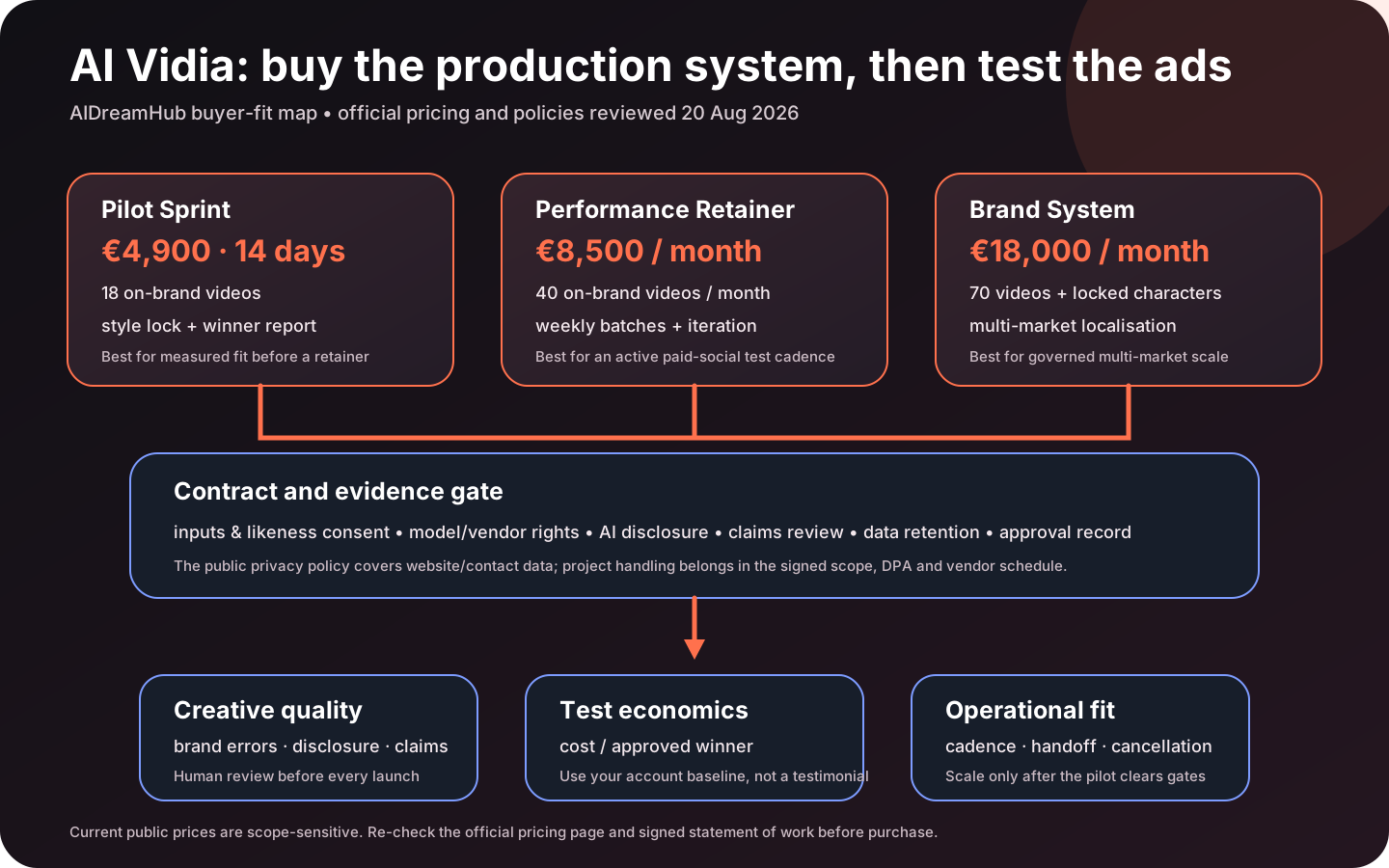
| Offer | Public price reviewed 20 Aug 2026 | Published scope | Best buyer hypothesis | Check before signing |
|---|---|---|---|---|
| Pilot Sprint | €4,900 fixed 14-day engagement | 18 on-brand videos, brand style lock, concepts, ratio cuts, winner report | Team that wants a measured trial before recurring spend | Exact asset mix, media spend, revision meaning, test ownership and delivery dates |
| Performance Retainer | €8,500/month | 40 videos/month up to 30 seconds, weekly batches, dedicated creative director, testing log | Paid-social team with a stable weekly test cadence | Capacity definition, pause/cancellation, response times, source files and change requests |
| Brand System | €18,000/month | 70 videos/month up to 60 seconds, locked character/style system and multi-market localisation | Brand operating across several markets, dealers or stores | Likeness rights, language QA, local claims review, model vendors and system handover |
The live pricing page says final scope and cadence are quoted per brief. Some older AI Vidia articles still contain lower historical ranges, while the current pricing page shows €4,900, €8,500 and €18,000. Treat the live pricing page and signed statement of work as authoritative, re-check taxes and deliverables, and record the review date rather than copying an old blog number.
A practical engagement and evaluation workflow
- Qualify the need. Estimate how many genuinely new concepts and variants your account can test each month. A retainer is wasteful if media spend or review capacity cannot absorb the output.
- Build a rights-clean brief. Supply product images, brand rules, prior ads and claims only when you own or are authorised to use them. Identify real people, trademarks, music, locations and regulated claims separately.
- Run the pilot as an experiment. Freeze baseline CTR, hook rate, hold rate, conversion, cost per acquisition and human review time before the first batch. Predefine what counts as a winner.
- Approve the brand lock. Review character identity, product geometry, packaging, typography, colours, voice, prohibited motifs and disclosure rules before volume rendering begins.
- Use human gates. Require a named reviewer for factual claims, likeness, product fidelity, accessibility, subtitles and platform policy. Attractive AI output is not evidence that an ad is compliant.
- Test against a control. Randomise new creative against current ads with comparable audience, placement and spend. Avoid attributing an account-wide ROAS change to a single production partner without a controlled read.
- Scale or exit. Move to a retainer only if cost per approved winner, speed and internal workload beat the in-house or alternative baseline. Preserve the style system, source files, approvals and deletion obligations on exit.
Who should shortlist AI Vidia—and who should not
| Situation | Fit | Reason | Decision test |
|---|---|---|---|
| DTC team with active paid social and creative fatigue | Strong potential fit | The offer is designed around weekly variants and performance feedback | Can the account test at least the promised cadence without starving each ad of spend? |
| Multi-market consumer brand needing a repeatable avatar/style | Potential Brand System fit | Locked characters and localisation are explicit deliverables | Are likeness, translation, claims and handover rights contractually complete? |
| One hero film or documentary shoot | Weak fit by default | The model optimises variant throughput, not physical production authenticity | Compare a film studio when real locations, talent and cinematography are the product |
| Small business seeking a DIY editor | Poor fit | This is a managed studio with four-figure entry pricing, not a low-cost SaaS seat | Use Creatify, Arcads, Pencil or another self-serve tool and price staff time |
| Regulated or high-risk advertising | Conditional fit only | AI speed increases the review burden for claims, disclosures and sensitive traits | Require counsel, local reviewers, audit records and model/vendor disclosure |
| Team needing an API or downloadable model | Not the stated product | No public model, API or software license is offered | Choose a software platform or model provider instead |
Privacy, intellectual property and disclosure boundaries
The April 2026 privacy policy describes website and enquiry processing: contact-form data in email/form relay, opt-in GA4 with IP anonymisation, anonymous Vercel performance telemetry, and sub-processors including Vercel, Google Analytics, Resend/Formsubmit and Google Workspace. It states contact messages are kept 24 months, analytics 14 months, and contracted client data for the engagement plus five years for tax compliance. Those statements are useful, but they do not replace a project-specific data processing agreement, security schedule or list of generation vendors.
The public pricing and FAQ say full IP transfers on delivery and that a locked character or style system belongs to the client. That is a commercial promise to capture precisely in the statement of work. Ask what counts as source material, which third-party model terms apply, whether prompts and intermediate renders transfer, how real-person likeness and voice consent are documented, and whether the studio may display the work. The terms page also clarifies that unnamed showcase work may be exploration or a spec piece and that campaign metrics are historical, not performance guarantees.
- Do not upload unreleased products, customer lists or sensitive personal data until project storage, access, retention, deletion and model-training use are documented.
- Require explicit consent and geographic/media duration for real-person face or voice references; a generated avatar can still create publicity, labour and deception risk.
- Keep product claims, prices, nutrition, finance, health and environmental assertions in a source-of-truth system reviewed outside the generation pipeline.
- Agree where AI disclosure is required by platform policy, market law, brand ethics or synthetic-media provenance rules; ‘looks traditional’ is not a compliance strategy.
- Document music, fonts, stock, model outputs and client assets separately. An overall IP-transfer clause cannot transfer rights the supplier never obtained.
- The service terms are governed by Danish law and Copenhagen courts, while a signed scope controls a client project. International buyers should review jurisdiction, VAT and cross-border data terms.
Score the pilot on accepted outcomes, not asset count
| Metric | Definition | Why it matters |
|---|---|---|
| Approved creative rate | Assets passing brand, product, claims and policy review / delivered assets | Exposes the correction cost hidden by high output volume |
| Cost per tested winner | All supplier and client labour cost / variants beating a frozen account threshold | Makes agency, SaaS and in-house paths comparable |
| Time to first valid test | Brief approval to an ad live with correct tracking | Separates fast renders from operational delivery |
| Product/character defect rate | Geometry, label, identity, motion or continuity errors / reviewed assets | Measures the main generative production risk |
| Novel concept rate | Distinct hypotheses tested / total variants | Prevents 40 minor crops from being counted as 40 ideas |
| Compliance escape rate | Material issues found after approval / published assets | Tracks whether the human review gate actually works |
| Internal review minutes | Client minutes spent briefing, correcting and approving / accepted winner | Captures the work that a managed service is supposed to remove |
Our preferred KPI is cost per compliant, tested winner. It includes fees, internal review, revisions and media-test cost, and it refuses to reward attractive volume that never ships. Use the vendor's case studies to form hypotheses, not to set your expected uplift: audience, offer, spend, attribution and existing creative quality can dominate the result.
AI Vidia versus agencies, SaaS platforms and in-house production
| Option | What you are buying | Advantage | Trade-off | Choose when |
|---|---|---|---|---|
| AI Vidia | Copenhagen managed AI performance-creative studio | Brand lock, human direction, weekly production and ad-ready handoff in one engagement | Four-figure entry, vendor workflow, project-specific rights and performance must be validated | You need recurring consumer ad variants and prefer a specialist partner |
| Superside | Broad enterprise creative subscription with AI workflows and platform | Many creative disciplines, enterprise collaboration and global team | Higher enterprise minimum and broader service than a focused ad studio | Multiple departments need design, video, brand and strategy capacity |
| Pencil | Self-serve AI ad creation and iteration platform | Software control and faster internal experimentation | Your team owns prompting, QA, policy, editing and creative direction | You already have performance marketers and designers |
| Arcads | AI actor/video ad software | Fast talking-head and UGC-style variants | Narrower production surface; likeness, scripts and final polish remain buyer duties | Actor-led ads are the main format and a team can operate the tool |
| Creatify | Self-serve product-to-video advertising platform | Low-friction automated video creation and SaaS economics | Less bespoke brand system and managed campaign operation | Small team needs affordable product-video volume |
| Traditional agency or film studio | Human concepting and physical production | Authentic locations, actors, cinematography and established rights workflows | Slower and costlier for large variant matrices | A hero campaign or real-world authenticity matters more than weekly volume |
| In-house hybrid stack | Staff plus selected image/video/editing tools | Maximum control, learning and data governance | Hiring, tool churn, review and capacity become internal operations | Creative demand is stable enough to justify a permanent capability |
Our independent conclusion: AI Vidia is most interesting as a specialised production operating system for performance teams, not as an AI-model breakthrough. Its differentiator is the combination of brand lock, human creative direction, variant cadence and media-buyer handoff. The right first purchase is the smallest pilot that can produce statistically useful tests. Scale only if it lowers cost per compliant winner and client review time. Buyers seeking a cheap video generator, an API or a guaranteed ROAS uplift should choose another category.
Frequently asked questions
Is AI Vidia the same as NVIDIA?
No. AI Vidia is Vidia ApS, a Copenhagen creative studio. The similar spelling does not indicate an NVIDIA product or affiliation.
Is it a self-serve AI video generator?
No. The public offer is a managed creative service. The studio handles concepting, generation, editing, review and delivery; it does not advertise a public creation API or downloadable model.
What does AI Vidia cost?
As reviewed 20 August 2026, the official pricing page lists a €4,900 Pilot Sprint, €8,500/month Performance Retainer and €18,000/month Brand System. Final scope is quoted per brief, so confirm the current page and contract.
What is the difference between the pilot and retainer?
The 14-day pilot tests fit and ships a defined first batch with a winner report. The retainer adds weekly recurring production, a dedicated creative director and testing cadence.
Who owns the output?
The public site promises full IP transfer on delivery and ownership of locked character/style systems. The signed scope should define source files, intermediate renders, third-party terms, portfolio use and likeness rights.
Does AI Vidia guarantee better ROAS?
No. Its terms explicitly say historical CPA, CTR and win-rate numbers are not promises of future performance. Run a controlled pilot against your own baseline.
How does it handle personal data?
The site privacy policy covers enquiries and web analytics, lists sub-processors and retention periods, and offers GDPR rights. For client assets and generation vendors, request project-specific security, DPA, retention and model-training terms.
When should I choose a SaaS tool instead?
Choose self-serve software when your team can own creative direction, prompting, editing, policy review and measurement and needs lower software pricing or API-like control.
Sources reviewed
- AI Vidia official home and current positioning
- Official pricing and scope
- Official production process
- Official creative examples
- Official case studies and self-reported outcomes
- Official AI video ads service page
- Privacy policy, April 2026
- Terms of service, April 2026
- Superside official AI creative service
- Pencil official AI ad platform
- Arcads official AI actor ads platform
- Creatify official AI video ads platform
Independently reviewed 20 August 2026. Prices, scopes, case-study counts, policies and vendor tooling can change. Verify the live official pages and signed statement of work before purchasing.