MuseGen is a browser-based creative studio centered on AI music generation. Its current interface advertises Suno V5.5, full songs, instrumentals, lyrics, vocals, WAV export and stems, while paid workflows add music extension, covers, vocal removal, audio-to-MIDI and music-video creation. The same credit balance can also be used across image and video tools.
The useful promise is rapid ideation: convert a creative brief into two or more audible directions before committing studio time. The risky promise is “radio-ready” or “rights-safe” output. A polished render can still contain weak composition, unintelligible lyrics, resemblance to existing music, unauthorized source material or uncertain copyright protection. Treat MuseGen as a drafting and production service, then apply musical, legal and release review.

What MuseGen currently offers
| Workflow | Published capability | What to verify |
|---|---|---|
| Create Music | Prompt or custom-mode song generation, including instrumental option | Model used, duration, language quality and credits per output |
| Extend Music | Continue an existing track or section | Transition, key, tempo, rights in uploaded source |
| Cover Music | Create a cover-style transformation | Composition rights, voice/likeness consent and distribution license |
| Vocal Remover | Two-stem or multi-stem separation | Artifacts, phase cancellation and permission to process the recording |
| Audio to MIDI | Convert audio ideas to editable note data | Timing, pitch, polyphony and instrument mapping accuracy |
| WAV and stems | Paid export for downstream production | Sample rate, bit depth, true isolation and plan availability |
| Music video | Create visual content from generated tracks | Image/video rights, identity, continuity and platform disclosures |
A prompt is a production brief
Genre plus mood is rarely enough. Write the brief as if handing it to a session musician: purpose, audience, tempo range, meter, tonal center, instrumentation, vocal register, song structure, lyrical point of view, emotional turn and prohibited elements. Describe musical attributes instead of naming a living artist.
| Brief field | Weak input | More controllable input |
|---|---|---|
| Purpose | “Make a catchy song” | “25-second instrumental opening for a sustainable-design podcast” |
| Rhythm | “Energetic” | “104 BPM, 4/4, syncopated bass, restrained four-on-the-floor kick” |
| Palette | “Modern pop” | “Muted electric piano, dry drums, warm mono synth bass, no acoustic guitar” |
| Structure | “Full song” | “4-bar intro, 8-bar verse, 8-bar chorus, brief bridge, final chorus” |
| Lyrics | “About hope” | “First-person present tense; rebuilding a neighborhood garden after a storm; no clichés” |
| Voice | “Like [artist]” | “Low alto, intimate delivery, clear consonants, no melisma” |
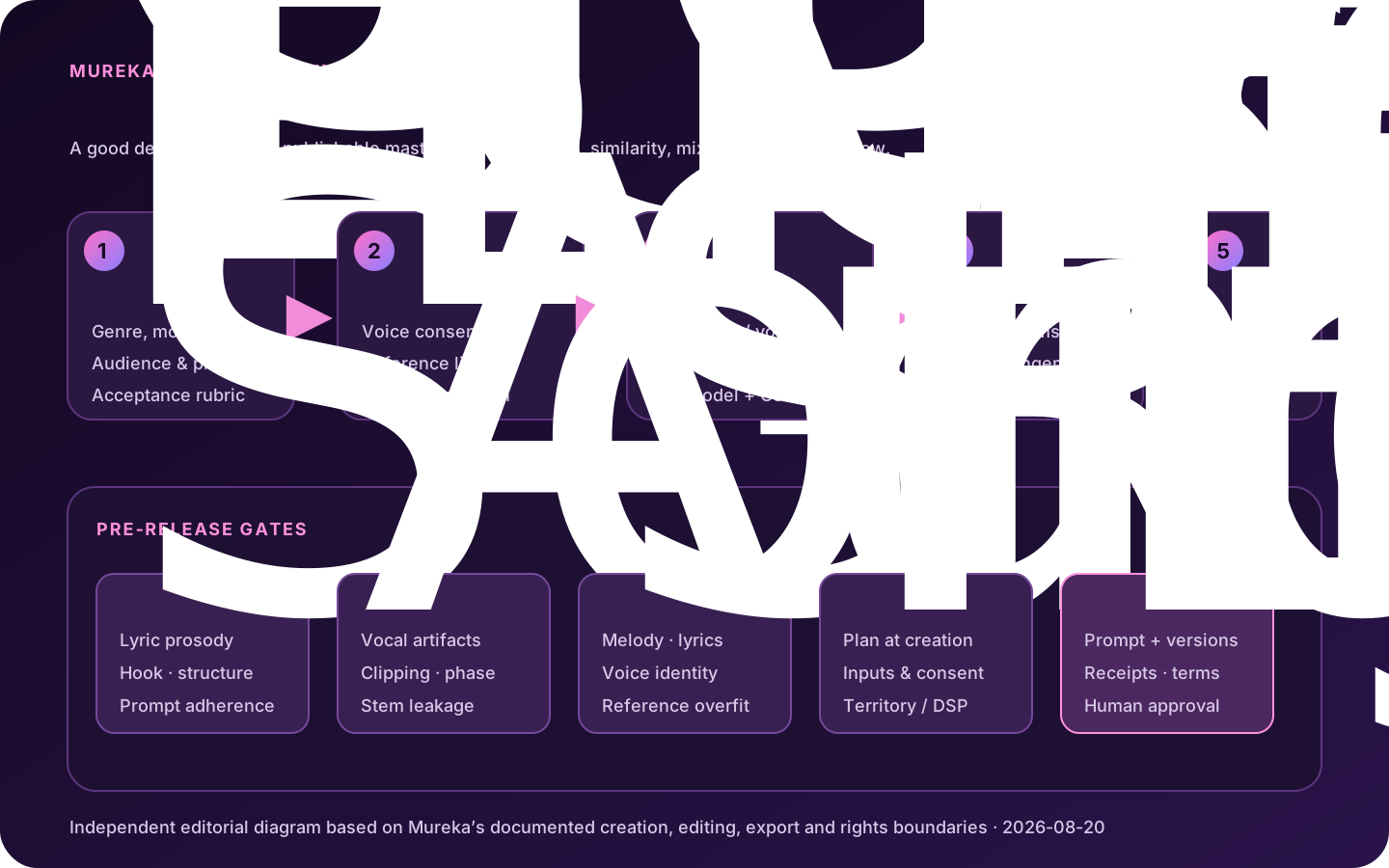
Generate a small matrix rather than repeated random variations. Hold lyrics and structure constant while testing two arrangements; then hold arrangement constant while testing two voices. Record prompt, model, date, credits and output ID. Without this discipline, it is impossible to know which instruction improved the result.
Plans and credit economics
The current pricing page displays annual-billing-equivalent monthly prices: Basic $9.50 with 1,600 monthly credits and “up to 320 songs”; Pro $14.50 with 4,000 credits and “up to 800 songs”; and Unlimited $34.50 with unlimited generations subject to fair use. Pro lists Suno V5/V5.5, stems, covers, extension, audio-to-MIDI, music video and WAV export. Confirm annual total, renewal interval, taxes and checkout currency before subscribing.
The interface currently shows a 10-credit cost for a music generation, while pricing’s “up to” arithmetic implies about five credits per song. This may reflect different models, number of generated candidates or changed pricing. Treat live pre-generation cost as authoritative and capture it before a batch. “Unlimited” also requires reading fair-use limits, concurrency, queue priority and possible throttling.
| Plan | Published allowance | Best initial fit | Check before purchase |
|---|---|---|---|
| Basic | $9.50/month annual equivalent; 1,600 credits; up to 320 songs | Regular idea and content drafts | Which models/exports are excluded? |
| Pro | $14.50/month annual equivalent; 4,000 credits; up to 800 songs | Stems, WAV and broader production tools | Actual credits for each model and operation |
| Unlimited | $34.50/month annual equivalent; fair-use unlimited generations | High-volume experimentation | Fair-use, concurrency, throttling and commercial terms |
Measure cost per accepted track: subscription and add-on spend divided by outputs that survive musical and rights review. Include discarded generations, stem separation, video creation, editing and human production time. A low generation price can hide a high rejection rate.
Ownership language is not a copyright guarantee
MuseGen’s Terms dated October 24, 2025 say users retain rights to prompts, lyrics, stems, uploads and output songs they create. They also grant MuseGen a worldwide, non-exclusive, royalty-free license to process, store and display user content to provide and improve the service, including collaboration, quality assurance, support and model refinement consistent with the Privacy Policy.
That contractual allocation does not establish that every jurisdiction will recognize copyright in a predominantly machine-generated composition or recording. Human authorship, selection, arrangement and editing matter. Nor does “original” mean no similarity exists: generative systems can produce familiar melodic contours, lyric phrases, voices or production signatures. Keep evidence of human contribution and run similarity review before a meaningful commercial release.
| Rights layer | Question | Evidence to retain |
|---|---|---|
| Prompt/lyrics | Were they written by you or licensed? | Draft history, source notes and contributor agreement |
| Uploaded audio | Do you control composition, master and performer rights? | License, split sheet and recording consent |
| Generated output | What do current plan and model-provider terms grant? | Terms snapshot, plan receipt, model and output ID |
| Voice | Could a listener identify a real performer? | Consent/release or documented non-impersonation review |
| Similarity | Does melody, lyric or recording substantially resemble existing work? | Search report and musical/legal review |
| Distribution | What do distributor and platform policies require? | Disclosure, metadata, licenses and claim history |
Covers, voice and uploaded recordings
A cover involves at least the underlying composition and the new recording. Uploading a commercial song to a transformation tool does not itself grant permission to reproduce, adapt or distribute it. Requirements differ by territory and use; audiovisual synchronization generally raises separate concerns. Obtain professional clearance for releases, advertising, games and client projects.
Do not imitate a recognizable living singer without consent. Describing vocal properties—range, texture, articulation and performance energy—is both more controllable and less misleading than a celebrity name. If a result accidentally resembles a real person, regenerate or obtain clearance rather than relying on an “AI-generated” label.
Musical quality review
| Dimension | Pass condition | Common failure |
|---|---|---|
| Composition | Memorable motif develops across sections | Loop-like repetition without meaningful variation |
| Harmony | Progression supports melody and transition | Unmotivated key shift or unresolved ending |
| Structure | Sections arrive with intentional contrast | Verse and chorus have identical energy |
| Lyrics | Coherent viewpoint, concrete imagery and singable stress | Mixed metaphors, clichés or syllables fighting melody |
| Vocal | Correct words, pronunciation, breath and emotional arc | Garbling, invented phonemes or unnatural vibrato |
| Mix | Lead, bass and transients translate across devices | Pumping, harsh high end or buried vocal |
| Master | No clipping; loudness suits destination without crushing dynamics | Louder preview mistaken for better quality |
| Originality | No material resemblance requiring escalation | Familiar hook, lyric phrase or signature voice |
Stems and MIDI are starting points
Stem separation can contain bleed, phase artifacts and watery transients; test each stem alone and recombined. Audio-to-MIDI may misread chords, ornaments, drums and pitch bends. Quantize selectively, validate tempo and key, and replace unreliable parts with intentional performance. Exporting WAV does not prove lossless upstream generation or professional mastering specifications—inspect the actual file.
Privacy and collaboration
Uploads may include unreleased songs, voices and client material. The Terms’ service-improvement license makes the current Privacy Policy important: verify retention, deletion, training/model-refinement use, subprocessors, region and collaborator access before using confidential content. Use watermarked or shortened test files until the data path is approved.
For teams, assign roles and keep a project ledger showing who supplied lyrics, uploaded audio, selected generations and approved release. The Terms say workspace owners remain responsible for invited collaborators. Remove access when a project ends and export required evidence before account cancellation.
Refund and cancellation reality
The Refund Policy dated April 9, 2026 says subscriptions and digital credits are generally non-refundable once delivered or used, except for legal rights, duplicate charges, billing errors, undelivered services or explicit offers. Cancellation stops future renewal at the end of the current billing period and normally does not prorate the paid period. Test the workflow before consuming a large credit purchase.
A release workflow
- Write the brief and document permitted references.
- Create lyrics separately and fact-check names, claims and translations.
- Generate a controlled comparison matrix and log every output.
- Select on composition before loudness or polish.
- Export stems/WAV and repair arrangement, performance and mix in a DAW.
- Run lyric, voice, melody and source-material rights review.
- Master for the destination and test phone, headphones and speakers.
- Prepare contributor splits, metadata and AI disclosure required by distributor/platform.
- Archive prompt, model, terms snapshot, receipt, files and approvals.
Alternatives
| Option | Best fit | Tradeoff versus MuseGen |
|---|---|---|
| MuseGen | One credit balance across music, stems, MIDI and visual tools | Aggregator terms and live credit mapping require scrutiny |
| Suno | Direct access to the underlying mainstream song workflow | Fewer bundled cross-media tools |
| Udio | Song generation, remixing and iterative section work | Different model behavior, plans and rights terms |
| Stable Audio | Instrumental/audio generation and sound design | Less centered on complete vocal songs |
| AIVA | Instrumental composition and structured creative workflows | Different strengths in vocals and modern song output |
| Human composer + DAW | Distinctive authorship, exact revisions and clear contributor relationships | Higher time and budget, stronger creative accountability |
Frequently asked questions
Can MuseGen create complete songs?
Yes. The current interface advertises full songs with lyrics and vocals, plus instrumental generation.
Do users own their outputs?
The current Terms say users retain rights in their content and outputs, while granting MuseGen a service/improvement license. Copyrightability and third-party clearance remain separate questions.
Can I release the music commercially?
Review the current plan/model terms, all uploaded material, voice and similarity risks, and distributor rules for the specific release.
Are stems and WAV included?
The pricing page currently lists them in Pro and Unlimited, not Basic. Verify the live export screen and file specifications.
Is Unlimited truly unrestricted?
No. The page explicitly says fair use applies. Confirm throttling, concurrency and acceptable-use limits.
What should I test first?
Create four controlled variations of one original brief, then compare acceptance rate, credit cost, stem quality, correction time and rights confidence.
Primary sources
- Official MuseGen homepage and generator
- Official plans and credit allowances
- Official Terms of Service, October 24, 2025
- Official Privacy Policy
- Official Refund Policy, April 9, 2026
- U.S. Copyright Office AI initiative and reports
- DistroKid guidance on cover-song licensing
Last reviewed July 25, 2026. Models, credit costs, features and rights terms can change; save the terms and checkout state that apply when creating a commercial project.