LlamaIndex review: a data-first framework for RAG and document agents
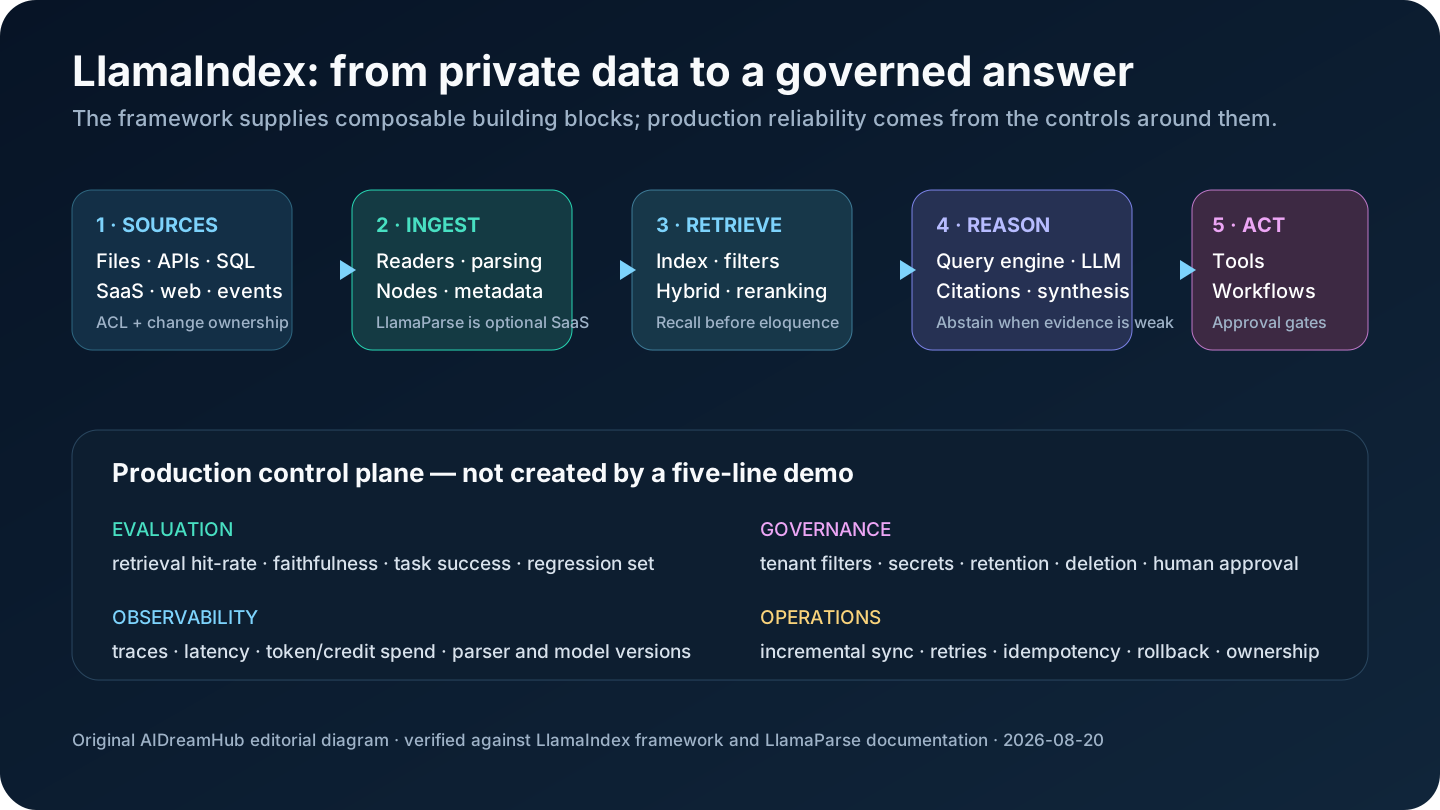
LlamaIndex is an open-source framework for connecting private or domain data to LLM applications. Its centre of gravity is not the chat UI: it is the path from a source document or system of record to nodes, metadata, indexes, retrievers, query engines and tools that an agent can use. The framework supports Python and TypeScript, model and vector-store integrations, event-driven Workflows, evaluation and observability integrations.
The most useful way to judge LlamaIndex is therefore not “can it answer a PDF in five lines?”—many libraries can. The real question is whether your team wants a composable, data-first layer for ingestion and retrieval, and is prepared to own evaluation, permissions, synchronization and operations. LlamaIndex can shorten implementation; it does not make weak data, permissive access or an untested retriever production-ready.
This page distinguishes three related products that are often conflated: LlamaIndex OSS is the MIT-licensed framework; Workflows is the event-driven orchestration model used for multi-step and agentic applications; and the hosted LlamaParse/LlamaCloud platform is a separate commercial service for parsing, extraction, classification, splitting and managed indexing. You can use the framework without buying the hosted service.
What the product is in 2026
| Layer | What LlamaIndex provides | What the application team must decide |
|---|---|---|
| Open-source framework | LlamaIndex OSS; Python and TypeScript | Application code, data transformations, retrieval and agent tools remain under your control |
| Current maintenance | llama-index-core v0.14.24 released 19 Aug 2026 | Active releases are a positive signal, but modular integration packages can move at different versions |
| License | MIT for the main repository | Check every integration, model, parser and database separately |
| Managed document layer | LlamaParse platform / LlamaCloud dashboard | Optional paid service; document data crosses a vendor boundary unless an enterprise deployment is arranged |
| Commercial pricing snapshot | $0 with 10K credits; Starter $50/month with 40K credits | Pricing and credit consumption vary by operation and can change; verify before procurement |
| Best-fit job | Document-heavy RAG and agents over private data | Strongest when retrieval and document structure are first-class design concerns |
The stack, component by component
| Layer | What LlamaIndex provides | What the application team must decide |
|---|---|---|
| Readers and connectors | Load files, APIs, databases and SaaS sources into Document objects | Authorization, rate limits, source deletion and incremental sync |
| Parsing and transformations | Split documents into Nodes, attach metadata and transform content | Chunk boundaries, table/image fidelity, OCR quality and versioned transformations |
| Indexes and storage | VectorStoreIndex and integrations with vector, document, graph and index stores | Tenant isolation, encryption, backup, schema evolution and database cost |
| Retrievers and post-processors | Semantic, keyword, hybrid, metadata-filtered retrieval and reranking options | Recall targets, filter correctness, reranker latency and failure fallback |
| Query/chat engines | Retrieve context and synthesize answers with chosen LLMs | Citation design, refusal policy, prompt-injection handling and model spend |
| Agents and tools | Expose query engines, functions, APIs and MCP tools to an LLM | Least privilege, side-effect approvals, tool timeouts and audit logs |
| Workflows | Event-driven multi-step orchestration, including agents, tools and data sources | Durability, idempotency, state storage, retries and operator recovery |
| Evaluation/observability | Faithfulness, answer/context relevance, retrieval metrics and integrations | Representative datasets, release gates, trace retention and human review |
Where LlamaIndex is a strong fit—and where it is not
LlamaIndex is a strong candidate for enterprise search, support assistants, technical-document Q&A, due-diligence research, contract or invoice extraction, research copilots and document agents that combine retrieval with bounded actions. It is especially useful when engineers need to swap embedding models, vector stores, rerankers or parsers without redesigning the whole application.
It is less compelling for a simple chatbot over a handful of stable pages, a product whose main challenge is a complex transactional agent rather than data retrieval, or a team that wants a fully managed answer product with no infrastructure ownership. A direct model SDK plus database can be clearer for small systems; LangGraph or another runtime may be a better primary orchestrator for long-running, stateful business processes; a managed search platform can be easier when procurement values an end-to-end SLA over framework flexibility.
Our editorial view: choose LlamaIndex when retrieval quality is a product capability you intend to engineer. Do not choose it merely because a tutorial creates a VectorStoreIndex quickly. The abstraction pays off only if the team measures what enters the index, what is retrieved and why an answer is allowed to act.
A production RAG and agent workflow
- Define an answer contract: permitted sources, required citations, freshness target, users, tenants and questions the system must refuse.
- Build an evaluation set before optimizing: include common questions, rare facts, conflicting documents, access-control tests, stale content and deliberately unanswerable requests.
- Ingest with stable source IDs and document versions. Record the source ACL, canonical URI, modified time, parser version and content hash on every Node.
- Start with a small baseline—one embedding model, one vector store and transparent top-k retrieval. Measure retrieval hit-rate and MRR before adding query rewriting, hybrid search or reranking.
- Synthesize answers only from permitted retrieved evidence. Return citations and an explicit no-answer state; do not make the model improvise when coverage is weak.
- If an agent can call tools, separate read tools from side-effecting tools. Validate arguments server-side and require human approval for money movement, messages, deletion or sensitive exports.
- Trace parser, retriever, reranker, model and tool versions. Gate every change on retrieval, faithfulness, latency, cost and authorization regressions; keep a rollback path.
Production readiness: the checks demos omit
| Risk | Test or control | Why it matters |
|---|---|---|
| Retrieval miss | Hit-rate/MRR on labelled queries; inspect false negatives | A fluent model cannot cite a passage the retriever never returned |
| Hallucination | Faithfulness and citation-entailment checks plus human sampling | LLM-as-judge scores are signals, not proof |
| Cross-tenant leak | Mandatory metadata filters tested with adversarial identities | Filtering after generation is too late |
| Stale index | Change feed, reconciliation job, deletion test and freshness SLO | A successful initial crawl says nothing about tomorrow |
| Prompt injection | Treat retrieved text as untrusted data; isolate tool policy from prompts | Documents can contain instructions designed to redirect an agent |
| Cost spike | Budgets for parsing, embedding, reranking, LLM tokens and retries | Open-source framework cost is not zero operating cost |
| Dependency drift | Pin core and integration packages; canary upgrades and read release notes | The modular ecosystem releases packages independently |
| Workflow failure | Idempotency keys, bounded retries, durable state and operator resume | A notebook loop is not a recoverable business process |
Privacy, hosting and cost boundaries
With LlamaIndex OSS, data location depends on the services you configure. Local parsing, embeddings, vector storage and models can keep content inside your environment; an OpenAI embedding endpoint, hosted vector database or telemetry integration creates additional processors. The framework does not automatically make the stack private. Build a data-flow inventory for every reader, model, store, callback and trace exporter.
The hosted LlamaParse platform is a distinct decision. Its pricing FAQ states that SaaS data is encrypted in transit and at rest, cached data is retained for 48 hours by default, caching can be disabled, and enterprise private-VPC deployment is available. It also lists SOC 2 Type II, GDPR and HIPAA claims. These are vendor statements, not a substitute for reviewing the DPA, region, sub-processors, deletion behaviour, logs, backups and your own regulatory duties.
Cost has at least five meters: document parsing, embeddings, vector storage/search, reranking and generation/tool calls. Add re-indexing, evaluation runs and observability retention. The pricing page equates 1,000 hosted-platform credits to $1.25 at review time, but different operations consume different credits. Run a representative document mix—scanned PDFs, tables, slides and clean text—before forecasting unit economics.
LlamaIndex alternatives: choose the centre of gravity
| Option | Choose it when | Trade-off versus LlamaIndex |
|---|---|---|
| LangChain + LangGraph | Broad agent/tool ecosystem and durable graph-style orchestration are primary | Retrieval is available, but LlamaIndex offers a more data/index-centred vocabulary and document workflow |
| Haystack | Explicit serializable component pipelines and production search/RAG are the desired mental model | Pipeline structure is clear; LlamaIndex has a particularly broad context-augmentation and query-engine surface |
| Microsoft Semantic Kernel | .NET, C# or Java alignment and Microsoft-centric enterprise integration dominate | Better language/org fit for some enterprises; document ingestion and RAG may need more separate choices |
| Direct model + vector DB SDKs | The system is small, stable and the team wants minimal abstraction | Less framework churn and hidden behaviour, but you own connectors, chunking, evaluation and orchestration |
| LlamaParse without LlamaIndex | The job is document OCR/extraction feeding an existing stack | Use the managed parser independently; do not add the full framework solely for brand consistency |
Independent verdict
LlamaIndex's distinctive strength is the continuity from ingestion metadata to retrieval, synthesis and document-aware tools. That continuity makes it easier to diagnose “the answer is wrong” as a set of testable stages instead of one model problem. The current project is actively maintained, and the modular packages reduce the need to install every provider integration.
The same modularity creates its main maintenance cost: examples can age, package versions diverge, defaults can change and a prototype can hide several external services. Production teams should pin dependencies, own a small set of explicit components and resist importing a new abstraction until an evaluation shows a benefit.
Bottom line: LlamaIndex is one of the best fits for engineers building document-heavy RAG or data-aware agents who want control over retrieval. It is not an accuracy guarantee, a vector database, an access-control system or a finished SaaS chatbot. Its value rises with disciplined evaluation; without that discipline, it can simply help a team produce a more elaborate untested demo.
FAQ
Is LlamaIndex free and open source?
The main LlamaIndex repository is MIT-licensed. Model APIs, vector databases, hosting and the commercial LlamaParse/LlamaCloud platform can charge separately. Check the license of each integration and the current hosted pricing.
Do I need LlamaCloud or LlamaParse to use LlamaIndex?
No. The open-source framework can ingest, index and retrieve with local or third-party components. LlamaParse is optional when managed document parsing, extraction or indexing is worth the vendor and credit cost.
Is LlamaIndex only for RAG?
No. It includes agents, tools, Workflows, structured extraction, multimodal components and evaluation integrations. RAG remains its clearest differentiator because data ingestion and retrieval are first-class concepts.
LlamaIndex or LangChain—which should I choose?
Choose by centre of gravity. LlamaIndex fits document-heavy retrieval and context augmentation; LangChain/LangGraph often fits broad tool orchestration and durable graph workflows. A hybrid—LlamaIndex retriever exposed as a tool to another runtime—is valid.
Can LlamaIndex run fully on-premises?
The open-source code can be deployed in your environment, but full on-premises operation requires local choices for models, embeddings, parsing, storage and telemetry. The hosted LlamaParse product is a separate boundary; enterprise deployment options require vendor confirmation.
Does LlamaIndex prevent hallucinations?
No. It can return source nodes and provides evaluation modules, but the application must measure retrieval, require citations, define abstention behaviour and test unsupported answers. LLM-based evaluators also need calibration and human review.
Sources reviewed
- Framework documentation
- LlamaParse platform quickstart
- Evaluation documentation
- Official GitHub repository
- GitHub releases
- LlamaParse pricing and data-handling FAQ
- LangChain product concepts
- Haystack documentation
- Microsoft Semantic Kernel
Last independently reviewed 20 August 2026. Versions, prices, credits and vendor security claims can change; verify primary documentation before deployment or procurement.