About AgentScope
Agent-Oriented Programming for Building LLM Applications, Open-sourced by Alibaba
Key Features
- Powerful AI technology
- User-friendly interface
- Efficient workflow integration
- Continuous updates and improvements
Use Cases
AgentScope is an excellent tool in the AI Agent category, suitable for all users who need AI assistance.
How to evaluate this developer tool
AgentScope should be evaluated against a real user job rather than a polished demonstration. Use it when its supported runtime, model providers, deployment surface, and permission model match the way your team already builds and reviews software. A good demo is not enough: test it against a real repository, data set, or production-like workload.
Checks that create useful evidence
- Confirm the current repository, license, maintenance status, release cadence, supported platforms, and whether the listed website is still the canonical project.
- Test installation from a clean environment and record required runtimes, GPU or memory needs, API keys, network access, and services started in the background.
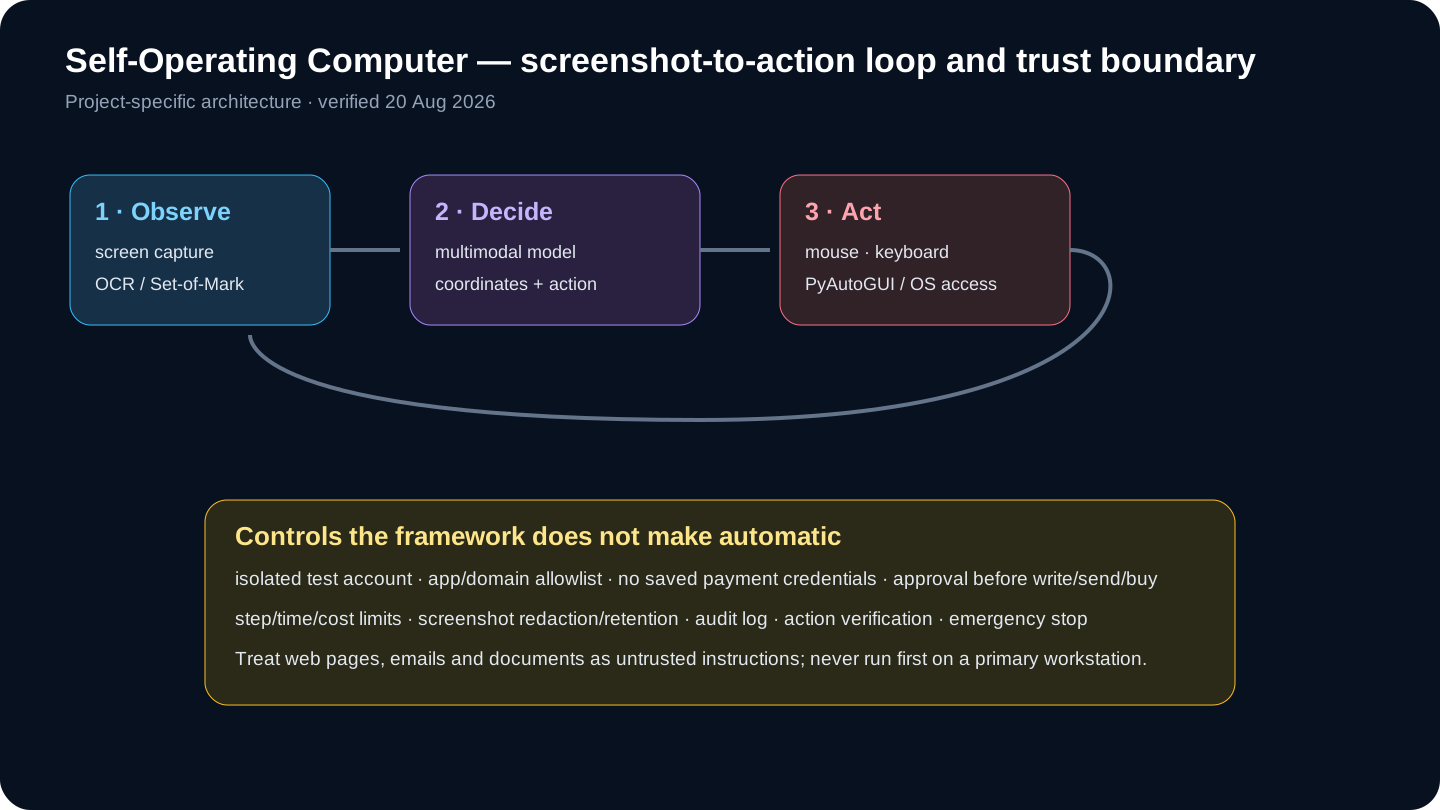
- Inspect what code, prompts, files, telemetry, and secrets leave the machine. For agents, check approval boundaries before shell commands, edits, browser actions, or external messages.
- Measure task success, latency, token or infrastructure cost, failure recovery, logs, reproducibility, and the amount of human review still required.
Recommended trial workflow
Start with one bounded task and a disposable branch or sandbox. Capture the input, configuration, model/version, output, tests, and failure mode. Expand to team use only after the result is repeatable and the permission, audit, and rollback paths are understood.
Important limitations
Open-source availability does not guarantee active maintenance, secure defaults, stable APIs, or production support. Hosted versions may collect different data than self-hosted versions. Model quality, provider limits, and dependency updates can change results without a visible change to the tool's interface.
How to compare alternatives
Compare at least one simpler library or deterministic workflow, one adjacent open-source project, and one managed service. The best alternative is the option that meets the same task with less operational burden—not merely the product with the closest marketing category.
FAQ
Is this ready for production use?
Treat production readiness as a property of the exact version and deployment, not the project name. Verify maintenance, tests, security controls, observability, failure recovery, upgrade policy, and performance on your own workload.
What should a proof of concept measure?
Measure successful task completion, human correction time, latency, total model or infrastructure cost, data exposure, failure rate, and whether another engineer can reproduce the result from the recorded configuration.
When is a simpler tool better?
Prefer a smaller library or deterministic workflow when the task is stable, errors are expensive, permissions are broad, or the team cannot operate another model-serving or agent layer.
Source and freshness note
This evaluation framework was reviewed on 25 July 2026. The link below is the website currently stored for this listing; it may be an official product page, repository, app-store entry, regional page, or third-party service. Confirm ownership and current terms before signing in, paying, installing software, or uploading data.
AgentScope's current product shape
AgentScope describes itself as a production-oriented framework for building agents around modern models' native reasoning and tool use. Its current Python stack includes a built-in ReAct agent, tools and skills, memory, planning, human-in-the-loop steering, evaluation, model fine-tuning, realtime voice, MCP and A2A support, and a message hub for multi-agent workflows. A Java implementation is also under active development.
The framework is a better fit for teams that want these pieces under one open-source abstraction than for teams that only need a single model call. Before adoption, build one tool-using agent and verify cancellation, timeouts, tool schemas, memory boundaries, human takeover, tracing, model-provider switching, and failure recovery.
Important distinction: framework support for human steering or observability does not make an agent safe by default. Permission boundaries, secret handling, sandboxing, prompt-injection resistance, and production monitoring remain application responsibilities.
Current sources