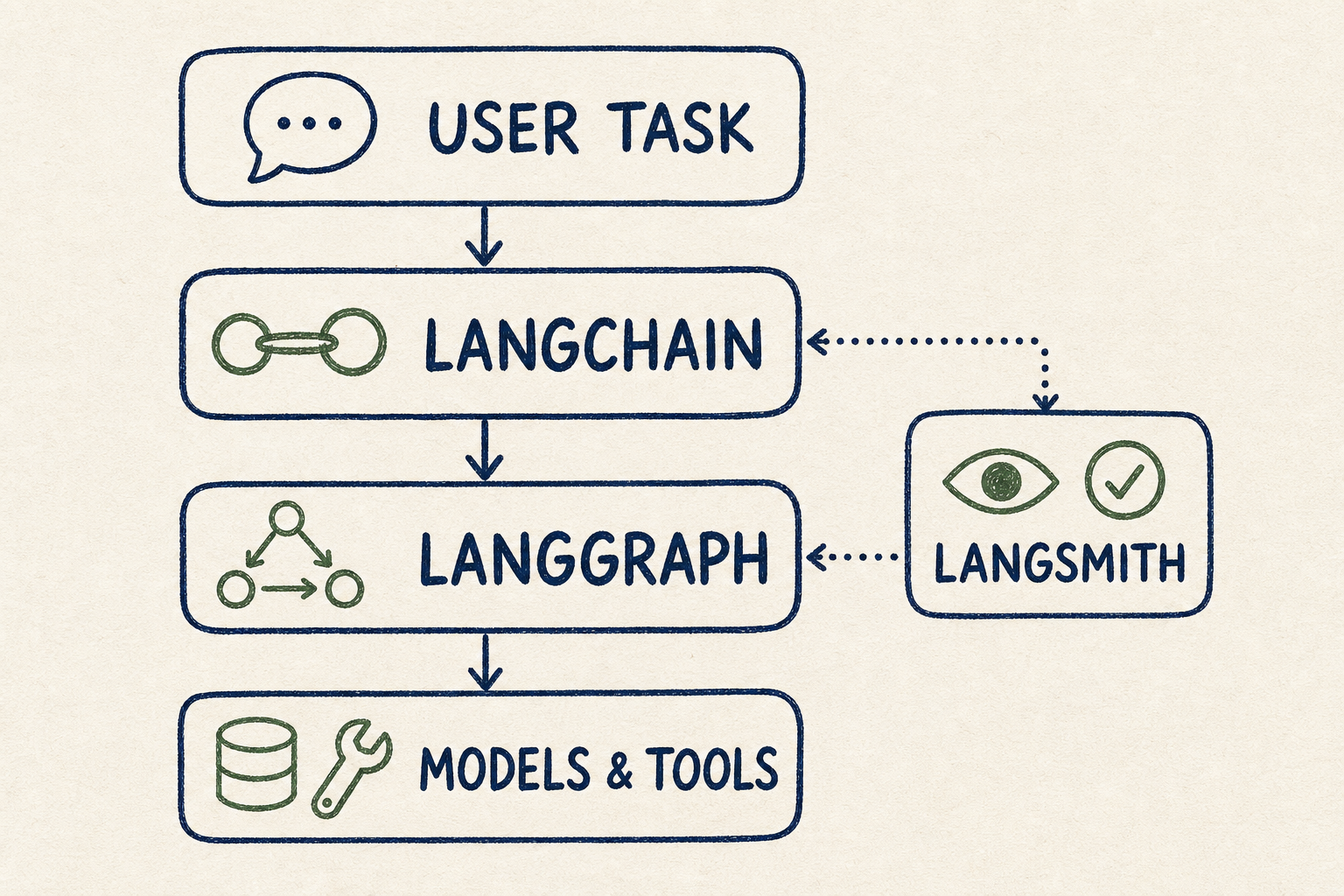
LangChain is an open-source framework for building applications that let language models call tools, retrieve context, maintain state, and complete multi-step tasks. It is best understood as one layer in a larger ecosystem: LangChain provides a high-level agent interface and integrations, LangGraph provides lower-level stateful orchestration, and LangSmith provides tracing, evaluation, testing, monitoring, and deployment services. This distinction matters because many teams adopt “LangChain” when they actually need only a model SDK, or they expect the high-level package to solve workflow reliability that belongs in LangGraph and their own application architecture.
The practical question is not whether LangChain is popular. It is whether its abstractions reduce the amount of integration and orchestration code your team owns without hiding behavior you need to debug. A useful evaluation should therefore begin with a real task, representative tools and failure cases—not a one-prompt demo.
What LangChain does—and what it does not do
Current LangChain documentation presents the framework as the quick-start path for agents. It standardizes common operations such as selecting a chat model, defining tools, creating an agent loop, shaping messages, adding middleware, and connecting provider or data integrations. The framework can save meaningful engineering time when an application needs to switch providers, combine several tools, or add cross-cutting controls such as dynamic prompts, tool filtering, retries, summarization, or human approval.
LangChain does not make a model accurate, secure, or autonomous by itself. It also does not remove the need to design permissions, validate tool arguments, constrain data access, handle partial failures, evaluate outputs, or monitor cost. Its default agent abstraction is a starting architecture. Production behavior still comes from the models, prompts, tools, middleware, state model, and policies selected by the application team.
Core capabilities worth testing
- Model abstraction: use a consistent interface across supported providers, while accounting for provider-specific features and message semantics.
- Tool calling: expose typed functions or external services to the model and return results to the agent loop.
- Middleware: intercept requests and responses to add policy, logging, redaction, retries, model routing, context management, or human review.
- Structured output: request data that conforms to an application schema instead of parsing free-form prose.
- Retrieval integrations: connect document loaders, embeddings, vector stores, and retrievers, while retaining responsibility for indexing and access control.
- Streaming: surface tokens, state updates, or intermediate events so a user is not left waiting on a long agent run.
LangChain vs LangGraph vs LangSmith
The three products overlap in examples, but they solve different problems. Start at the highest level that gives enough control; moving immediately to a graph can create unnecessary state-management work, while staying in a simple agent loop can make branching and recovery difficult.
| Layer | Primary job | Use it when | Do not assume |
|---|---|---|---|
| LangChain | High-level agents, models, tools, middleware, and integrations | You want to assemble a tool-using agent quickly and customize its behavior through supported extension points | That a prebuilt agent loop automatically provides application-specific safety or reliability |
| LangGraph | Stateful orchestration and durable execution | You need explicit nodes, transitions, branches, checkpoints, interrupts, resumability, or human-in-the-loop control | That every chatbot or retrieval flow benefits from a graph |
| LangSmith | Tracing, datasets, evaluation, monitoring, and deployment tooling | A team needs shared visibility into runs, regression tests, online evaluations, and production operations | That the commercial platform is required to use the open-source frameworks |
A customer-support assistant illustrates the split. LangChain can define tools for account lookup, order status, and refund-policy retrieval. LangGraph can encode the rule that a refund above a threshold pauses for human approval and resumes after a reviewer responds. LangSmith can capture traces, compare prompt versions on a test dataset, and monitor failure or latency patterns. Your application must still authenticate the customer, enforce the refund limit on the server, and prevent one account from reading another account’s data.
When LangChain is a good fit
LangChain is usually a strong candidate when the application needs multiple provider or tool integrations, the team expects the agent architecture to evolve, and engineers value a common interface more than minimal dependency count. Typical examples include research assistants that search several sources, operations copilots that read and update business systems, document agents that combine retrieval with structured extraction, and internal developer tools that need approval gates.
It is less compelling for a single model call with a fixed prompt and a stable JSON response. In that case, the provider SDK plus a small validation layer may be easier to understand and maintain. It may also be the wrong default for latency-sensitive paths where every abstraction and callback must be measured, or for a team that wants to own a small, purpose-built state machine rather than adopt a fast-moving framework ecosystem.
Alternative frameworks and where they differ
No comparison table can select a framework without a workload. The useful differences are control model, data focus, multi-agent assumptions, typing, observability, and how much architecture the framework imposes. The following is a decision aid, not a permanent feature matrix; verify current documentation before adoption.
| Option | Design center | Potential advantage | Choose carefully when |
|---|---|---|---|
| LangChain + LangGraph | Broad agent integrations plus explicit stateful orchestration | Large ecosystem and a path from quick agent prototypes to controlled workflows | You want a very small dependency surface or dislike rapidly changing abstractions |
| LlamaIndex | Context-augmented applications, data connectors, indexing, retrieval, and agents | Strong fit when the core problem is turning private data into reliable model context | The workload is primarily general tool orchestration rather than data and retrieval |
| Microsoft AutoGen | Conversational and event-driven multi-agent applications | Useful concepts and components for agents that communicate or collaborate | A single controlled workflow would be simpler than a multi-agent design |
| CrewAI | Role-based crews and flows | Accessible mental model for dividing a business process among specialized agents | Role-play abstractions obscure permissions, state transitions, or error ownership |
| Pydantic AI | Python agents with typed dependencies, outputs, validation, and model portability | Attractive to teams already centered on Python typing and Pydantic models | You need LangChain’s particular integration ecosystem or LangGraph execution model |
| Provider SDK only | Direct use of a model API | Lowest conceptual overhead for narrow, stable use cases | You are rebuilding tool routing, state, retries, observability, and evaluations repeatedly |
A production-oriented implementation path
- Define a bounded outcome. “Answer account questions using approved records” is testable; “act as an autonomous employee” is not. Specify allowed inputs, outputs, tools, users, and stop conditions.
- Build the smallest vertical slice. Connect one model and one or two tools using the high-level LangChain agent interface. Keep side effects disabled or routed to a sandbox.
- Create an evaluation set early. Include normal requests, ambiguous requests, missing data, conflicting instructions, malicious retrieved text, tool errors, and requests the agent must refuse or escalate.
- Add typed tool contracts. Validate every argument on the server. Use narrow operations such as get_order_status instead of exposing a general database or shell tool.
- Introduce middleware deliberately. Add authentication context, secret redaction, model routing, context limits, retries, and approval requirements as visible policies—not scattered prompt text.
- Move to LangGraph only when the flow needs it. Explicitly model branching, retries, checkpoints, or resumable human review. A graph should clarify lifecycle and ownership.
- Trace and compare runs. Whether you choose LangSmith or another observability stack, capture prompt/model versions, tool calls, latency, token use, errors, and final outcome without logging sensitive content indiscriminately.
- Release behind limits. Start with restricted users, read-only tools, rate and spend limits, short execution budgets, and a kill switch. Expand permissions only after reviewing real failures.
Security and reliability checklist
Agents combine probabilistic model output with deterministic systems, so the security boundary must sit outside the model. Prompt instructions are not authorization. Retrieval content and tool responses can contain hostile instructions, and a correct-looking trace can still represent an unsafe action.
- Least privilege: give each tool only the identity, scope, fields, and operations required for the current user and task.
- Server-side enforcement: re-check authorization, amount limits, resource ownership, and business rules when a tool executes.
- Untrusted context: treat user text, web pages, files, database fields, tool output, and serialized agent state as potentially adversarial.
- Human approval: pause before irreversible, high-value, external, or reputation-sensitive actions. Show the proposed action and relevant evidence.
- Failure budgets: limit iterations, wall-clock time, tokens, tool calls, recursion depth, and spend per run.
- Dependency hygiene: pin packages, monitor security advisories, review transitive dependencies, and test upgrades against the evaluation set.
- Data handling: decide what can be sent to model providers and observability systems; redact secrets and personal data before transmission or logging.
- Idempotency and recovery: make retried side effects safe, record action identifiers, and define how interrupted runs resume or roll back.
How to evaluate LangChain with useful metrics
“The demo worked” is not a metric. Measure the end-to-end task at the same grain users care about. A useful scorecard combines quality, safety, operations, and cost.
| Dimension | Example measure | Why it matters |
|---|---|---|
| Task success | Percentage of test cases completed with correct evidence and action | Captures whether the entire workflow works, not just the final prose |
| Tool accuracy | Correct tool, arguments, sequence, and result interpretation | Finds errors hidden behind fluent responses |
| Safety | Unauthorized-action rate and prompt-injection success rate | Tests boundaries under adversarial input |
| Human effort | Review minutes and escalation rate per completed task | Shows whether automation actually reduces work |
| Reliability | Timeout, retry, duplicate-action, and unrecoverable-run rates | Exposes production failure modes |
| Latency and cost | P50/P95 completion time and total model/tool cost per successful task | Prevents optimizing cheap calls that produce expensive failed workflows |
Practical verdict
LangChain is valuable when its integrations and agent interface let a team reach a testable workflow quickly, and when the team is willing to understand the layers below the abstraction. The strongest adoption path is incremental: begin with LangChain, add LangGraph when state and control justify it, and select LangSmith or another evaluation and observability system based on operational and data requirements.
Do not adopt the whole ecosystem because a tutorial uses it. Build the same representative task with the simplest viable alternative, compare task success, debugging effort, latency, cost, and upgrade burden, then choose. For many teams, LangChain’s real advantage is not fewer lines in the first prototype; it is having established extension points as the agent grows. Its main tradeoff is the learning and maintenance cost of a broad, quickly evolving ecosystem.
Frequently asked questions
Is LangChain free?
The core LangChain and LangGraph frameworks are open source. Model APIs, databases, hosting, and other connected services can have separate costs. LangSmith has its own service plans and usage terms, so evaluate it separately from the framework license.
Do I need LangGraph to use LangChain?
No. Start with the high-level LangChain agent interface when its execution model fits. Use LangGraph directly when you need explicit workflow state, branching, checkpoints, interrupts, durable execution, or more control over how a run resumes.
Do I need LangSmith?
No. The open-source frameworks can be used without LangSmith. You still need tracing, evaluations, error monitoring, and production controls; LangSmith is one integrated option, not the only possible stack.
Is LangChain only for retrieval-augmented generation?
No. Retrieval is one common pattern, but LangChain also supports general tool-using agents, structured outputs, middleware, model routing, and multi-step applications. If retrieval is the dominant problem, compare its data workflow with retrieval-focused alternatives.
Can LangChain prevent prompt injection?
No framework can turn untrusted language into trusted authorization. LangChain middleware and workflow controls can help implement defenses, but the application must enforce permissions, validate tool calls, isolate secrets, require approval for risky actions, and test adversarial cases.
Should a new project follow older LangChain tutorials?
Prefer the current documentation and API reference. The ecosystem has changed substantially, and older examples may use deprecated chains, agents, imports, or package layouts. Pin versions and record the documentation version used by the project.
Primary and supporting sources
- LangChain overview and current agent positioning
- LangGraph overview and orchestration model
- LangSmith documentation
- LangChain middleware documentation
- LangChain ecosystem API reference
- LlamaIndex documentation
- Microsoft AutoGen documentation
- CrewAI documentation
- Pydantic AI documentation
Last reviewed: July 25, 2026. Features, package interfaces, service plans, and pricing can change; verify the linked official documentation before making a production decision.