About
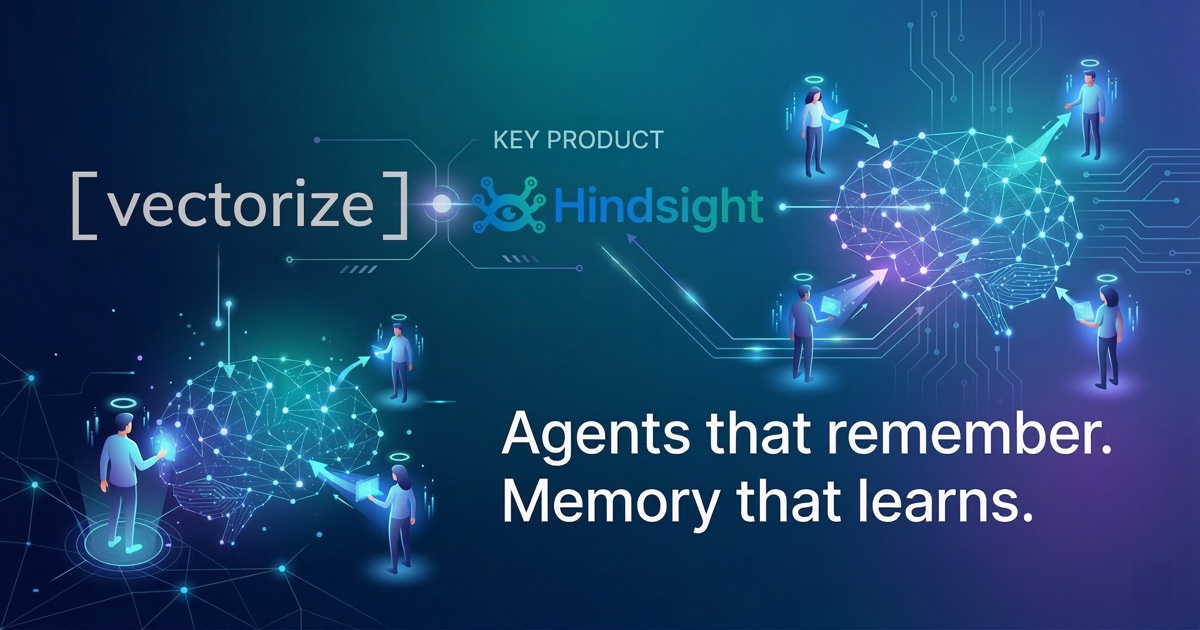
Hindsight treats memory as part of the agent stack instead of a retrieval afterthought. It stores user context, observations, and prior outcomes in a form agents can use later without dragging the full transcript into every prompt.
Why It Is Hot Now
It is getting hotter because more teams are realizing that longer-running agents break on memory before they break on model quality. Hindsight is riding that shift with a benchmark-heavy story, active docs, and a very clear product position.
Key Features
- Keeps per-user memory across sessions instead of resetting context every run.
- Stores experiences and corrections, not just conversation snippets.
- Works with existing agents through wrappers, SDKs, MCP tools, and direct APIs.
Real Use Cases
- Giving coding or support agents durable memory over multi-day workflows.
- Adding structured memory to an existing agent stack without rewriting the whole runtime.
- Capturing user preferences, prior decisions, and failure patterns for repeat tasks.
Community Pulse
Developers like the move away from raw transcript search toward structured memory and reflection. The usual skepticism is healthy: benchmark wins are not enough on their own, and teams still want proof on latency, memory quality, and bad-memory cleanup in production.
Limits and Risks
Hindsight adds another system to operate and tune. Teams still need policies for what gets stored, when memories decay, and how to stop an agent from confidently recalling the wrong thing.
Alternatives
Common alternatives include Mem0, Zep, Letta, Supermemory, and custom vector-store memory layers.
FAQ
- Who should evaluate Hindsight first? Teams building persistent copilots, coding agents, or internal AI operators that need memory beyond one session.
- What should teams validate early? Recall quality, storage policy, correction loops, and the latency cost of adding memory into real workflows.