Grok-1 is the 314-billion-parameter mixture-of-experts base model that xAI released with open weights and example JAX code in March 2024. It is a historical model release for researchers and infrastructure teams, not the current Grok consumer assistant and not the model behind every current xAI API feature. As of June 2026, xAI's current Grok product documentation introduces Grok 4.5, while its product also includes chat, files, voice, connectors, image and video creation, and other services that did not exist in the Grok-1 checkpoint.
This distinction is the most important fact on the page. Downloading Grok-1 gives you a raw pre-training checkpoint that xAI says was not fine-tuned for dialogue or another specific application. It does not recreate grok.com, live X knowledge, current agent tools, Grok Imagine, safety systems, hosting, or the behavior of newer proprietary models.
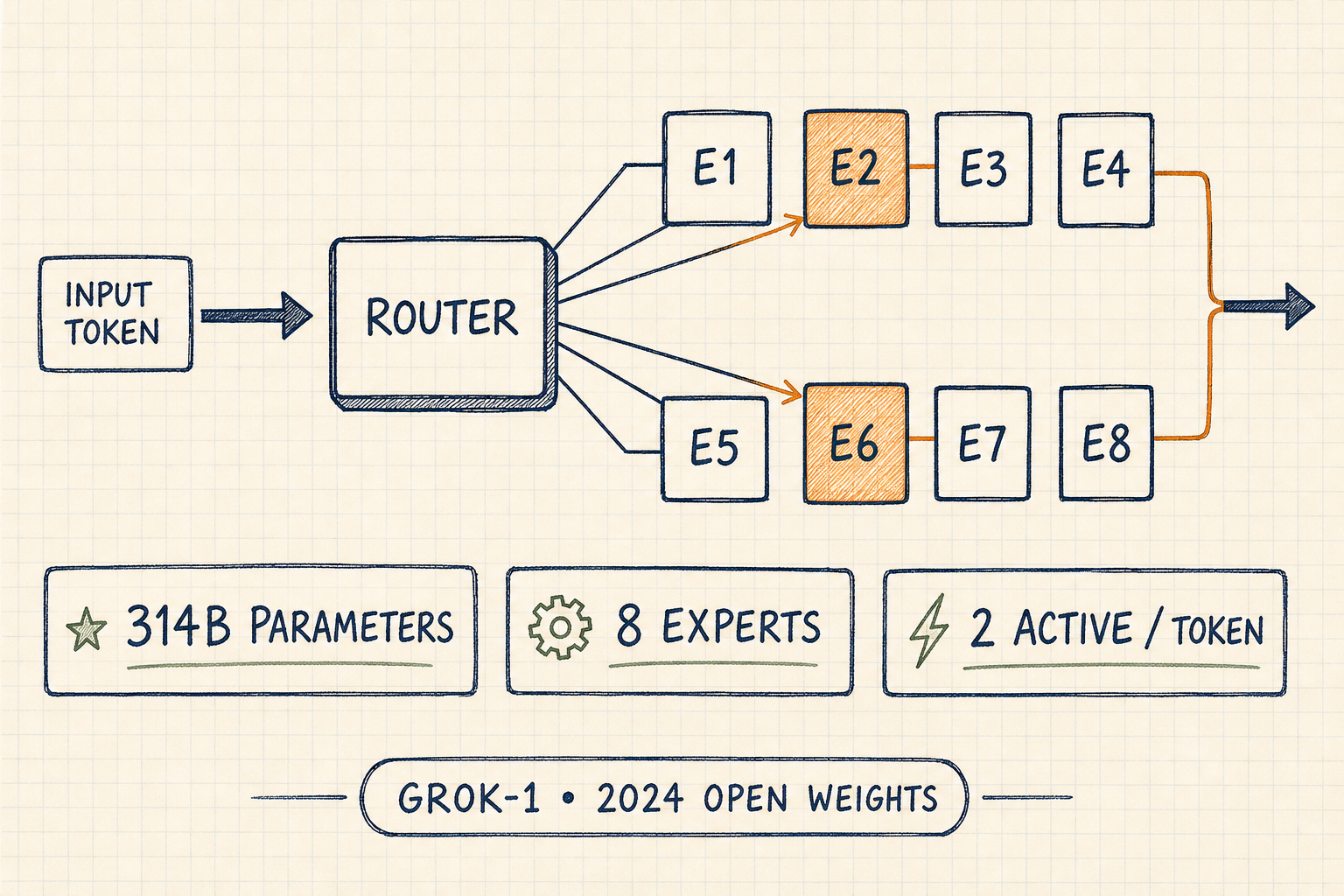
Grok-1 technical specifications
| Specification | Official Grok-1 release | Practical meaning |
|---|---|---|
| Model type | Raw base language model | Requires task adaptation, prompting, evaluation, and safety work before user-facing deployment |
| Total parameters | 314B | Checkpoint storage and memory requirements are far beyond a typical workstation |
| Architecture | Mixture of 8 experts | A router selects a subset of expert feed-forward paths for each token |
| Experts used per token | 2, about 25% of weights active | Active compute is lower than a dense 314B model, but all weights still need an appropriate storage and serving strategy |
| Layers | 64 | Deep transformer stack with substantial distributed inference requirements |
| Attention | 48 query heads, 8 key/value heads | Grouped key/value heads reduce part of the attention memory cost |
| Embedding size | 6,144 | Large hidden representation contributes to model memory and compute |
| Tokenizer | SentencePiece, 131,072-token vocabulary | Applications must use the released tokenizer for compatible token IDs |
| Maximum sequence length | 8,192 tokens | Much shorter than many newer long-context model offerings |
| Reference stack | JAX example code; activation sharding and 8-bit quantization support | The repository demonstrates correctness, not an optimized production server |
| License | Apache License 2.0 for repository source and Grok-1 weights | Review the exact license scope and all third-party dependencies and downstream use obligations |
Open weights does not mean ready-to-run
xAI's repository explicitly warns that the included mixture-of-experts implementation is inefficient and was chosen to validate model correctness without custom kernels. The reference path expects a machine with enough GPU memory for a 314B checkpoint. Even with 8-bit weights, raw weight storage alone is on the order of hundreds of gigabytes before runtime overhead, caches, framework buffers, replication, and redundancy. Lower-bit community conversions can reduce memory but may change accuracy and are not the same artifact as xAI's official checkpoint.
A serious deployment needs a compatible checkpoint format, sharding plan, optimized MoE kernels, accelerator topology, model server, tokenizer service, batching policy, key/value cache strategy, monitoring, and recovery. Measure interconnect traffic as well as individual GPU utilization: expert routing across devices can turn communication into the bottleneck.
Grok-1 versus the current Grok product
| Capability | Grok-1 open-weight checkpoint | Current Grok product/API |
|---|---|---|
| Purpose | Research and self-hosted experimentation with a 2023-era base model | Current assistant and developer services |
| Dialogue behavior | Not instruction- or dialogue-fine-tuned in the released checkpoint | Product-specific post-training, prompts, tools, and safeguards |
| Current information | No built-in live retrieval or X access | May include current search, X context, connectors, or agent tools depending on surface |
| Multimodality | Released as a text base model | Current product documents files, voice, images, video, and Grok Imagine features |
| Operations | You provide hardware, serving, scaling, security, and monitoring | xAI operates the hosted service subject to plans, limits, terms, and availability |
| Model generation | Grok-1 | Newer model families; current docs identify Grok 4.5 |
When Grok-1 still makes sense
- MoE research: inspect a large released mixture-of-experts architecture, routing behavior, sharding, and inference optimization.
- Reproduction studies: compare the official checkpoint and reference implementation with community runtimes or conversions.
- Historical evaluation: study how a prominent 2023 pre-training checkpoint behaves relative to later open models under a controlled benchmark.
- Infrastructure experiments: test distributed loading, quantization, expert placement, and serving systems when suitable hardware already exists.
It is usually a poor default for a new application that simply needs a capable self-hosted assistant. Newer, smaller open models can offer stronger instruction following, longer context, multimodality, easier serving, better tool use, and lower total cost. The relevant comparison is accepted task performance per unit of hardware and engineering effort, not total parameter count.
Deployment decision checklist
- Define the research or product reason. Explain why Grok-1 is required rather than a newer dense or MoE model.
- Estimate the full footprint. Include downloaded checkpoint, converted copies, memory, key/value cache, temporary storage, replicas, and backup.
- Select a serving implementation. Verify that it supports the exact architecture, tokenizer, quantization, expert routing, and target hardware.
- Validate conversion. Compare logits or a fixed evaluation suite against the official reference before trusting a converted checkpoint.
- Add post-training or controls. A raw base model is not a safe chat assistant; define prompting, fine-tuning, moderation, and refusal behavior for the intended use.
- Benchmark end to end. Record load time, tokens per second, time to first token, batch throughput, memory, communication overhead, power, failure rate, and output quality.
- Secure the service. Authenticate requests, isolate model workers, limit input length and concurrency, protect logs, and block untrusted access to management endpoints.
Alternatives to compare
| Alternative path | Why compare it | Decision criterion |
|---|---|---|
| Newer open-weight dense model | Simpler serving and strong instruction-tuned variants | Quality and throughput on the same hardware budget |
| Newer open-weight MoE model | Retains sparse-compute research value with newer capabilities | Kernel support, active parameters, context, license, and ecosystem |
| xAI hosted API | Access to current Grok models without operating a 314B checkpoint | Task success, data terms, regional availability, latency, and cost |
| Other hosted frontier API | Broader provider and governance comparison | Accepted-result cost, tools, context, safety, support, and switching risk |
| Retrieval plus smaller model | A smaller model grounded in approved data can outperform a large base model on a narrow job | Evidence accuracy, latency, maintainability, and total infrastructure cost |
Evaluation metrics
- Task success: percentage of representative tasks accepted after human review.
- Serving efficiency: output tokens per second per accelerator and per watt at useful batch sizes.
- Time to first token: interactive delay after queuing, including routing and prefill.
- Quality after quantization: change in task metrics and failure patterns versus the reference precision.
- Total cost: hardware, power, storage, networking, engineering, downtime, and review per accepted result.
- Safety behavior: harmful completion, data leakage, prompt-injection, and policy failure rates for the intended application.
How to validate a converted or quantized checkpoint
Most teams will not serve the original JAX checkpoint directly. A conversion can reorder tensors, change expert routing, alter tokenizer files, select a different numerical precision, or introduce runtime-specific kernels. Do not validate it by reading one plausible completion. Start with file manifests and hashes, confirm tensor names and shapes, and compare a deterministic set of token IDs and next-token logits against the official reference at selected layers or final output where the toolchain allows it.
Then run a fixed evaluation set at the intended sequence lengths and batch sizes. Compare perplexity or task accuracy, numerical drift, expert selection, repetition, output truncation, language behavior, and failure under long prompts. Record conversion script commit, source checkpoint hash, quantization method, calibration data, runtime version, kernel flags, and hardware. Treat a community file as a separate build artifact with its own provenance—not as interchangeable with xAI's release.
License and governance review
Apache 2.0 is permissive, but it does not answer every deployment question. Preserve required notices, document modifications, and review patent and trademark clauses with the actual distribution model. The repository license applies to the released source and Grok-1 weights; it does not automatically license application data, third-party libraries, community conversions, fine-tuning datasets, generated branding, or content retrieved by a downstream system.
Organizations should also define acceptable-use rules, evaluation ownership, incident response, model-card documentation, and a process for removing unsafe or unauthorized fine-tuning data. If the model is exposed externally, publish the limitations relevant to users: it is an older raw base checkpoint, has no inherent current-data access, may generate inaccurate or harmful text, and depends on application-level safeguards.
Frequently asked questions
Is Grok-1 open source?
xAI released the Grok-1 weights and repository code under Apache 2.0. “Open weights” is the clearer description because the release does not include the full training dataset or training pipeline. Review the repository license for exact scope.
Can Grok-1 run on a normal PC?
Not through the official reference path. The 314B checkpoint requires very large memory and the repository warns that its example MoE implementation is not efficient. Community quantization or offloading may reduce requirements but introduces major performance and fidelity trade-offs.
Is Grok-1 the model used on grok.com today?
No. Grok-1 is a historical released checkpoint. Current xAI documentation identifies newer Grok generations and a much broader hosted product.
Does Grok-1 include real-time X data?
No. The downloaded checkpoint has no automatic connection to X, web search, or current events. Retrieval and data access must be built separately with appropriate permissions.
Is Grok-1 instruction tuned?
xAI describes the release as the raw base model after pre-training, not fine-tuned for dialogue or another specific application.
Should a startup self-host Grok-1?
Only with a clear research or infrastructure reason and suitable hardware. Most product teams should benchmark newer smaller open models and hosted APIs before accepting Grok-1's operational burden.
Official sources
- xAI: Open Release of Grok-1
- Official xai-org/grok-1 repository and model specifications
- Grok-1 Apache 2.0 license text
- Current Grok product overview
- Original Grok and Grok-1 announcement
- Official xAI API cookbook
Last reviewed July 25, 2026. Grok-1 specifications refer to the 2024 open-weight release; current Grok models, product features, plans, and API availability should be verified separately.