Qwen3 is Alibaba Cloud's 2025 generation of open-weight large language models. The official repository covers dense and mixture-of-experts checkpoints from 0.6B to 235B total parameters, hybrid thinking, tool use, multilingual work and self-hosting. It remains useful because the weights, model cards and Apache-2.0 license give developers a reproducible target rather than a moving hosted alias.
However, this page's GitHub URL does not represent the latest Qwen endpoint in August 2026. Qwen3-2507 was the final open update in the original repository. The open successor line has moved through Qwen3-Next and Qwen3.5 to Qwen3.6, including Qwen3.6-27B and Qwen3.6-35B-A3B. Alibaba Cloud Model Studio separately serves proprietary managed IDs such as qwen3.8-max and newer Plus snapshots. Those hosted services are related Qwen products, not aliases for the GitHub Qwen3 checkpoint. The first decision is therefore model identity: historical Qwen3, current open Qwen3.6, or a hosted Model Studio service.
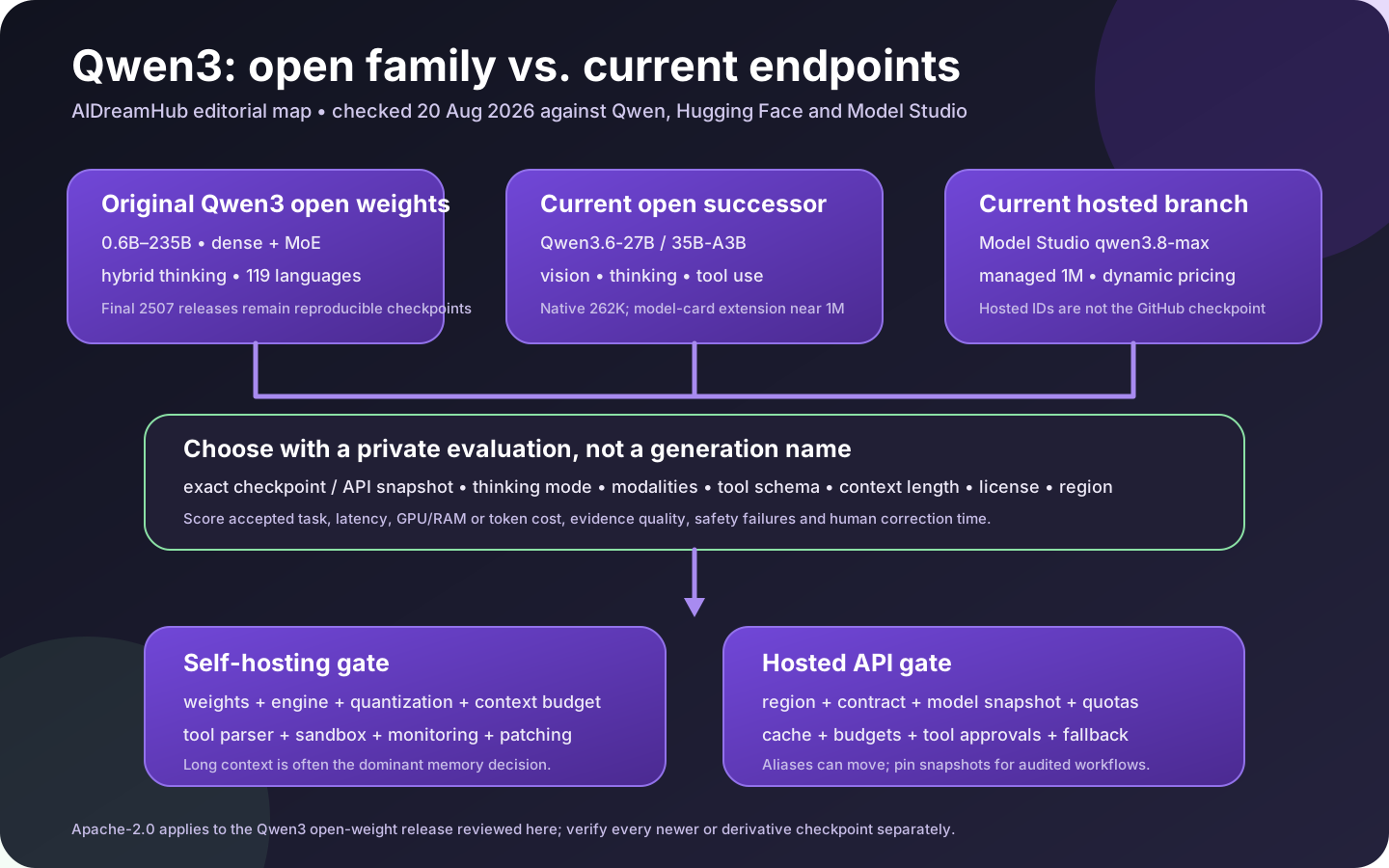
What “Qwen3” means now
| Branch | Representative models | Status in August 2026 | Choose it when |
|---|---|---|---|
| Original Qwen3 | Qwen3 dense 0.6B–32B; MoE 30B-A3B and 235B-A22B; final 2507 Instruct/Thinking updates | Stable open-weight generation; no longer the newest family | You need a known Apache-2.0 checkpoint, existing fine-tune compatibility or smaller sizes. |
| Qwen3-Next / Qwen3.5 | 80B-A3B Next; later dense and MoE successors | Intermediate architecture/release generations | An existing deployment or evaluation specifically targets one checkpoint. |
| Current open Qwen3.6 | Qwen3.6-27B; Qwen3.6-35B-A3B | Current open general/coding branch reviewed here | You want vision, stronger agentic coding, preserved thinking state and current engine support. |
| Model Studio hosted Qwen | qwen3.8-max, current Plus/Flash and dated snapshots | Managed, proprietary, region- and account-dependent | You want a managed API, built-in platform features, large context and no GPU operations. |
This boundary prevents two common errors. First, do not quote Qwen3's 2025 launch benchmark or 32K training context as the specification of a 2026 hosted alias. Second, do not assume a hosted Qwen ID can be downloaded. Open model cards, Model Studio documentation and the Qwen chat product are separate surfaces with different versions, limits, data terms and costs.
Original Qwen3 remains a broad open-weight toolkit
The original family includes dense 0.6B, 1.7B, 4B, 8B, 14B and 32B models plus 30B-A3B and 235B-A22B MoE models. “A3B” and “A22B” describe activated parameters per token, not the storage size: a 30B-A3B checkpoint still carries roughly 30B total parameters. The launch release supported 119 languages and dialects and introduced a soft switch between thinking and non-thinking behavior. Later 2507 checkpoints separated Instruct and Thinking variants and added much longer-context recipes for selected large models.
The Qwen3 repository says all its open-weight models use Apache License 2.0. That is commercially friendly, includes a patent grant and requires preserving license/notices when redistributing covered material. It does not grant rights to training prompts, third-party datasets, user uploads, trademarks or generated content. Verify the exact model repository and any quantization, merge or fine-tune rather than inheriting a license from the family name.
| Selection constraint | Better starting point | Why | Risk to test |
|---|---|---|---|
| Edge or memory-constrained experiment | Original Qwen3 0.6B–4B or a verified quantization | Smaller weights and broad runtime support | Instruction quality, multilingual drop and hallucination may dominate. |
| General local assistant on a workstation/server | Qwen3 8B/14B or current Qwen3.6 after hardware profiling | Balance between capability and operational cost | KV-cache memory, context length and concurrent users. |
| High-throughput MoE | 30B-A3B or Qwen3.6-35B-A3B | Low active parameters can improve decode economics | Total weight memory, expert routing, framework maturity and batch behavior. |
| Current vision/coding agent | Qwen3.6 27B or 35B-A3B | Newer post-training, visual input and agent-focused features | Tool parser, reasoning state, image preprocessing and sandbox safety. |
| No GPU operations | Model Studio snapshot ID | Managed inference, quotas, platform integrations and billing | Region, retention, price tiers, alias movement and provider dependency. |
Qwen3.6 changes the deployment assumptions
Qwen3.6-27B is a dense vision-language model; Qwen3.6-35B-A3B is an MoE model with about three billion active parameters. Their official cards describe a native 262,144-token context and extension to roughly 1.01 million tokens. That extended number is a configuration capability, not a promise that every server or GPU layout can sustain it. The 27B card's reference SGLang command uses tensor parallelism across eight GPUs for 262K context and advises reducing context after out-of-memory errors while retaining at least 128K for thinking quality. Treat that as a reference setup—not a universal minimum or a laptop claim.
Qwen3.6 thinks by default but no longer uses Qwen3's prompt-level /think and /nothink soft switch. Self-hosted frameworks typically receive chat_template_kwargs.enable_thinking; Model Studio uses an API-level enable_thinking parameter. The newer models can preserve prior thinking traces for agent scenarios, which may reduce repeated reasoning and improve cache reuse. Preserve them only when the model card and serving stack agree on the message format; otherwise state can bloat context or break parsers.
Deployment workflow and evaluation
- Freeze identity. Record repository, exact checkpoint revision, tokenizer, license, quantization, chat template and serving-engine version—or the hosted dated snapshot ID.
- Build a private task set. Include Chinese and target languages, retrieval, code changes, tool calls, long documents, refusals, prompt injection and malformed inputs.
- Profile the real context. Start with the shortest window that passes tasks. Measure weight memory, KV cache, prefill, decode, throughput and out-of-memory behavior.
- Test both modes. Compare thinking and non-thinking on accepted-result rate, latency, token volume and tool correctness; do not reward visible verbosity.
- Harden tools. Parse and validate arguments server-side; enforce identity, authorization, budget, sandbox, network and human approval.
- Canary changes. Re-run the frozen suite before updating weights, aliases, engine, prompt, retrieval or quantization.
- Track the denominator. Calculate total cost per accepted outcome, including GPU idle time or API tokens, retries and human correction.
| Metric | Definition | Why it catches hidden failure |
|---|---|---|
| Supported task success | Accepted answers with valid evidence divided by tasks | Penalizes fluent unsupported responses. |
| Tool-call success | Correct tool, schema, authorization, sequence and result handling | Separates reasoning quality from action safety. |
| Long-context recall by position | Correct evidence from early, middle and late input | Tests more than the maximum accepted length. |
| Cost per accepted result | GPU/API, retries and review divided by approved outputs | Prevents a cheap model with costly corrections from winning. |
| Operational stability | OOM, repetition, parser failure, timeout and rollback rate | Finds serving problems hidden by benchmark averages. |
Hosted pricing and the long-context tax
Model Studio's live pricing table, checked August 20, 2026, lists the global qwen3.8-max service with up to one million input tokens at CNY 12 per million input tokens and CNY 36 per million output tokens. Other Max, Plus and regional IDs have different tiers, promotions and free quotas. For example, the documented qwen3.6-plus list price rises when a single request crosses 256K input. Do not copy one Qwen price across regions or models, and do not treat a temporary promotion as durable architecture.
Self-hosting moves the bill from tokens to accelerators, memory, storage, networking, engineering and utilization. A long window grows KV-cache and prefill work even when the weights fit. Quantization reduces memory but may affect accuracy, throughput and kernel support. Compare a hosted snapshot with two local candidates on the same task set; include capacity at peak concurrency, not only single-user tokens per second.
Safety, privacy and production limits
- Prompt injection: retrieved pages, repositories, documents and tool output are untrusted. Separate data from instructions and enforce actions outside the model.
- Code execution: use an isolated checkout/container, bounded credentials, egress policy, tests, reviewed diffs and protected deployment.
- Multilingual safety: test refusal, toxicity and policy behavior in each deployed language; 119-language coverage is not 119-language safety parity.
- Vision inputs: strip unnecessary metadata, control access, scan uploads and test instructions hidden in images or documents.
- Hosted data: review Model Studio's regional endpoint, contract, retention, logging and account controls for the selected deployment; open-weight licensing does not describe hosted data processing.
- Self-host responsibility: operators own authentication, isolation, monitoring, abuse prevention, patching, deletion and incident response.
Qwen versus adjacent open and hosted choices
| Option | Why it belongs on the shortlist | Main trade-off | Decision test |
|---|---|---|---|
| Qwen3 / Qwen3.6 open models | Broad sizes, Apache-2.0 releases, Chinese/multilingual strength, MoE and dense choices, active tooling | Family/version complexity; long context and vision raise serving requirements | Private multilingual, coding and tool tasks on target hardware. |
| DeepSeek V4 | Low hosted prices, open V4 weights and efficient million-token architecture | Much larger full checkpoints and different data/provider boundary | Accepted-result cost for long agents; operational footprint. |
| Meta Llama family | Large deployment ecosystem, many vendors and derivative checkpoints | License is not Apache-2.0; model sizes and capabilities differ | Vendor portability, target-language quality and license review. |
| Google Gemma family | Smaller open models and Google ecosystem tooling | Different license terms, scale choices and multilingual behavior | Quality per GB and per watt for the actual edge/server workload. |
| Managed frontier API | No model-serving operations, managed scaling and current proprietary capability | Price/alias changes, provider lock-in and data governance | Same private tasks, region controls, fallback and total accepted cost. |
Our judgment: Qwen's strongest advantage is deployment optionality. It spans small dense checkpoints, efficient MoE models, current vision/coding open weights and managed Alibaba Cloud services. Its weakness is the same breadth: “Qwen3” is too imprecise for architecture, procurement or reproducibility. Choose the smallest exact checkpoint that clears the private evaluation; use a dated hosted snapshot for governed production; upgrade to Qwen3.6 rather than assuming the 2025 Qwen3 repo is current; and keep Qwen3-2507 when stability, compatibility or a smaller footprint matters more than novelty.
FAQ
Is Qwen3 still current?
It is still maintained as a usable open-weight generation, but it is not the newest Qwen branch. Qwen3-2507 was the final original update; Qwen3.6 is the current open successor reviewed here, while Model Studio hosts newer proprietary IDs.
Is Qwen3 open source?
The official repository calls the Qwen3 weights open-weight and licenses them under Apache 2.0. Verify the exact checkpoint and derivative. “Open source” can overstate access because training data and full training pipeline are not necessarily released.
Which Qwen model should run locally?
Start with the smallest checkpoint that passes your private tasks. Original Qwen3 offers very small through 32B dense options; Qwen3.6 27B/35B-A3B provides newer vision and agent features but needs more current serving infrastructure.
Does Qwen3.6 support one million tokens locally?
The model cards describe native 262K context and extension to about 1.01M. Actual support depends on engine, GPUs, precision, concurrency and memory. Test the required length; do not allocate the maximum by default.
Is qwen3.8-max downloadable?
No. It is a managed Model Studio ID, not the GitHub Qwen3 checkpoint. Use an explicitly published Qwen3.6 or earlier model repository when open weights are required.
Can Qwen use tools and MCP?
Yes, with Qwen-Agent or supported serving engines and parsers. Model-generated arguments still require application-side schema validation, authorization, sandboxing, limits and approval for consequential actions.
Can Apache-2.0 Qwen weights be used commercially?
Apache-2.0 generally permits commercial use subject to its notice and other terms, but verify the exact model and derivative and review data, output, trademark and application obligations separately. This page is not legal advice.
Sources reviewed
- Qwen3 official GitHub repository, release history and Apache-2.0 notice
- Qwen3 launch article: architectures, languages and hybrid thinking
- Qwen3 technical report
- Current Qwen3.5/Qwen3.6 open-model repository and release history
- Qwen3.6-27B official model card and deployment guidance
- Qwen3.6-35B-A3B official model card
- Alibaba Cloud Model Studio qwen3.6-plus capabilities and context limits
- Alibaba Cloud Model Studio live model and pricing table
- Model Studio thinking-mode documentation
Independently reviewed 2026-08-20. Models, snapshots, prices, promotions, context limits, licenses and regional availability change; verify the exact official model card, Model Studio page and active account before deployment.