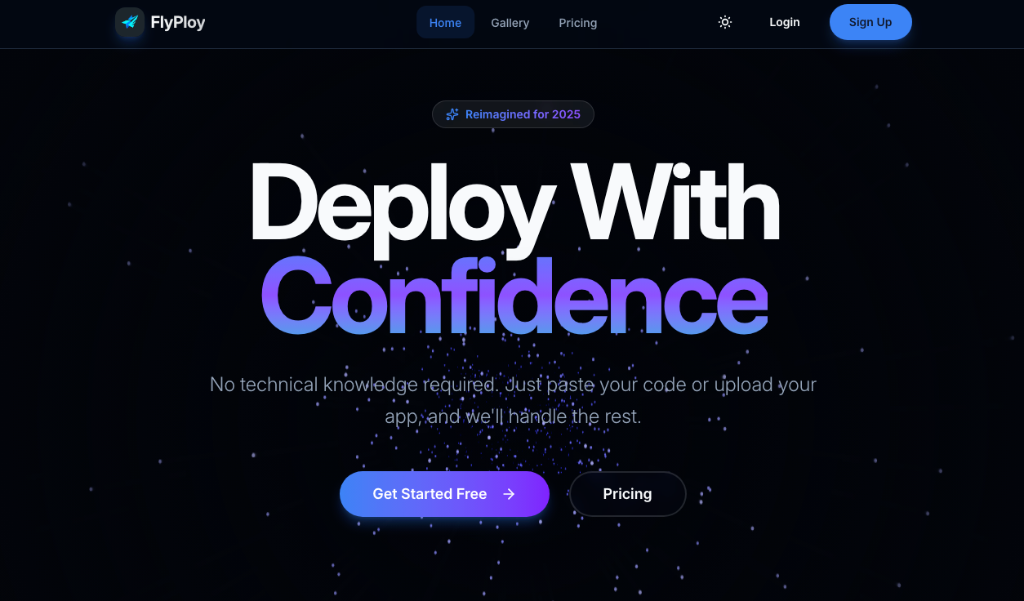
FlyPloy is a young, hosted deployment service at flyploy.com. Its clearest public use case is moving a small web or AI-assisted project from local files to a shareable URL: register, create a project, paste code or upload a ZIP, then deploy. That makes it a light Platform as a Service, not an AI coding model, not Fly.io, and not the unrelated Ploy.ai marketing product. The distinction matters because the buying question is operational trust—build behavior, secrets, logs, rollback, data handling and exit—not model quality.
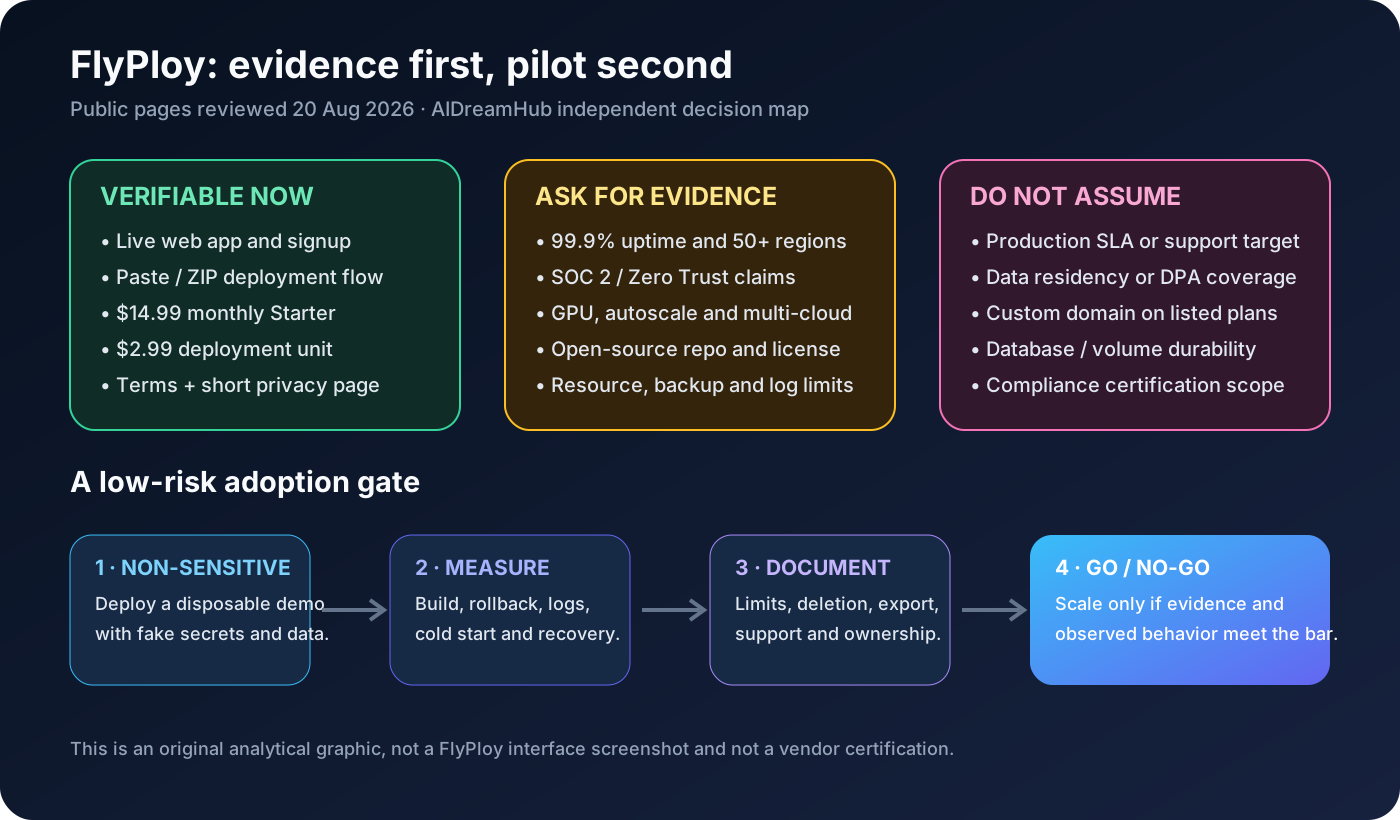
The service was reachable and its English and Chinese marketing, signup, pricing, documentation, privacy and terms pages were inspected on 20 August 2026. The public evidence supports the existence of the workflow and checkout offers. It does not independently substantiate every infrastructure statement on the homepage. Claims such as 10,000+ deployments, 99.9% uptime, 50+ regions, sub-100 ms builds, SOC 2 compliance, distributed GPU clusters, multi-cloud portability and open-source availability are vendor claims unless FlyPloy supplies a status history, certification scope, region list, benchmark method, repository and license. This review therefore separates what a buyer can verify today from what must be proved during procurement.
Entity and product boundary: a light deployment service, not Fly.io
FlyPloy's homepage promotes a four-step upload flow and its founder article describes deploying an exported Google AI Studio project. The getting-started page, however, describes connecting a Git provider and also publishes a shell installer for an allegedly self-hosted mode. Those paths may coexist, but the documentation is too thin to establish feature parity, supported runtimes or the security model. A cautious user should treat paste/ZIP hosting as the verified entry point and ask support to demonstrate repository import or self-hosting before designing a workflow around it.
The footer calls FlyPloy open source, yet no official public repository, source release, version tag or license was found in the linked navigation or targeted search at review time. Open source is a legal and operational property, not a design adjective. Until a repository and license are published, buyers should classify the hosted service as proprietary and should not assume that the installer grants audit, modification, redistribution or self-host continuity rights.
Evidence ledger: verified, claimed and currently unknown
| Topic | Public evidence found | Confidence | Action before production |
|---|---|---|---|
| Basic deployment | Homepage and founder walkthrough describe paste/ZIP upload; signup and dashboard links are live | Moderate: workflow exists, but no independent hands-on benchmark in this review | Deploy a disposable sample and record build, domain, HTTPS, logs and rollback behavior |
| Pricing | Live pricing page lists a seven-day trial, $14.99/month Starter and $2.99 deployment unit | High for displayed price on review date; scope can change | Capture checkout total, tax, renewal and exact unit semantics |
| Availability | Homepage states 99.9% uptime and 50+ regions | Low without public status history, SLA, region list or measurement method | Request status data, incident process, service credits and selected region |
| Security/compliance | Homepage states isolated runtimes, Zero Trust, DDoS protection and SOC 2 compliance | Low without report type, auditor, period, scope, controls or trust center | Request SOC report under NDA, penetration summary, DPA and subprocessor list |
| AI/GPU capability | About page states model hosting, GPU acceleration and an AI API proxy | Low without resource catalog, quotas, model/runtime matrix or technical guide | Run a representative workload and obtain written GPU, scaling and proxy limits |
| Open source/self-host | Footer and getting-started page use those terms and show an install command | Low: no public repository or license located | Do not execute remote installer on a trusted host; obtain source, checksum, license and uninstall docs |
| Data durability | No clear public backup, volume, database, retention or export specification located | Unknown | Test restore/export and contract RPO, RTO, deletion and ownership |
| Support | Starter lists email support; Terms list [email protected] | Moderate for a contact route, unknown response target | Measure response during trial and contract severity targets if production matters |
Current offers and the questions hidden behind the price
| Offer shown 20 Aug 2026 | Displayed price | Published inclusion | Important ambiguity | Best use |
|---|---|---|---|---|
| Free | $0/month | Seven-day trial, one active deployment, temporary app-*.flyploy.com domain, community support, basic analytics | What happens to the deployment and data on day eight; resource and traffic limits | Short non-sensitive evaluation |
| Starter | $14.99/month | Five active projects, flyploy.com subdomains, one million AI tokens/month, email support, analytics and SSL | Token provider/model, compute, bandwidth, build, log and retention limits; custom domain not clearly listed | Small demos after a successful trial |
| Pay As You Go | $2.99 per deployment unit | One deployment per unit, flyploy.com subdomain, SSL and email support | Whether rebuilds, failures, rollbacks or updates consume another unit; runtime duration | Occasional one-off publishing only after unit rules are confirmed |
| Technical consulting | Quote | Custom solution design and architecture consultation | Deliverables, ownership, support, infrastructure fees and acceptance criteria | A scoped service engagement, not a substitute for platform documentation |
Card subscriptions auto-renew monthly or yearly until canceled. The terms say non-card finite access and deployment-unit purchases do not auto-renew unless checkout says otherwise. Digital access and used units are generally non-refundable; duplicate, erroneous, unauthorized or undelivered charges can be reviewed. Prices exclude possible tax and payment-provider fees. Recheck the live checkout because pricing is dynamic and the Starter page does not disclose enough resource metering to estimate production total cost.
A seven-gate evaluation workflow
- Choose a reversible sample. Use a static site or small stateless app with synthetic data, no customer records and no production credentials. Keep source in your own repository.
- Inspect the artifact. Remove hard-coded API keys, confirm dependency licenses, generate a software bill of materials if appropriate, and set strict spending or API quotas outside FlyPloy.
- Test the advertised path. Try paste or ZIP first. Record supported file size, build time, runtime detection, environment-variable handling, domain behavior and errors. Do not infer repository or container support from logos.
- Exercise failure. Ship a broken build, restart the app, rotate a secret, roll back, exceed a safe quota and request logs. Measure what the interface actually exposes.
- Ask the evidence questions. Request architecture, tenancy isolation, subprocessors, locations, encryption, deletion, backups, incident notice, SOC scope, uptime history and support targets. For AI proxying, ask whose key is used, which model creates the token allowance and whether prompts are retained.
- Measure portability. Export code, configuration and data; rebuild on a second host. A deployment platform is safer when exit is tested before dependence grows.
FlyPloy versus established deployment paths
| Option | Public operating model | Strength | Trade-off | Choose when |
|---|---|---|---|---|
| FlyPloy | Guided paste/ZIP light PaaS; vendor also claims Git and self-host paths | Low-friction concept and simple displayed entry prices | Young evidence base; key limits, SLA, compliance proof and portability are undocumented | A disposable demo validates the workflow and simplicity is worth the uncertainty |
| Vercel | Git/CLI deployments, preview environments, functions, CDN and usage-priced infrastructure | Mature documentation, framework workflow, published limits and enterprise controls | Many billing dimensions; free Hobby is personal/non-commercial | Frontend or Next.js workflow needs previews, integrations and documented platform behavior |
| Railway | Service and database deployment with subscription plus metered CPU, RAM, storage and egress | Clear resource model, logs and general-purpose backend experience | Costs follow running resources and require basic operational understanding | A backend, worker or database needs transparent consumption pricing |
| Cloudflare Pages/Workers | Git or direct static assets plus edge functions and published quotas | Strong global delivery and generous static-site path | Workers concepts and product boundaries add learning; not conventional long-running containers | Static/edge architecture fits and the team can work within documented limits |
| Self-managed VPS/container | You operate server, runtime, proxy, backups, patches and monitoring | Control, predictable topology and portability | Highest operational and security burden | Regulation, special runtime or control justifies real DevOps ownership |
Privacy, terms and operational risk
FlyPloy's privacy page, last updated 1 December 2025, says it may collect identity, contact and technical data and use data to perform a contract or for legitimate interests. It does not publicly identify the legal controller, address, contact for privacy requests, retention periods, cookies/analytics in the policy text, international transfer mechanism, specific subprocessors, data residency, deletion procedure or rights workflow. The page itself loads Google Analytics. This is too sparse for sensitive customer or regulated data without a DPA and security review.
The terms, updated 23 June 2026, are more specific about billing and user content. Users keep rights in code, files, prompts and settings while granting FlyPloy the limited rights needed to host, process, deploy, secure and support them. The terms allow suspension for abuse, risk or nonpayment and disclaim warranties and many damages. They do not create a public production SLA, detailed data-return commitment or clear governing-law section in the text reviewed. That shifts continuity risk to the buyer.
- Never paste production API keys into source. Use scoped environment secrets, rotate them after the pilot and cap upstream spend.
- Do not run
curl ... | shon a trusted server until the installer is downloaded, reviewed, checksummed and linked to a license and uninstall path. - Assume a flyploy.com subdomain is temporary until custom-domain support, DNS exit and certificate behavior are demonstrated in your plan.
Pilot scorecard: what should determine the decision
| Metric | How to test | Pass signal |
|---|---|---|
| First valid deployment | Time from clean ZIP to working HTTPS URL | Repeatable result with comprehensible errors, not a single lucky run |
| Secret safety | Inspect browser bundle, logs and configuration after rotation | No secret reaches client assets; old credential stops working |
| Rollback/recovery | Deploy a fault, restore prior artifact and simulate restart | Measured recovery meets workload tolerance and preserves needed data |
| Cost predictability | Map every action and running hour to checkout/bill | A written unit model reconciles with observed charges |
| Observability | Find build/runtime logs, health and usage information | Enough detail to diagnose without emailing support for every incident |
| Support quality | Send one technical, one billing and one privacy question | Accurate answers arrive within the required business window |
| Portability | Rebuild the same project elsewhere from owned artifacts | No proprietary dependency blocks exit |
| Evidence completeness | Review DPA, security, SLA, limits and subprocessor answers | Risk owner can sign off without relying on homepage slogans |
Independent verdict: FlyPloy is worth considering for non-sensitive demos and AI Studio exports when the main goal is getting a shareable link with minimal setup. The live product and low displayed prices make a trial reasonable. It is not yet a defensible default for regulated, stateful or revenue-critical production based only on public evidence. The most important finding is not that the ambitious claims are false; it is that too few of them are auditable. Use the seven-day trial as a procurement test, not merely a usability tour. If FlyPloy can provide architecture, limits, compliance evidence, recovery behavior and predictable unit semantics, its simplicity may be valuable. If not, Vercel, Railway, Cloudflare or a controlled server offer a better-documented risk boundary.
Frequently asked questions
Is FlyPloy the same company as Fly.io?
No. FlyPloy is the service at flyploy.com. Fly.io is a separate infrastructure company with its own Fly Machines, flyctl CLI, pricing and documentation.
Is FlyPloy open source?
Its footer says open source and the getting-started page mentions self-hosting, but no official public repository or license was found during this review. Treat open-source availability as unverified until a repository, version and license are provided.
How much does FlyPloy cost?
On 20 August 2026 the page showed a seven-day Free trial, Starter at $14.99 per month, Pay As You Go at $2.99 per deployment unit and quoted consulting. Confirm taxes, renewal and resource limits at checkout.
Can I deploy a Google AI Studio app?
That is the clearest advertised use case: export the project, paste code or upload a ZIP, then deploy. Test API-key handling with a disposable key before sharing the URL.
Does one deployment unit include future updates?
The page says one deployment per unit but does not publicly define rebuild, failure, rollback or update accounting. Ask support and run a small paid test before relying on the unit price.
Does FlyPloy provide SOC 2 compliance and 99.9% uptime?
The homepage makes those statements, but this review found no public SOC report scope, trust center, SLA or status history. Procurement should request evidence rather than repeat the claim as an independently verified fact.
Is it safe for customer data?
The public privacy notice is too brief to answer that for sensitive data. Obtain a DPA, subprocessor list, locations, encryption, retention, deletion, incident and access-control details first.
Should I use FlyPloy instead of Vercel or Railway?
Use FlyPloy when its upload-first simplicity wins a measured, reversible pilot. Prefer an established alternative when published limits, framework integration, databases, observability, compliance evidence or production support matter more.
What should I deploy first?
A stateless demo with synthetic data, replaceable domain and tightly scoped secrets. Test logs, rollback, deletion, billing and export before increasing impact.
Sources and verification trail
- FlyPloy official home
- FlyPloy official pricing
- FlyPloy getting-started documentation
- FlyPloy official product claims
- FlyPloy privacy policy
- FlyPloy terms of service, updated 23 June 2026
- FlyPloy founder deployment walkthrough
- Vercel official pricing
- Railway official pricing documentation
- Cloudflare Pages official limits
- GitHub official deploy-key security guidance
Independent review completed 20 August 2026. Prices, limits, legal text and product capabilities can change. Verify the live official pages, checkout and written contract before purchase or production use.