DeepSeek is both a consumer AI assistant and a developer platform built around DeepSeek's model families. In August 2026, the current API line is DeepSeek V4: deepseek-v4-flash is the lower-cost, higher-concurrency option, while deepseek-v4-pro is the stronger route for difficult reasoning and agentic work. Both expose a one-million-token context window, thinking and non-thinking modes, tool calls, JSON output, OpenAI-compatible Chat Completions, and an Anthropic-format endpoint.
That current-state distinction matters. Many DeepSeek reviews still describe the 2024 V3 model or the 2025 R1 reasoning release as if they were the models now served by the API. They are historically important—and R1's reinforcement-learning approach helped make visible reasoning mainstream—but they are not interchangeable with V4. DeepSeek's legacy API names deepseek-chat and deepseek-reasoner were scheduled to become inaccessible after July 24, 2026. New integrations should use the explicit V4 model IDs and treat old tutorials as migration material.
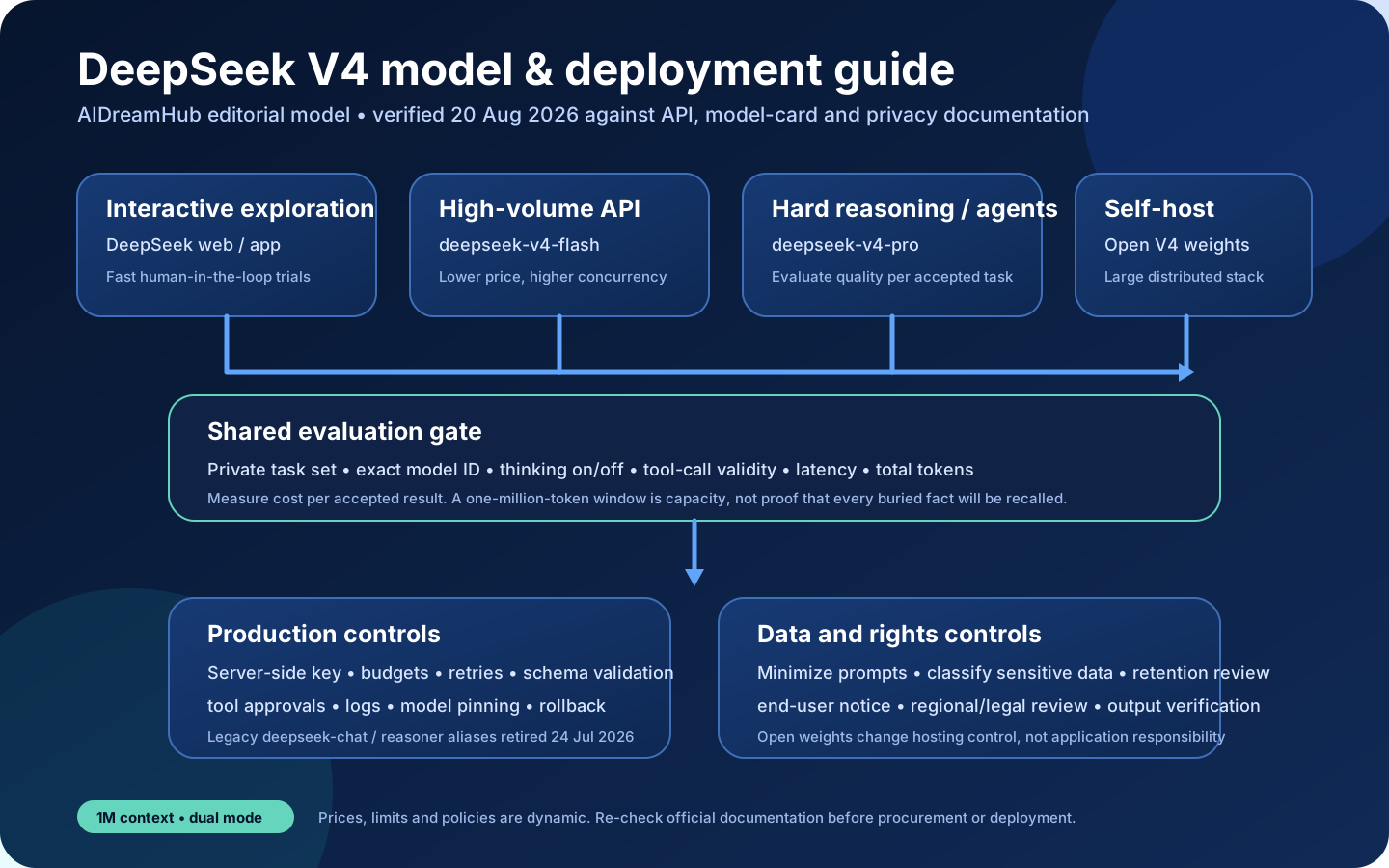
Current V4 model and API snapshot
| Decision | DeepSeek V4 Flash | DeepSeek V4 Pro | Practical reading |
|---|---|---|---|
| API model ID | deepseek-v4-flash | deepseek-v4-pro | Pin the explicit ID; do not depend on retired aliases. |
| Model shape | 284B total / 13B active parameters | 1.6T total / 49B active parameters | These MoE totals do not translate directly into task quality; benchmark the workload. |
| Context / maximum output | 1M / up to 384K | 1M / up to 384K | Capacity is not guaranteed recall. Long inputs still need retrieval and evidence tests. |
| Modes | Thinking and non-thinking; thinking is the API default | Thinking and non-thinking; thinking is the API default | Disable thinking for simple deterministic jobs; evaluate it for difficult planning. |
| Tool and structured output | Tool calls, JSON output, beta strict tool schema | Tool calls, JSON output, beta strict tool schema | Schema conformance is not business-rule correctness; validate every action server-side. |
| Current concurrency limit | 2,500 | 500 | Flash is the natural starting point for throughput; quotas can change. |
The API's OpenAI-compatible base URL remains https://api.deepseek.com; the Anthropic-format endpoint is https://api.deepseek.com/anthropic. Compatibility reduces migration work, but it does not make behavior identical to OpenAI or Anthropic models. Reasoning fields, tool-call traces, token accounting and supported parameters still require provider-specific tests.
Price the accepted result, not the token headline
DeepSeek's live price table, checked on August 20, 2026, lists V4 Flash at $0.0028 per million cache-hit input tokens, $0.14 per million cache-miss input tokens and $0.28 per million output tokens. V4 Pro is listed at $0.003625, $0.435 and $0.87 respectively. These are unusually low published API rates, but a production estimate should include long reasoning traces, retries, tool results, uncached prefixes, evaluation, storage and human review. DeepSeek explicitly reserves the right to change pricing; the official pricing page and active account are the purchasing authority.
| Workload | Start with | Escalate when | Measure |
|---|---|---|---|
| Classification, extraction, rewriting | V4 Flash, non-thinking | Schema or factual acceptance misses the target | Validated fields, latency and cost per accepted record |
| Support or knowledge assistant | V4 Flash with retrieval | Evidence synthesis fails on difficult cases | Citation support, abstention, retrieval freshness and correction time |
| Code change with tools | Flash pilot with thinking | Repository-wide planning or debugging needs Pro | Tests passed, diff review, tool errors and rollback rate |
| Math, planning, difficult analysis | V4 Pro with thinking | Human or alternate-model review remains required | Task success—not length or apparent confidence |
| Very long documents or agent traces | Either model after a retrieval baseline | The long window improves end-to-end acceptance | Recall by position, contradictions, latency and total input cost |
The strongest economic insight is the cache gap. A stable prefix can be far cheaper than repeatedly sending unique input, but teams should not pad prompts merely to chase a cache discount. Design reusable system instructions and reference blocks, log hit rates, and remove irrelevant context. Cheap tokens can still create expensive review.
Thinking mode and tool use have a state contract
Thinking mode is enabled by default in V4. The OpenAI-format API uses a thinking toggle and reasoning_effort values that DeepSeek currently maps to high or max. In thinking mode, common sampling controls such as temperature, top_p, presence_penalty and frequency_penalty have no effect. A migration that silently retains those knobs can therefore look configured while changing nothing.
Multi-turn tool agents need extra care: when a thinking response performs a tool call, DeepSeek says the intermediate reasoning_content must be included in subsequent context. Ordinary turns without a tool call do not need the previous reasoning trace. Build this distinction into the conversation state rather than concatenating whatever the SDK happens to return.
- Define the smallest tool schema and validate it in the application.
- Let the model propose an action, but resolve identity, authorization and limits on the server.
- Require approval for code execution, messages, purchases, deletion and production changes.
- Return structured tool errors; cap loops, tokens, wall time and spend.
- Store model ID, thinking setting, tools, arguments, result, approvals and final outcome.
- Replay a frozen evaluation set before changing models, prompts or retrieval.
DeepSeek offers a beta strict tool mode on a beta endpoint. It helps the generated arguments conform to a supported JSON Schema, but it cannot know whether an account number is authorized, a deployment is safe, or a refund follows company policy. Treat grammar as one control layer, not as permission.
One million tokens is capacity, not memory
V4's distinctive engineering claim is efficient million-token context. DeepSeek combines compressed and sparse attention in a mixture-of-experts architecture, and the model card reports large KV-cache and inference-compute reductions versus V3.2 at long sequence lengths. Hugging Face's independent technical walkthrough highlights the same architecture as useful for long-running agents whose tool traces would otherwise overflow context.
The editorial caveat is equally important: a model accepting a million tokens does not prove that it will find a buried clause, reconcile every revision, resist injected instructions, or preserve early constraints after hundreds of tool calls. Test information at the beginning, middle and end; include duplicates and contradictions; ask for evidence spans; compare full-context prompting with retrieval. In many applications, retrieval plus a smaller verified context is cheaper and easier to debug.
Chat, hosted API or open weights?
| Surface | Good fit | Main boundary | Control to add |
|---|---|---|---|
| DeepSeek web/app | Exploration, drafting and one-off analysis | Consumer interface, account limits and service privacy terms | Avoid secrets; verify important outputs and sources. |
| DeepSeek hosted API | Products, automation, agents and scalable inference | Provider dependency, dynamic models/prices, developer data obligations | Server-side keys, budgets, evals, retention review and fallback. |
| Self-hosted V4 weights | Organizations that need infrastructure control and can operate a large distributed model | V4 Pro and Flash are not laptop-class deployments | Capacity planning, inference hardening, patching, monitoring and safety layers. |
| Distilled/older DeepSeek-family model | Smaller hardware, research or narrow local tasks | Different capability, context, license and behavior from the current V4 API | Name the exact checkpoint; never label it simply “DeepSeek V4.” |
The V4 model cards publish open weights under MIT. That is unusually permissive for model distribution, but “open weights” does not mean effortless self-hosting, and it does not grant rights to input data or absolve an operator from output, privacy, safety or sector-specific obligations. DeepSeek V4 Pro is a 1.6-trillion-parameter MoE model; even Flash is a 284-billion-parameter model. Serious deployments require distributed accelerators, serving software, quantization/precision decisions and an operational security program.
Privacy and governance
DeepSeek's privacy policy says the consumer services may collect prompts, files, photos, feedback and chat history, and that collected personal data may be directly processed and stored in the People's Republic of China. It also warns users not to submit sensitive personal data without an appropriate basis. The policy states that end-user processing inside applications built by developers using the open platform is not covered by that consumer notice; the application developer must provide the relevant disclosure. Teams therefore need to review the API agreement and actual account controls rather than assuming a chat policy answers every API retention or regional question.
- Classify data before sending it and prohibit credentials, private keys and unnecessary personal data.
- Use tenant-aware access control before retrieval and before every tool call.
- Document controller/processor roles, regional requirements, retention and deletion.
- Keep prompts, traces and output out of logs unless the logging purpose and access are approved.
- Run legal, security and procurement review for regulated or confidential workloads.
- Verify generated claims against authoritative systems; fluent reasoning is not evidence.
DeepSeek compared with adjacent choices
| Option | Reason to shortlist it | Trade-off to test | Best evaluation |
|---|---|---|---|
| DeepSeek V4 | Low published API prices, open weights, 1M context, dual reasoning modes and two API formats | Data governance, provider-specific state handling and very large self-host footprint | Cost per accepted long-context or agent task |
| OpenAI platform | Broad multimodal APIs, tools and managed product ecosystem | Model, feature and price differences; closed-weight dependency | Same task set with identical tool and evidence gates |
| Anthropic Claude | Strong coding/agent workflows and native Anthropic API ecosystem | DeepSeek's Anthropic-format compatibility is not behavioral parity | Repository task success, tool safety and correction time |
| Google Gemini | Google product/cloud integration and multimodal/long-context options | Surface, region and model availability vary | Document, media and enterprise-cloud workload |
| Qwen or another self-hostable family | More checkpoint sizes and potentially easier hardware fit | Capability and licensing differ by checkpoint | Target hardware throughput and private-task quality |
Our judgment: DeepSeek's most defensible advantage is not that it is universally “as good as” a named closed model. It is the combination of low hosted prices, open V4 weights and efficient long context. That combination creates negotiating leverage and architectural choice. The counterweight is operational: teams must own evaluation, data-boundary decisions and agent state more explicitly. Start with V4 Flash; promote only demonstrably harder cases to Pro. Consider self-hosting only when control or sustained scale repays the infrastructure burden.
FAQ
Is DeepSeek free?
The consumer chat may provide free access subject to current service limits. The hosted API is usage-priced. Self-hosted weights avoid per-token provider billing but create hardware, engineering, security and electricity costs.
Should developers still use deepseek-chat or deepseek-reasoner?
No for new work. DeepSeek's V4 release notice scheduled both legacy aliases to become inaccessible after July 24, 2026. Use deepseek-v4-flash or deepseek-v4-pro and verify the live model list.
Which DeepSeek V4 model should I choose?
Begin with V4 Flash for extraction, support, routine coding and throughput. Route to V4 Pro only when a representative evaluation shows higher accepted-task quality that justifies the extra cost and lower concurrency.
Does the 1M context window replace RAG?
No. It expands capacity, but retrieval can still improve freshness, permissions, evidence visibility, latency and debugging. Compare full-context and retrieval approaches with facts placed throughout the input.
Can DeepSeek run locally?
DeepSeek publishes V4 weights, but the full V4 models require large distributed infrastructure. Smaller or distilled DeepSeek-family checkpoints are easier to run, yet they are not equivalent to the current V4 hosted API.
Is DeepSeek suitable for confidential data?
Do not decide from model quality alone. Review contracts, account controls, processing region, retention, deletion, access and applicable law. Minimize prompts and avoid secrets. Self-hosting changes infrastructure control but does not remove governance duties.
Sources reviewed
- DeepSeek V4 release and API migration notice
- DeepSeek API models and live pricing
- DeepSeek thinking-mode guide
- DeepSeek tool-calling guide
- DeepSeek privacy policy, updated February 10, 2026
- Official DeepSeek V4 model card and weights
- Hugging Face technical analysis of DeepSeek V4 long-context efficiency
- DeepSeek-R1 technical paper on reinforcement-learning-based reasoning
Independently reviewed 2026-08-20. Prices, model IDs, limits, policies and availability are dynamic; verify the official documentation and active account before procurement or production deployment.