BLOOM is BigScience's open-access multilingual language-model family, released in 2022 after a year-long collaboration involving more than a thousand researchers. The flagship is a 176-billion-parameter decoder-only transformer trained on the ROOTS corpus: 1.6TB of processed text, 350 billion unique tokens, 46 natural languages and 13 programming languages. Smaller 560M, 1.1B, 1.7B, 3B and 7.1B checkpoints make the architecture easier to study and deploy.
BLOOM deserves a prominent place in open-model history. Its training logs, data governance work, model card and Responsible AI License made large-scale development unusually inspectable. But historical importance is not current production fitness. In August 2026 the flagship has a short 2,048-token sequence length, no native vision or contemporary agent tool protocol, and far higher serving cost than newer models of similar or better practical quality. Hugging Face's model page currently shows no hosted inference provider for the 176B checkpoint. For most new products, BLOOM should be treated as a reproducible research baseline, multilingual heritage model or migration source—not as the automatic open-LLM default.
BLOOM, BLOOMZ and the checkpoint ladder
| Option | What it is | Best 2026 role | Important limit |
|---|---|---|---|
| BLOOM 560M–7.1B | Smaller causal base-model checkpoints | Education, architecture study, language adaptation and inexpensive reproduction | Base completion is not instruction following; quality is dated. |
| BLOOM 176B | Flagship multilingual base LM | Research baseline, historical audit and exact replication | Very large weights, 2K context and no current hosted provider on its model page. |
| BLOOMZ 560M–176B | BLOOM checkpoints multitask-finetuned on xP3 prompts | Reproducing cross-lingual instruction-tuning research or maintaining an existing validated workflow | Instruction-following improves, but capability and context remain 2022-era. |
| mT0 | Multilingual T5-family models from the same xP3 work | Encoder-decoder and instruction-tuning comparisons | Different architecture and deployment behavior from BLOOM. |
BLOOM is a base causal model: a prompt asks it to continue text, not reliably to obey a chat instruction. BLOOMZ is the instruction-tuned branch and is usually the more appropriate choice for prompt-based tasks. Adding “please answer” to BLOOM does not turn it into BLOOMZ. Record the exact repository, revision and task template because the family name alone hides the most important behavioral difference.
Language coverage is broad, not uniform
ROOTS covers 46 natural and 13 programming languages, with an intentional emphasis beyond English. That was exceptional in 2022, especially for French, Spanish, Arabic, Indic and Niger-Congo languages. Coverage does not mean equal data volume or equal task quality. English represented roughly 30% of the natural-language training text, while many languages had much smaller shares. Tokenization, web-source composition, benchmark availability and cultural representation vary.
| Question | What to test | Do not infer |
|---|---|---|
| Does the language exist in ROOTS? | Exact language/variety, script and domain share | That every dialect is supported equally |
| Can BLOOM generate fluent text? | Human-rated fluency, factual support and harmful stereotypes | That fluency equals correctness |
| Can BLOOMZ follow instructions? | Task templates in the target language and code-switching | That English prompt behavior transfers |
| Should we adapt a smaller checkpoint? | Licensed local corpus, tokenizer efficiency and catastrophic forgetting | That more monolingual data automatically improves safety |
| Is a modern alternative better? | Same private tasks, hardware, latency and review rubric | That a newer release wins every low-resource language |
The BLOOM RAIL license is not Apache-2.0
BLOOM and BLOOMZ use the BigScience BLOOM RAIL 1.0 license. It permits use, modification and distribution subject to use-based restrictions in Attachment A. It also reaches certain model derivatives and requires downstream distribution to carry restrictions and updated documentation. The training data is explicitly not licensed by the model license. Treat the license as a product requirement, not a footer.
The model card describes high-stakes biomedical, legal, political, financial and individual-scoring uses as out of scope and warns that generated text may appear factual while being wrong. A compliance review must examine the exact use, redistribution, derivative, notices, model card and acceptable-use controls. “Open access” is not the same legal category as permissive open source. This is an operational summary, not legal advice.
Hardware and inference reality
The full BF16 176B checkpoint is hundreds of gigabytes before runtime overhead. Hosting requires distributed accelerators, model parallelism, storage, networking and a serving stack; even quantized variants need careful quality and kernel validation. Smaller checkpoints are practical, but their capability is also much lower. BLOOM's ALiBi attention supports a 2,048-token training sequence, far below modern long-context workflows.
| Constraint | BLOOM response | More realistic 2026 option | Test |
|---|---|---|---|
| Single workstation | Use a small checkpoint or third-party quantization | Current 4B–14B model from Qwen, Gemma, Llama or Mistral | Quality per GB, tokens/s and power |
| Multilingual instruction following | BLOOMZ, not base BLOOM | Current multilingual instruct model | Native-speaker acceptance and safety |
| Long documents/RAG | Chunk aggressively around 2K context | Current long-context model plus retrieval | Evidence recall, citation and latency |
| 176B research reproduction | Distributed cluster and pinned old stack | Use BLOOM only when exact replication matters | Checkpoint hash, numerical drift and total compute |
| Managed product API | No current provider on flagship model page | Managed frontier API or managed current open model | Region, retention, SLA, cost and fallback |
Adopt, reproduce, retain or migrate
- Define the reason. Choose BLOOM for research continuity, exact benchmark replication, license study, language history or a validated legacy workflow—not because 176B sounds capable.
- Choose base versus instruction-tuned. Use BLOOMZ for prompted tasks; use BLOOM base for causal-LM research and continued pretraining.
- Pin everything. Save checkpoint/revision, tokenizer, Transformers/PyTorch/CUDA stack, precision, prompt template and license copy.
- Build a multilingual private evaluation. Include factuality, target varieties, code-switching, bias, refusals, summarization and long-input truncation.
- Measure operations. Record weight memory, KV cache, startup, prefill, decode, concurrency, energy, OOM and recovery.
- Dual-run a successor. Compare Qwen, Llama, Mistral, Gemma or a hosted API on identical inputs and human rubrics.
- Set exit criteria. Migrate when accepted-task quality, context, safety or operating cost clears a written threshold; retain BLOOM as a frozen baseline if it remains useful.
| Metric | Definition | Why it matters |
|---|---|---|
| Supported task success | Accepted answers with evidence / tasks | Penalizes plausible misinformation. |
| Language parity gap | Best-language acceptance minus target-language acceptance | Exposes uneven multilingual performance. |
| Cost per accepted result | Compute, retries and review / approved outputs | Captures the cost of dated quality. |
| Context failure | Truncation, lost evidence and chunk-boundary errors | Makes the 2K limit visible. |
| Migration regret | Tasks where replacement loses a required language/domain behavior | Prevents novelty-only migration. |
Safety, data and maintenance limits
- Use the model card's out-of-scope list and the RAIL use restrictions as launch gates.
- Never use unverified output for consequential medical, legal, finance, political or individual-scoring decisions.
- Evaluate stereotypes, toxicity and false certainty separately in every production language.
- Separate retrieved text from system instructions and validate any downstream action outside the model.
- For continued pretraining, establish rights and provenance for new data; the BLOOM license does not license ROOTS data.
- Pin an older working stack in a container because future library compatibility is not guaranteed.
- Monitor model and repository status; accessible files and recent metadata changes do not imply active frontier development.
BLOOM versus current alternatives
| Option | Reason to choose | Trade-off | Our 2026 reading |
|---|---|---|---|
| BLOOM/BLOOMZ | Open-science provenance, ROOTS/data cards, multilingual history, exact reproducibility | 2K context, large footprint, dated quality/tooling, RAIL restrictions | Research/legacy choice, rarely a new-product default |
| Qwen open family | Broad current sizes, strong multilingual/coding options and permissive releases | Complex model lineage and serving requirements | Strong first comparison for multilingual self-hosting |
| Meta Llama | Large deployment/vendor ecosystem | Community license, not Apache; language and size vary | Good portability comparison with license review |
| Mistral open models | Efficient European open-model ecosystem and modern inference stacks | License and openness vary by checkpoint | Test for compact production serving |
| Google Gemma | Modern smaller checkpoints and strong tooling | Gemma terms, language coverage and Google ecosystem choices | Test quality per GB/watt |
| Managed API | Current capability, long context, tools and no cluster operation | Data/region, price, provider dependency and moving models | Best operational baseline for a new application |
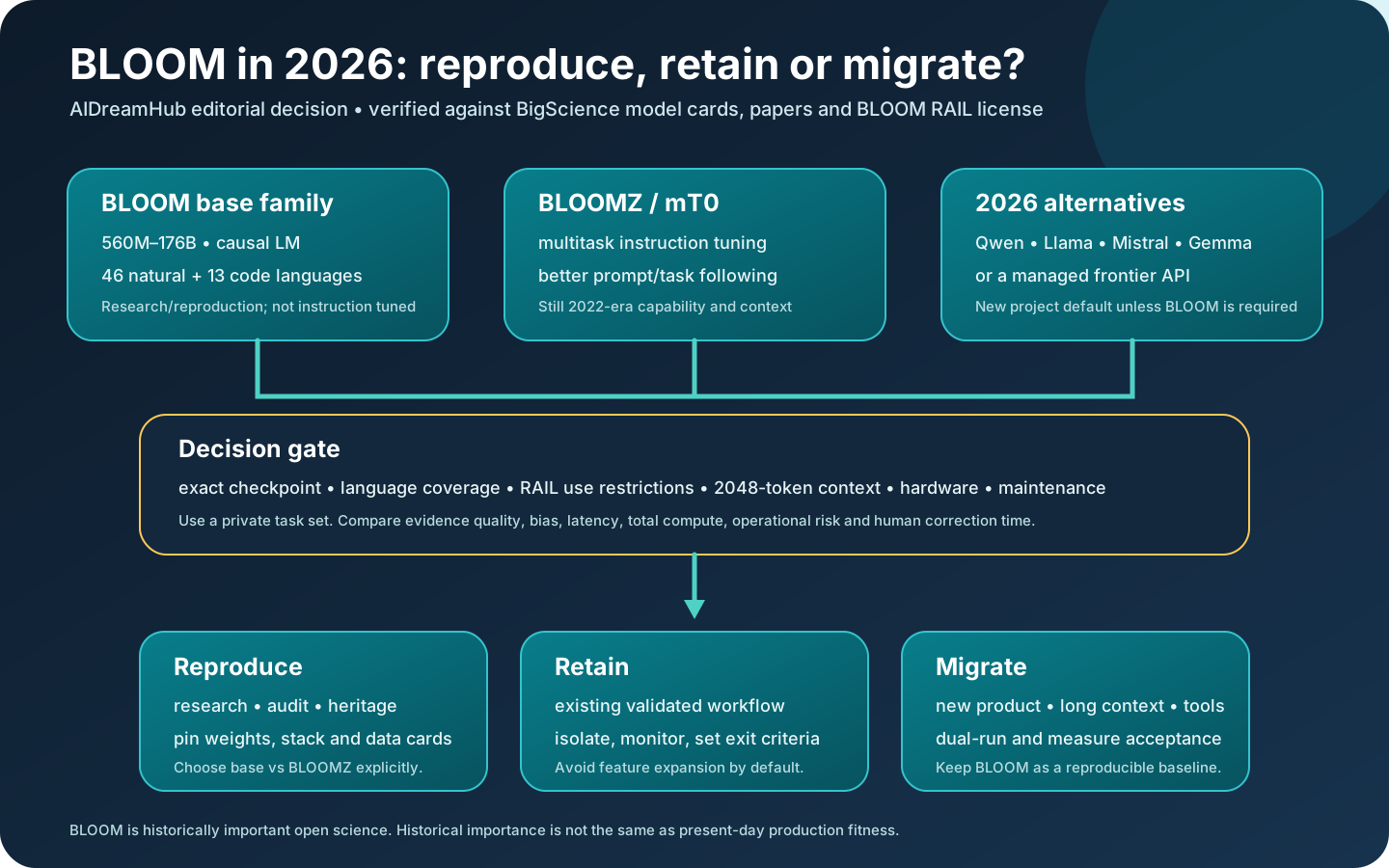
Our judgment: reproduce BLOOM when the research question is about BLOOM, BigScience, ROOTS, multilingual open science or historical comparability. Retain it when an existing low-risk workflow has documented value and migration does not yet repay validation. For a new assistant, RAG system, coding agent or long-document product, benchmark a current model first. BLOOM's durable contribution is the process it made visible—not an obligation to keep serving the 176B checkpoint.
FAQ
Is BLOOM still maintained?
The model files and cards remain accessible and the broader BigScience ecosystem has some active repositories, but BLOOM is a 2022 model generation rather than an actively advancing frontier family. Treat compatibility and hosting as your responsibility.
What is the difference between BLOOM and BLOOMZ?
BLOOM is a causal base model trained to continue text. BLOOMZ is BLOOM multitask-finetuned on xP3 prompts to follow instructions across languages. Choose BLOOMZ for prompted tasks and BLOOM for base-model research or continued pretraining.
How many languages does BLOOM support?
The training corpus contains 46 natural and 13 programming languages. Their data shares and quality differ. Test the exact language, variety, script, domain and task with native reviewers.
Can BLOOM be used commercially?
The BLOOM RAIL license permits use subject to conditions and use restrictions. It is not Apache-2.0. Review the exact application, redistribution and derivative obligations with counsel.
Can BLOOM 176B run locally?
Not on an ordinary laptop or workstation. The full checkpoint needs a distributed accelerator setup and substantial memory. Smaller BLOOM/BLOOMZ checkpoints or a current compact model are more practical.
Does BLOOM have long context?
No by modern standards. The model was trained with a 2,048-token sequence length. Use careful chunking for reproduction, or choose a current long-context model for new RAG and document systems.
Should a new product use BLOOM?
Usually not as its first choice. Use it when open-science provenance, a specific language result, exact reproduction or legacy compatibility matters; otherwise compare current open models and managed APIs.
Sources reviewed
- Official BLOOM model card, data, risk and current hosting status
- Official BLOOMZ instruction-tuned model card
- BLOOM technical paper
- BLOOMZ / xP3 cross-lingual multitask tuning paper
- Hugging Face BLOOM launch and open-science context
- BigScience BLOOM RAIL 1.0 license
- ROOTS corpus preparation repository
- BigScience compute-budget and model-design paper
- BigScience collaboration case study
Independently reviewed 2026-08-20. Model hosting, library compatibility, licenses and alternatives change; verify exact model cards, repositories and legal terms before deployment.