BabyAGI is an open-source autonomous agent experiment by Yohei Nakajima. The original 2023 task-loop agent popularized goal-driven task creation, execution, memory, and prioritization; the current project is an experimental self-building function framework, not a production-ready AGI system.
BabyAGI: autonomous agent experiment and function framework
BabyAGI is one of the most influential early open-source experiments in autonomous AI agents. Created by Yohei Nakajima in 2023, the original BabyAGI showed how a language model could take a high-level objective, create tasks, execute them, store results in memory, and reprioritize the next steps in a loop.
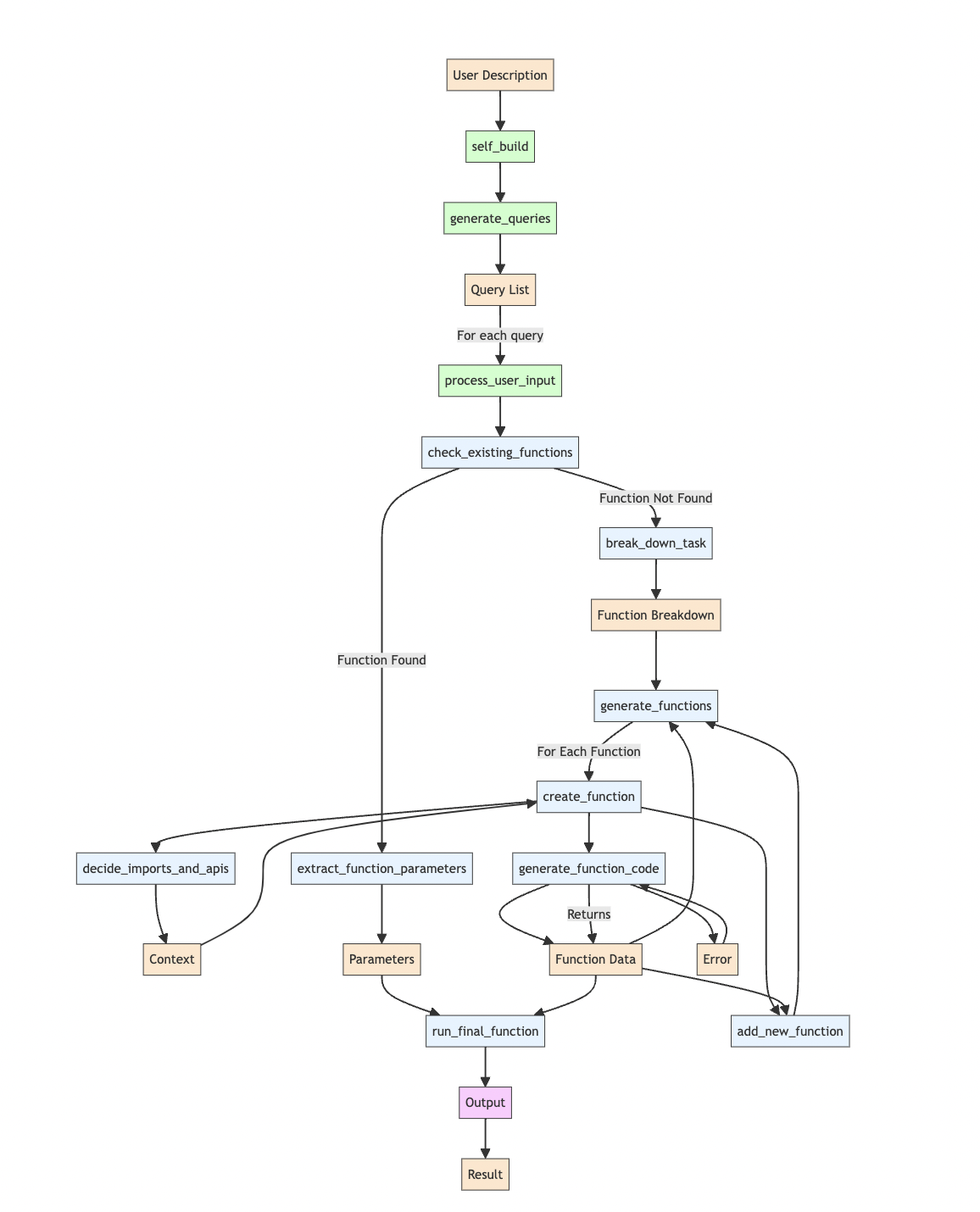
The current BabyAGI repository is different from the original viral script: the original March 2023 version has been archived, while the newer project explores a self-building autonomous agent built around a function framework called functionz. It stores, manages, and executes functions with dependency tracking, key dependencies, logging, and a dashboard.
What BabyAGI is good for
Learning agent architecture: study the classic execute, create, prioritize loop that shaped the first wave of AI agents.
Experimenting with autonomous workflows: prototype how an objective can be decomposed into subtasks and iterated over time.
Function-based agent design: explore the newer idea that agent behavior can emerge from registered functions with dependencies and logs.
Research and teaching: compare BabyAGI with AutoGPT, LangGraph, CrewAI, AutoGen, OpenAI Agents SDK, and other agent frameworks.
Important status note
BabyAGI is best treated as an educational and experimental project. The official repository explicitly frames it as a place to share ideas and spark discussion, not as a production-ready enterprise automation platform. If you need reliable production agents, use BabyAGI to understand the pattern, then evaluate more maintained orchestration frameworks.
Architecture and use cases
Classic BabyAGI: a task-driven loop with an LLM, task list, execution agent, task creation agent, prioritization agent, and vector memory.
Newer BabyAGI: a function runtime that registers callable functions, resolves dependencies, stores secrets as key dependencies, logs executions, and supports a dashboard.
Use cases: agent education, research prototypes, autonomous task planning demos, workflow decomposition, function registry experiments, and comparisons with modern agent frameworks.
Not ideal for: unsupervised business-critical automation, regulated workflows, or systems that require strong guardrails, monitoring, and operational support.
Official and reference media
Official repository media illustrating the self-building direction of the newer BabyAGI project.GitHub project reference for the open-source BabyAGI repository.
Practical recommendation
Use BabyAGI if your goal is to understand where autonomous agents came from and how task loops evolved. For production work, treat it as a reference pattern rather than a turnkey product: add human approval, budget controls, observability, retry logic, and strong permission boundaries before adapting any BabyAGI-style loop.
Manus is a hosted general-purpose AI agent that uses cloud VMs, browser automation, files, code and integrations to complete multi-step tasks. This independent guide covers plans and credits, Cloud Browser vs Browser Operator, authenticated actions, privacy, approvals, task design, evaluation and alternatives.
ai-agentfree
5430
Gemini CLI
An open-source AI agent that brings the power of Gemini directly into your terminal.
ai-agentfree
4150
AgentScope
AgentScope is an Apache-2.0 agent framework with ReAct agents, tools, skills, memory, planning, human steering, evaluation, fine-tuning, MCP/A2A integrations, realtime voice, and multi-agent orchestration.
ai-agentfree
4860
Auto-GPT
Auto-GPT is an open-source autonomous-agent project and platform from Significant Gravitas for building, running, and managing AI assistants and workflows.