
Asteroid is now positioned primarily as a healthcare portal integration platform, not a general-purpose consumer browser agent. It turns browser, desktop, Citrix and sometimes private web-interface workflows into callable operations for tasks such as eligibility checks, prior authorization, claims follow-up, provider enrollment, referral intake, scheduling and EHR extraction or write-back. Teams can build with the Astro assistant, use graph-based agents and SDK/API triggers, or engage Asteroid for managed delivery.
Who Asteroid is for
The strongest fit is a healthcare or healthcare-adjacent organization with high-volume work trapped behind authenticated portals and no usable API. Examples include a healthtech product that must write appointments into many EHRs, an operations team checking benefits across payer sites, a revenue-cycle team collecting denial details, or a voice agent that completes a call but still needs to submit a structured form in the provider's system.
It is a weaker fit when a stable standards-based or vendor-supported API already covers the workflow, volume is too low to justify integration governance, the portal explicitly prohibits automation, or every transaction requires nuanced licensed judgment. Browser automation can bridge an access gap; it should not become a shortcut around clinical, payer, contractual or regulatory responsibility.
What the platform includes
| Layer | Asteroid capability | What a buyer must validate |
|---|---|---|
| Build | Astro converts a process description or SOP into an agent; graph agents expose nodes and transitions | How generated steps are reviewed, versioned, tested and promoted |
| Run | Browser, Linux and Windows environments; desktop/Citrix support is marketed | Exact supported applications, network path, browser compatibility and regional availability |
| Authenticate | Profiles, encrypted credential storage and warm sessions | MFA handling, rotation, least privilege, vault administration and session revocation |
| Integrate | UI, API, MCP, Python/TypeScript SDKs, email, Slack and Sheets connections | Schema guarantees, idempotency, retries, webhooks, rate limits and downstream permissions |
| Supervise | Live View, intervention, approval checkpoints and recorded execution steps | Who watches, timeout behavior, escalation routing and immutable evidence |
| Optimize | Agentic browser runs may become deterministic scripts or direct private-interface calls | Change control, portal authorization, regression testing and rollback |
The agentic-to-deterministic model
Asteroid describes a three-stage optimization path. A frontier model initially navigates an unfamiliar interface. Successful patterns can then be converted into deterministic scripts, reducing model calls and variance. Where a portal exposes an underlying private interface and its use is permitted, the system may call that interface directly. This architecture can improve speed and unit economics, but each transition changes the risk profile.
An agentic step needs prompt-injection defenses and close supervision. A deterministic script needs selectors, assertions and regression tests. A private-interface integration needs explicit legal and technical review because undocumented endpoints can change without notice and may be outside the portal owner's intended use. Procurement should ask how Asteroid decides to promote a workflow, which evidence is retained, how customers approve changes, and how quickly the system falls back when the optimized path breaks.
Healthcare workflow examples and acceptance evidence
| Workflow | Required input | Accept only when | High-risk failure |
|---|---|---|---|
| Eligibility and benefits | Patient, member, payer and service context | Coverage, dates, copay/deductible and source timestamp are captured in a defined schema | Wrong patient or stale coverage silently written to the EHR |
| Prior authorization | Order, diagnosis/procedure, payer rules and attachments | Submission identifier, status, evidence and follow-up date are recorded | Missing attachment or unsupported clinical representation |
| Claims and denials | Claim identifiers and payer access | Status and denial reason reconcile to the right encounter | Appeal deadline or reason incorrectly interpreted |
| Scheduling | Patient, appointment type, provider, constraints and consent | Slot is confirmed in the authoritative EHR and returned to the requester | Duplicate, wrong-provider or wrong-patient booking |
| Credential verification | Provider roster and required registries | Source, checked date, identifier and exception are traceable | False clearance caused by a navigation or identity match error |
| EHR extraction/write-back | Scoped record request and field mapping | Completeness, provenance and patient identity pass reconciliation | Cross-patient disclosure or overwrite |
HIPAA claims are a starting point, not the whole review
Asteroid's site says the platform is HIPAA compliant and links to a trust center. A buyer still needs its own risk analysis and contract review. Confirm whether Asteroid will sign a business associate agreement; what services, subprocessors and model providers receive protected health information; where data and screenshots are processed; how long recordings and filesystem artifacts persist; and how deletion, breach notification and access audits work.
- Send only the minimum necessary PHI for the defined task and prohibit unrelated record browsing.
- Use separate least-privilege portal identities when the portal permits them; avoid shared staff credentials.
- Map every human, service account, API key, proxy, environment and downstream write-back identity.
- Redact screenshots, logs and support artifacts where full clinical content is not needed.
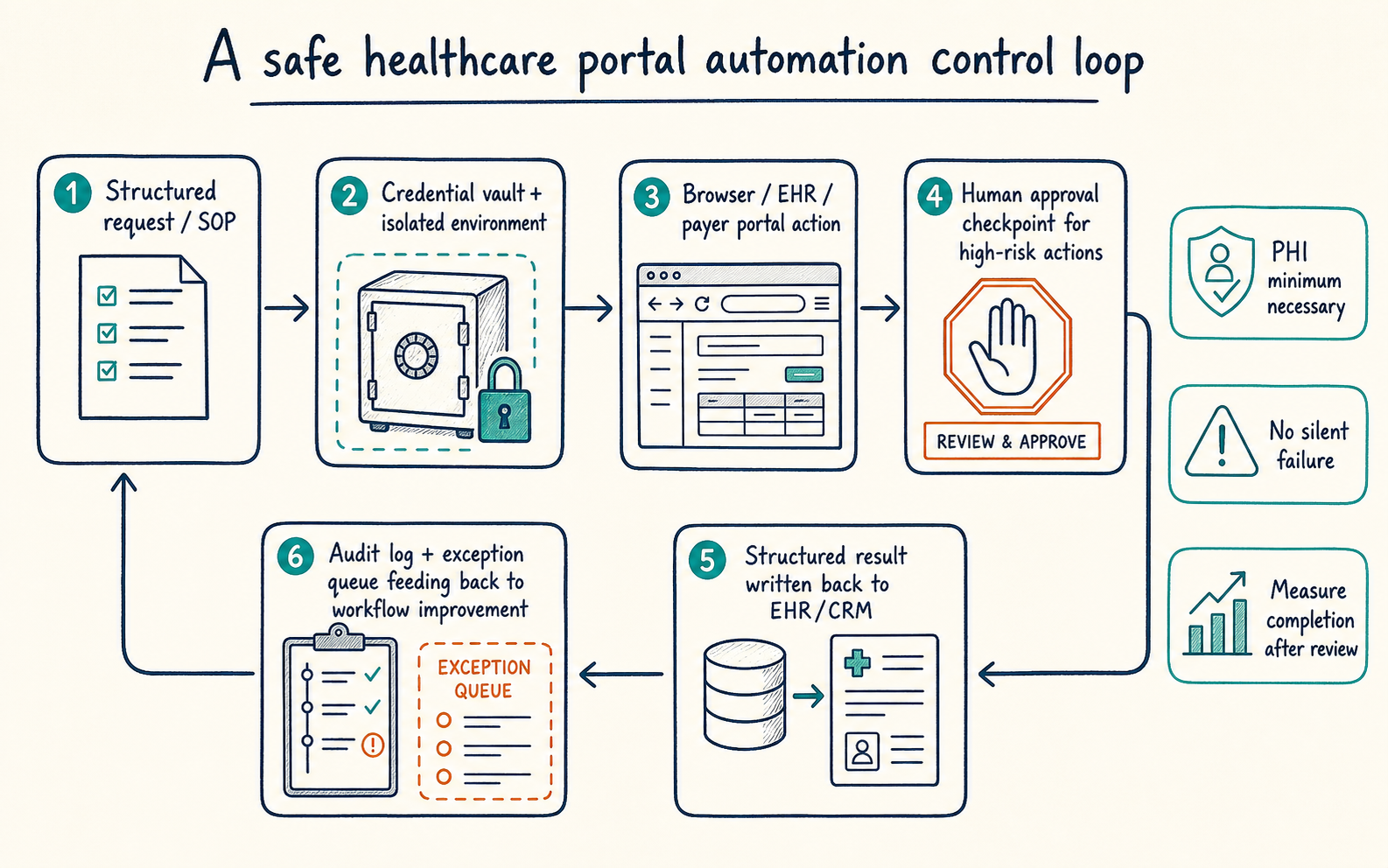
- Require explicit approval for irreversible, clinical, financial, enrollment, appeal and patient-communication actions.
- Exercise access revocation, credential rotation, downtime, portal lockout and incident-response procedures.
A production pilot in eight steps
- Select one bounded workflow. Prefer repetitive work with clear inputs, outputs and reversible test cases.
- Create a gold set. Include normal cases, missing fields, duplicate people, expired coverage, portal timeout, MFA, layout change and downstream outage.
- Define authority. Document which fields may be read, which actions may be written, and which steps always require a person.
- Use non-production or synthetic data first. Confirm isolation, logs and deletion before introducing PHI.
- Test identity reconciliation. Patient/member/provider matching should fail closed when identifiers conflict.
- Run shadow mode. Compare agent results with trained staff without allowing autonomous write-back.
- Measure reviewed outcomes. Count only correct, reconciled completions—not clicks, runs started or vendor-reported completion.
- Stage autonomy. Move low-risk reads first, then reversible writes, while keeping exception queues and rollback staffed.
Metrics that reveal real value
| Metric | Definition | Why it matters |
|---|---|---|
| Reviewed completion rate | Correct end states after identity and source reconciliation / eligible runs | Prevents a “finished” screen from masking wrong data |
| Silent-error rate | Incorrect results not flagged by the system / completed runs | The most dangerous failure class in unattended healthcare work |
| Exception minutes | Human diagnosis and correction time per eligible run | Shows whether automation reduced work or merely moved it |
| Portal-change recovery | Time from break detection to validated restoration | Maintenance, not demo success, determines long-term economics |
| Cost per accepted outcome | Platform, compute, portal, support and review cost / correct completions | Enables fair comparison with staff and API integration |
| PHI exposure surface | Systems, people and retained artifacts receiving task data | Automation value should not require uncontrolled data spread |
Pricing and procurement questions
Asteroid advertises usage-based pricing, self-serve entry and managed delivery for higher plans. Pricing pages and contracts can change, so model three scenarios: normal traffic, peak parallel traffic and a failure-heavy month after portal changes. Include environment minutes, model usage, proxies, storage, premium support, managed builds, retries and human review.
Ask whether failed and retried runs are billed, what counts as a run, how concurrency is capped, whether workflow maintenance is included, what service levels cover third-party portal outages, and how data is exported at termination. A low automation unit price can be misleading if each exception consumes a senior operator or engineer.
Alternatives
| Approach | Best when | Main tradeoff |
|---|---|---|
| Asteroid | Healthcare portal breadth, managed maintenance and governed computer use are central | Vendor dependency and usage economics require diligence |
| Official EHR/payer API or clearinghouse | A supported interface covers the workflow and data contract | Often slower onboarding or incomplete portal coverage, but more stable semantics |
| Playwright/RPA built internally | Few stable portals, strong engineering ownership and strict custom control | Team owns selectors, credentials, monitoring and every break |
| Browserbase plus an agent framework | Developers want browser infrastructure while retaining orchestration control | More assembly and healthcare governance work stays in-house |
| Human operations/BPO | Volume is low, judgment dominates or portal authorization is uncertain | Higher variable labor and slower scaling, but flexible exception handling |
Frequently asked questions
Is Asteroid only for healthcare?
The platform can operate browser and computer workflows more broadly, but its current website, ready-made workflow catalog, compliance story and strongest examples are healthcare-focused. Buyers outside healthcare should verify product support and economics for their portals.
Does it replace an EHR integration?
It can provide a practical bridge where a clean integration is absent. Prefer a supported standards-based or vendor API when it reliably covers the same operation, and avoid maintaining two conflicting sources of truth.
Can Asteroid handle MFA and changing portals?
The product documents profiles, warm sessions, intervention and adaptive workflows. Exact MFA methods, bot controls and portal terms vary; test each target and establish a staffed re-authentication and recovery path.
Can it process PHI?
Asteroid markets HIPAA-compliant operation. Processing PHI still requires an appropriate agreement, buyer risk assessment, minimum-necessary design, access controls, subcontractor review and verified retention/deletion behavior.
Should every step be autonomous?
No. Place approval gates before irreversible or high-impact actions, and fail closed on patient mismatch, missing evidence, ambiguous choices or changed portal behavior.
What is the best proof-of-concept success metric?
Use correct outcomes after human reconciliation, together with silent-error rate, exception minutes and total cost. Vendor completion rate alone is insufficient.
Official sources
- Asteroid healthcare portal platform overview
- Asteroid documentation overview
- Astro agent builder documentation
- Graph agent fundamentals
- Execution environment documentation
- Security and compliance documentation
- Current Asteroid pricing page
- Asteroid security page and trust-center entry
Last reviewed July 25, 2026. Product claims and customer metrics above are vendor-reported unless independently stated. Verify current documentation, contract terms and each target portal's authorization before production use.