AgentGPT is Reworkd’s browser-based autonomous-agent project from the early AutoGPT wave. A user names an agent, gives it a goal and watches it propose tasks, execute iterations and feed results back into later steps. It made autonomous planning easy to understand without a terminal and remains historically useful for demonstrations.
The critical current fact is maintenance status: Reworkd archived the public repository on January 28, 2026, making it read-only. The hosted site and plan page were still reachable when reviewed, but reachability is not evidence of active development, current models, security patches or reliable support. Treat AgentGPT as a legacy educational system, not a default production platform.
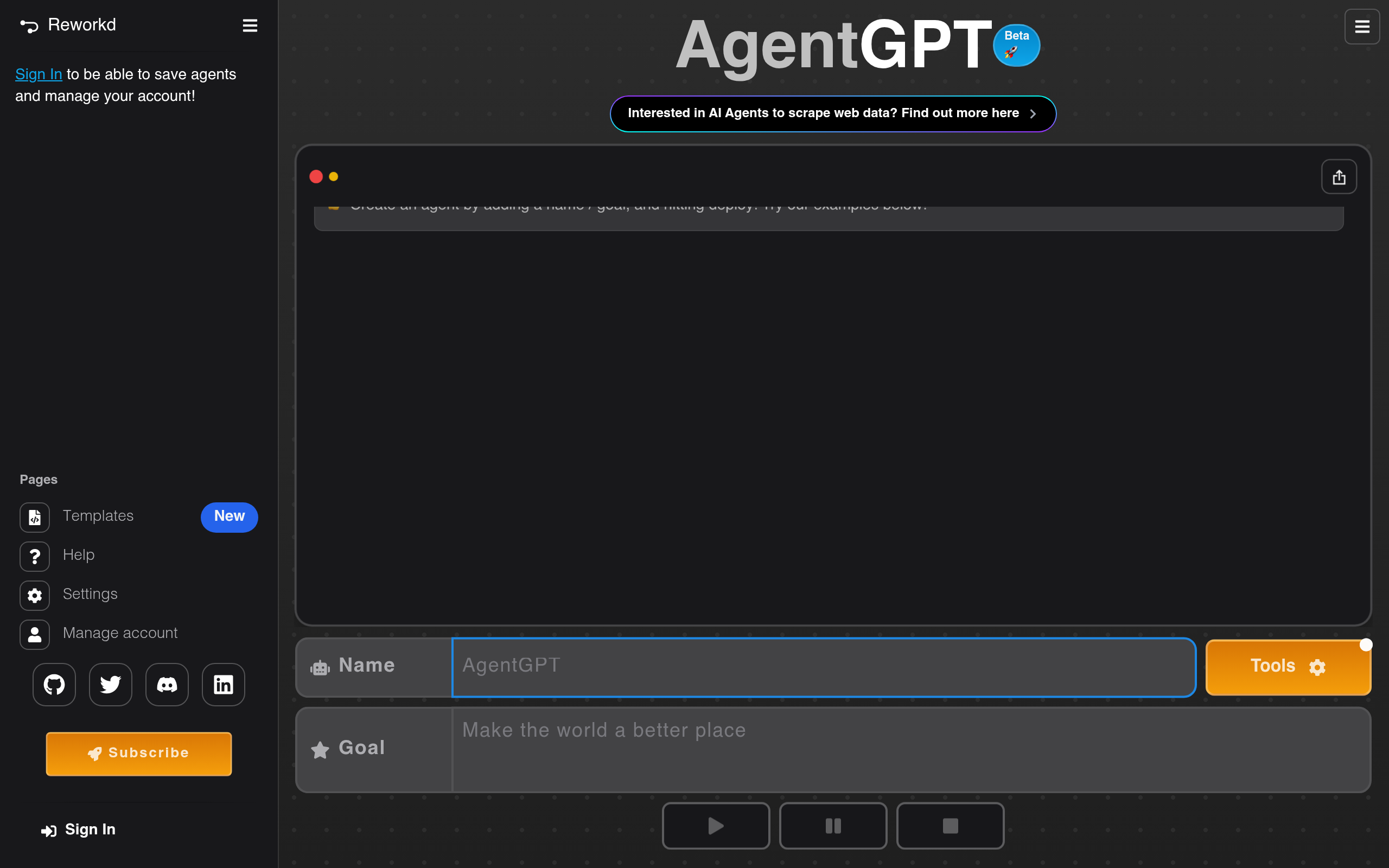
What the loop actually does
 user goal
    |
    v
 generate task list
    |
    v
 choose next task ---> call model / search / plugin
    |                         |
    |                         v
    '------ add result to memory/context
                              |
                    done? ----+---- no --> another loop
                      |
                     yes
                      v
                final narrative

 More loops can amplify progress, error, cost—or all three.
The model interprets the goal, invents intermediate tasks and evaluates its own progress. Without an external verifier, it can convert a wrong assumption into several confident steps. Search results can be stale or hostile; task lists can drift; and a final summary can hide unfinished work. Autonomous iteration is useful only when each step has bounded authority and observable success.
Current status at a glance
| Surface | Observed state | What it proves | What it does not prove |
|---|---|---|---|
| GitHub repository | Archived/read-only since Jan 28, 2026 | Source remains available | Security fixes or dependency maintenance |
| Latest GitHub release | v1.0.0 dated Nov 2, 2023 | Historical release artifact | Compatibility with current APIs |
| Hosted app | Reachable when reviewed | Service responds now | Future uptime, support or roadmap |
| Plan page | Free, $40 Pro and custom Enterprise copy visible | Current displayed offer | Billing/support reliability or value |
| Docs/security files | Historical project guidance remains | Original intended setup | Actively supported versions after archive |
Current displayed plans—with a legacy warning
The live plan page reviewed July 26, 2026 showed a Free Trial with five demo agents per day using GPT-3.5-Turbo, limited plugins and limited web search. Pro was displayed at $40/month with 30 agents/day, GPT-3.5-Turbo 16K, GPT-4 access, 25 loops per agent, unlimited web search, plugins and priority support. Enterprise was custom.
Those model labels and limits reflect an older era. GPT-3.5 Turbo has been retired from many modern workflows, and “GPT-4” is not a precise current model ID. Before subscribing, confirm checkout, renewal, cancellation, refund, supported models, last service update and an actual support response. Do not infer ongoing product investment from an active payment page.
| Buying check | Evidence required | Reason |
|---|---|---|
| Model | Exact current model ID and cutoff | Legacy brand names hide capability/retirement |
| Loop allowance | What counts, resets and stops a loop | Long loops can waste quota without outcome |
| Web search | Provider, citations and query handling | “Unlimited” does not guarantee source quality |
| Support | Response channel and SLA in writing | Repository is no longer maintained |
| Cancellation | Account path and effective date | Avoid renewal surprises |
| Data | Current privacy/retention/provider terms | Goals can contain sensitive business context |
Good educational tasks versus bad operational tasks
| Task | Fit | Why |
|---|---|---|
| Show how an agent decomposes a research question | Good demo | Visible planning is the learning objective |
| Brainstorm a fictional launch campaign | Reasonable | Low consequence and easy human selection |
| Collect a few public competitor hypotheses | Conditional | Every fact and source needs verification |
| Send outreach or publish content | Poor | External side effects need consent and approval |
| Make legal/medical/financial decisions | Unsafe | No accountable expert or reliable evidence chain |
| Operate production infrastructure | Unsafe | Legacy agent lacks modern permission/runtime governance |
Write goals with termination conditions
“Research the market and make us successful” has no observable completion state. A better goal is: “Find five publicly documented competitors in category X, capture official URL, current plan price and quoted feature evidence as of today, and return a table with unknown fields marked—not inferred. Stop after five or after eight search iterations.”
- Define output schema, source quality and freshness date.
- Set maximum loops, time and spending.
- State forbidden actions and data.
- Require uncertainty and missing fields.
- Specify who validates the result and what authoritative source wins.
Evidence-first review
Do not review only the final narrative. Inspect the task trace, URLs, dates and exact source claims. Open each cited page and distinguish source text from the agent’s inference. A search snippet is not enough; a third-party article cannot establish official pricing when a vendor page exists.
| Claim type | Preferred source | Required check |
|---|---|---|
| Price/limit | Live official pricing/terms | Currency, billing period, tax and date |
| Technical feature | Official docs/repository at pinned version | Exact API or reproducible test |
| Company event | Primary announcement plus independent reporting | Publication date versus event date |
| Performance | Transparent benchmark and own test | Dataset, baseline and rejected results |
| Recommendation | Evidence + explicit criteria | Separate fact from judgment |
Why more loops do not guarantee a better answer
Each iteration consumes context and may summarize earlier details. Errors can compound, duplicated tasks can consume the loop cap, and self-evaluation tends to favor plausible completion. Track unique verified facts gained per loop. Stop when two iterations add no evidence, repeat an action or contradict a confirmed constraint.
If a task needs durable waiting, retries, approvals and external writes, use a maintained workflow runtime with idempotency and auditability. A conversational loop should not be mistaken for distributed transaction management.
Self-hosting architecture and maintenance burden
The archived repository’s setup includes a Next.js/TypeScript frontend, FastAPI backend, MySQL database, NextAuth, Prisma/SQLModel, LangChain and provider keys. Optional Serper and Replicate keys extend search/media behavior. The automatic setup scripts were built around dependencies current at the time; modern Node, Python, Docker, database and OpenAI APIs may have breaking changes.
| Layer | Legacy risk | Minimum self-host check |
|---|---|---|
| Frontend/auth | Outdated Next.js/NextAuth vulnerabilities | Dependency audit, secure cookies, CSRF and session tests |
| FastAPI/backend | Old packages and permissive endpoints | Schema auth, rate limits and input bounds |
| Database | Migration drift and retained prompts | Backup/restore, encryption and deletion |
| OpenAI integration | Retired models/API behavior | Replace explicit IDs and regression test |
| Search/plugins | SSRF, prompt injection and key exposure | Allowlist, scoped keys and output labeling |
| Docker/setup scripts | Floating images and shell supply chain | Inspect, pin hashes and sandbox |
Forking creates a new product ownership obligation. Assign maintainers, establish a vulnerability process, update dependencies continuously and document data flows. If the purpose is simply to run modern agents, starting from a maintained framework is usually cheaper.
Secrets and access boundaries
Store provider keys outside source control, use low spending limits and rotate them. Do not expose the local app or API publicly without authentication, TLS and rate limits. Agent output and plugin content are untrusted. Never give an archived general agent broad filesystem, email, payment, cloud or social-media authority.
For a workshop, use a separate project/account, synthetic data and disposable keys. Monitor token/search consumption. Destroy the environment afterward and revoke credentials.
Historical value and what modern systems changed
AgentGPT demonstrated that a goal–task–execute loop could be made legible to non-developers. Modern production agent systems add explicit graphs, durable checkpoints, tool schemas, permissions, tracing, evaluations, human approvals and failure recovery. The design lesson is still valuable: users need to see what the agent plans. The implementation is no longer a safe default.
A one-hour classroom evaluation
- Give AgentGPT and a supervised chatbot the same bounded public-research goal.
- Limit the autonomous run to five iterations.
- Mark each task as useful, duplicate, unsupported or off-scope.
- Verify every source and count correct unique facts.
- Compare time, tokens, correction effort and final completeness.
The likely learning is not “autonomy always wins” but when decomposition helps and when supervision prevents drift. Preserve the run as educational evidence; do not publish unverified output.
Alternatives in 2026
| Option | Best fit | Tradeoff versus AgentGPT |
|---|---|---|
| AgentGPT | Historical demo of browser goal loops | Archived code and legacy hosted model stack |
| ChatGPT/Claude/Gemini supervised mode | Interactive planning and research | Less visible autonomy, easier correction |
| LangGraph | Maintained stateful production graphs | Developer implementation required |
| CrewAI | Python role/multi-agent experimentation | Still requires governance and evaluation |
| n8n / Make / Zapier | Business automation with explicit app steps | Platform dependency, stronger deterministic structure |
| OpenAI Agents SDK / Google ADK | Current provider SDK agent applications | Provider ecosystem and engineering work |
| Durable workflow + LLM steps | Long-running consequential operations | Higher setup, much stronger retry/audit semantics |
Frequently asked questions
Is AgentGPT still maintained?
No. The official GitHub repository was archived January 28, 2026 and is read-only.
Does the hosted site still work?
It was reachable when reviewed, and the plan page displayed offers. Availability does not imply active development or long-term support.
What does the current plan page show?
A free trial and a $40/month Pro plan with legacy GPT-3.5/GPT-4 wording, plus custom Enterprise. Verify checkout before paying.
Can I self-host it?
The source and setup remain available, but old dependencies and model integrations require security and compatibility work.
Is it suitable for production?
Not as an unmodified default. Choose a maintained runtime with permissions, evaluations, observability and durable failure handling.
Does it have live web access?
The hosted plan advertises web-search capabilities; self-hosting historically used an optional Serper key. Verify sources and protect against prompt injection.
Why keep the directory page?
It documents an influential agent interface and helps users avoid mistaking a still-live URL for a maintained modern platform.
Primary sources
- Official archived AgentGPT repository and status
- Official historical releases
- Archived security policy
- Hosted AgentGPT application
- Current displayed hosted plans
- Official self-host Compose definition
- Official historical environment configuration
- OWASP prompt-injection guidance
- MIT AI Agent Index for modern agent-transparency context
Last reviewed July 26, 2026. The repository is archived. Re-check hosted availability, model IDs, pricing, billing and support before any use or payment.