
Vercel AI SDK v7 review: an excellent TypeScript application layer, not a complete AI platform
Vercel AI SDK is a provider-agnostic TypeScript toolkit for web and Node.js applications. AI SDK Core normalizes generation, structured output and tools; AI SDK UI supplies framework hooks and a data-stream protocol; provider packages translate calls to model APIs. The current repository requires Node.js 22 or later and is licensed under Apache 2.0.
This review is anchored to [email protected], released 19 August 2026. Vercel also publishes maintenance releases on v5 and v6 branches, so a package page or old tutorial can easily show a valid but non-current API. Current agent examples use ToolLoopAgent and stopWhen; AI SDK 5 already changed useChat to a transport architecture and removed its internal input state. Audit the installed major before copying code.
The product boundary matters. The open-source SDK can call provider packages directly. Vercel AI Gateway is a hosted routing, billing and budget service; the repository now uses it by default in examples, but it is not required. AI Elements is an optional shadcn/ui-based component library. Vercel Cloud observability and deployment are also separate services. Calling all four “the AI SDK” hides data paths, commercial terms and lock-in.
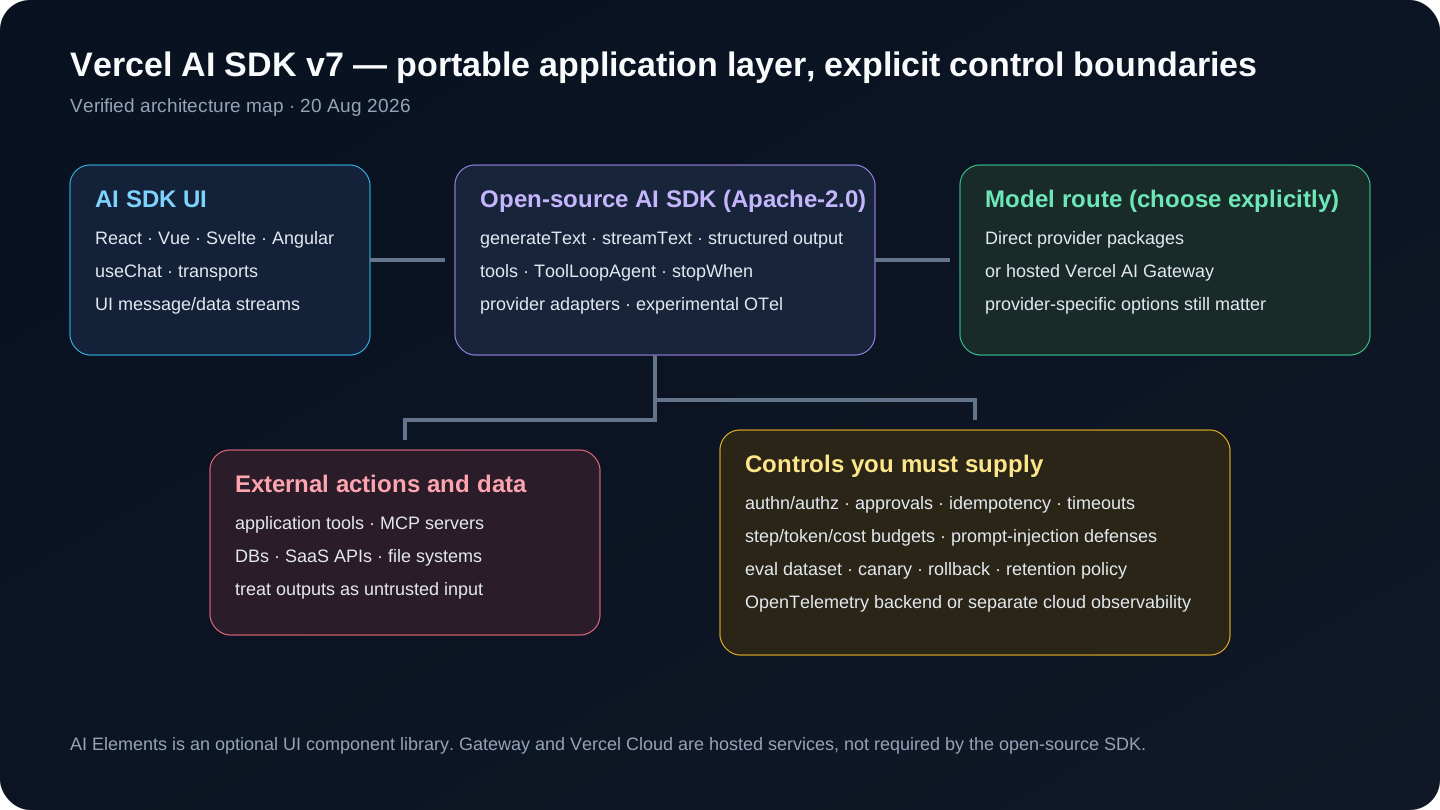
Current 2026 snapshot
| Item | Verified state on 20 Aug 2026 | Decision impact |
|---|---|---|
| Current main package | [email protected]; v5/v6 maintenance releases also exist | Pin the major and read its migration guide |
| Runtime | Node.js 22+ in the current repository | Check serverless and enterprise runtime policy |
| License | Apache License 2.0 | SDK code is permissive; providers and models have separate terms |
| Core API | generateText, streamText, structured output, tools | Good common application surface, not identical provider behavior |
| Agent API | ToolLoopAgent; default stepCountIs(20) | Set explicit stop, time and cost controls |
| UI | React, Vue, Svelte, Angular transports and rich message streams | Wire protocol and reconnect behavior need tests |
| Default route | Current README examples use Vercel AI Gateway | Direct provider packages remain possible |
| Telemetry | Experimental OpenTelemetry, opt-in per call | Prompts and outputs may enter the telemetry backend |
What belongs to the SDK—and what does not
| Layer | What it provides | Boundary to own |
|---|---|---|
| AI SDK Core | Generation, streaming, tool schemas/results, structured output, usage metadata | Provider capabilities, finish reasons and usage are not perfectly portable |
| Provider packages | Adapters for model APIs and provider-specific options/metadata | Version compatibility and feature parity vary |
| AI SDK UI | useChat-style hooks, transports, UI messages and data streams | Authentication, persistence, reconnect and error UX remain application work |
| ToolLoopAgent | Reusable multi-step loop with tools, callbacks, stop conditions and approvals | It is not durable execution, policy enforcement or a job queue |
| MCP client | Adapts MCP tools/resources/prompts; Streamable HTTP recommended for production | MCP server trust, credentials and tool authorization stay external |
| AI Elements | Optional UI components distributed through a component registry | Not required and not the Core runtime |
| Vercel AI Gateway | Hosted unified endpoint, routing, budgets, usage and fallbacks | Separate data plane, account, pricing and routing policy |
| Vercel Cloud | Hosting and observability products | Not conferred by Apache-licensed SDK use |
Provider abstraction, streaming and agent loops
The provider abstraction is valuable when the application uses the common denominator: text, messages, tool calls, structured results and normalized usage. It does not make models interchangeable. Reasoning fields, cached-token accounting, image/file inputs, hosted tools, safety refusals, tool-call IDs and provider options can differ. Preserve providerMetadata, raw finish reasons and warnings in test logs. A portable interface without a capability matrix merely moves provider-specific assumptions into production incidents.
Streaming has two levels. streamText emits model and tool parts on the server. AI SDK UI transports those parts as a richer UI message/data stream. A plain text transport is simpler, but official docs note that it cannot carry tool calls, usage or finish reasons. Production chat needs a defined contract for abort, retry, partial tool output, duplicate events, disconnect, reconnect and server errors. Never treat “the first token arrived” as proof that the final message, tool state or usage record is consistent.
ToolLoopAgent is a convenient agent loop, not a reliability system. It normally continues until the model stops calling tools, a tool lacks an execute function, approval is required, or a configured stop condition fires. The current default step ceiling is twenty, which may be far too expensive for an interactive endpoint. Set a smaller job-specific limit, overall timeout, abort signal, model/token budget and tool-level permissions. For repeatable business processes, the official guidance sensibly favors explicit structured workflows over a nondeterministic loop.
A production migration and evaluation workflow
- Pin Node.js,
ai, UI and provider-package versions in a lockfile; record the installed major and release notes. - Map the current application's prompts, messages, provider options, tool schemas, streaming protocol, retries, storage and billing fields.
- Define a provider capability matrix: tool calling, structured output, reasoning, files/images, safety fields, usage, context and regional requirements.
- Create a redacted golden evaluation set plus adversarial cases for prompt injection, malformed arguments, denied permissions and repeated side effects.
- Implement a thin application adapter around
generateText/streamText; keep provider-specific options explicit instead of hiding them. - Add server-side authentication, tenant authorization, tool allowlists, approvals, idempotency keys, timeouts and step/token/cost budgets.
- Instrument normalized metrics and raw warnings/finish reasons; keep sensitive prompts and tool payloads out of telemetry unless policy allows them.
- Shadow the new path, then canary by tenant or traffic percentage. Compare quality, stream integrity, tool success, latency and provider invoice.
- Test abort, disconnect, retry and Gateway/provider failure. Preserve the old adapter and protocol version until rollback has been rehearsed.
- Re-run the suite whenever the SDK major, provider adapter, model, prompt, tool or Gateway routing policy changes.
What to measure before switching providers
| Metric | How to test | Why it matters |
|---|---|---|
| Answer quality | Task-specific rubric and blinded pairwise review | Provider-neutral syntax cannot normalize model behavior |
| Structured output | Valid schema and semantic correctness rates | Valid JSON can still contain the wrong decision |
| Tool behavior | Selection, arguments, execution, approval and duplicate rate | Side effects are the highest-risk agent surface |
| Streaming integrity | First event, final event, order, reconnect and cancellation | Partial UI can diverge from server state |
| Latency | p50/p95 first event and completion by provider/model | Routing and tools change perceived speed |
| Usage and cost | Normalized tokens plus invoice reconciliation | Cached/reasoning tokens differ across providers |
| Safety | Injection, data-exfiltration, refusal and permission tests | Tool output is untrusted input |
| Reliability | Timeout, provider error, fallback and rollback success | A demo path omits failure behavior |
A useful migration does not start by changing an import. Inventory every existing model call, system prompt, tool schema, streaming event, retry, usage field and provider-specific option. Freeze representative production traces after redaction. Build a golden set with ordinary requests, long context, multilingual inputs, refusals, malformed tool arguments, concurrent tools, provider errors and deliberately unanswerable tasks. Run the old and new paths against the same inputs and record both normalized and raw provider results.
Evaluate each stage separately. Model quality, schema validity, correct tool selection, tool execution success and final-answer faithfulness are different metrics. Add latency-to-first-event, total latency, input/output/cached tokens, cost at the provider invoice, cancellation success and stream completion. For agents, measure steps per run, repeated tool calls, approvals, timeout rate and side-effect duplicates. A small shadow sample followed by a tenant or traffic canary is safer than a flag day; keep the prior adapter and stored protocol version for rollback.
OpenTelemetry support is useful but explicitly experimental. It is opt-in through experimental_telemetry and can include prompts, response text, tool calls and attributes. Treat telemetry as a separate data export: redact or disable sensitive values, constrain attribute cardinality, set retention and access policies, and test sampling. Vercel's hosted observability is another product; installing ai does not automatically provide an evaluation suite, trace store or incident workflow.
Security, privacy, cost and lock-in
| Risk | Concrete control | Residual boundary |
|---|---|---|
| Prompt injection | Separate instructions/data; allowlist tools; validate destinations and outputs | Models can still follow hostile content |
| Unauthorized tool action | Resolve identity/tenant server-side and authorize every call | Schema validation is not access control |
| Duplicate side effect | Idempotency key, transaction log and confirmation UI | Retries and reconnects can repeat work |
| Runaway agent cost | stopWhen, timeout, token/step/tool budgets | Default twenty steps is not a business budget |
| Telemetry leakage | Opt in selectively, redact, sample, restrict retention/access | Experimental OTel may export prompt/output data |
| Gateway drift | Pin provider/model/region or constrain allowed routes | Fallback trades reproducibility for availability |
| Version mismatch | Pin all AI SDK packages and test the installed major | Tutorials for v5/v6 can look current |
| False portability | Capability matrix and provider-specific regression suite | Common types do not erase API semantics |
Vercel AI SDK versus the real alternatives
| Option | Best when | Trade-off versus Vercel AI SDK |
|---|---|---|
| Vercel AI SDK v7 | TypeScript product UI, streaming and multi-provider calls are central | Excellent application ergonomics; durability and governance are your job |
| Direct OpenAI Node SDK | OpenAI-native Responses, realtime or hosted features dominate | Less abstraction and fastest feature access; strongest provider coupling |
| LangChain JS | Broad integrations, middleware and common agent patterns matter | Larger conceptual surface; LangGraph adds production runtime capabilities |
| LangGraph JS | Long-running state, checkpoints, interrupts and explicit graphs are required | More orchestration work; stronger durability/resume model |
| OpenAI Agents SDK TS | Handoffs, guardrails, sessions and built-in tracing fit the product | Agent-focused and OpenAI-centered, although custom models are possible |
| Custom fetch/provider SDKs | One model, tiny surface and full protocol control are enough | Lowest dependency; you build streaming UI, tools and portability yourself |
| AI SDK + Gateway | Unified account, budgets, routing and fallbacks are worth a hosted layer | Operational convenience adds a Vercel data/commercial boundary |
Security is largely above the SDK. A Zod or JSON schema validates an argument's shape, not whether this user may refund an order, query this tenant or send this email. Resolve identity and tenant server-side, authorize each tool invocation, minimize credentials, validate outputs, make side effects idempotent, require approval for consequential actions and record an audit event. Treat retrieved documents, web pages, MCP responses and previous tool output as untrusted data that can contain prompt injection.
Gateway routing can improve availability, but automatic fallback can change model behavior, region, data processor and price. Pin a provider or allowed set where reproducibility or compliance matters. As a dated pricing snapshot, the Gateway documentation in February 2026 listed a monthly free-credit tier, pay-as-you-go with no token markup and no Gateway fee for BYOK; commercial terms change, so verify the live page. Direct provider packages reduce this routing dependency but leave you to implement budgets, fallback and consolidated usage.
Our editorial judgment: AI SDK v7 is one of the strongest application-layer choices for a TypeScript team shipping a polished streaming interface across several model providers. Its types, UI protocol and tool primitives reduce repetitive glue. It is less compelling as the center of a long-running, durable, multi-agent back office system. Choose LangGraph or a workflow engine when persistence and resumability dominate; choose a provider SDK when provider-native features and minimal translation matter. The SDK earns adoption through ergonomics, not through a promise that portability, safety or operations come free.
Frequently asked questions
Is Vercel AI SDK free and open source?
The AI SDK repository is Apache-2.0 licensed. Model providers, Vercel AI Gateway, Vercel Cloud and any paid UI/service dependencies have their own pricing and terms.
Does it require Vercel hosting?
No. The SDK is a TypeScript library and supports Node.js applications outside Vercel. Current examples default conveniently to AI Gateway, but direct provider packages are available.
What is the current major version?
At this review on 20 August 2026, the main release is [email protected]. Vercel also maintains v5 and v6 branches, so inspect your lockfile before using an example.
Is AI Gateway part of the open-source SDK?
No. It is a separate hosted routing and billing service. The SDK can use it or call providers directly.
Is ToolLoopAgent safe for autonomous actions?
Not by itself. Add authorization, tool allowlists, approvals, idempotency, timeouts, stop conditions, audit logs and adversarial tests.
Does provider abstraction guarantee identical output?
No. It normalizes common API shapes. Model behavior, provider options, usage, errors, safety fields and feature support remain different.
Should I use text streams or UI message streams?
Use plain text only for a simple text-only interface. Tool calls, usage, finish reasons and rich parts require the UI data/message protocol and stronger state handling.
Does telemetry send prompts and outputs?
It can. The experimental OpenTelemetry integration is opt-in and supports sensitive prompt/response attributes. Configure redaction, sampling, retention and access deliberately.
When should I choose LangGraph instead?
Choose it when durable execution, persisted state, interrupts, long-running workflows and resumability are primary requirements.
How do I migrate without breaking chat?
Pin versions, capture the existing stream contract, run a golden dataset and failure suite, shadow traffic, canary gradually and keep a tested rollback adapter.
Sources and verification
- AI SDK repository
- AI SDK releases
- Apache 2.0 license
- Core: generateText and streamText
- Tool calling
- ToolLoopAgent reference
- AI SDK UI transports
- AI SDK stream protocol
- MCP integration
- OpenTelemetry integration
- Vercel AI Gateway overview
- AI Gateway pricing
- AI Elements component library
- LangGraph JavaScript overview
- OpenAI Node SDK
- OpenAI Agents SDK for TypeScript
Independent review dated 20 August 2026. Version, provider support, defaults and commercial pricing change quickly; verify the installed packages and live official pages before deployment.