
Qwen3.5-4B-3D-Coder
Qwen3.5-4B-3D-Coder is CCORE’s independent fine-tune for generating editable Three.js scenes as HTML and JavaScript, with local GGUF and FP16 options.
1
Views
0
Likes
Nov 2026
Added
huggingface.co
Website
Tags
Product Preview
A quick visual look at Qwen3.5-4B-3D-Coder before you visit the official site.
Editorial Review
About Qwen3.5-4B-3D-Coder
Research checked 6 November 2026. Publisher claims and third-party trials are identified separately; this page is not an AIDreamHub hands-on benchmark.
Scene code is the deliverable
Qwen3.5-4B-3D-Coder is an independent CCORE fine-tune of Qwen3.5-4B, not an official Qwen release. It writes code, often a self-contained HTML/JavaScript scene using Three.js. That is useful for procedural environments, teaching demos and browser prototypes; it is not the same operation as generating a mesh from a photograph.
A scene can look convincing while containing broken controls, duplicate variables or expensive geometry. Choose the model when editable code is valuable and somebody can run and repair it. If your actual deliverable is a rigged character or a production GLB asset, establish that separate pipeline first.
Official project page captured by AIDreamHub; not a locally run product.
Checkpoint, format and settings matter
The model page lists Q4_K_M and Q8_0 GGUF plus FP16 Safetensors, and identifies an October 27 checkpoint update. Record the revision rather than treating every download with the same name as identical. The public dataset contains 4,146 examples split into 3,933 training and 213 validation cases; that is not a benchmark of arbitrary production scenes.
The publisher recommends temperature 0.6–0.8, top-p 0.90–0.95, top-k 20–40 and repetition penalty 1.0 for the listed quantisations. LM Studio users are told to disable MTP. Treat those as a starting configuration and save it with each result, not a guarantee that another runtime’s defaults behave the same.
How to use: render a constrained first scene
With a compatible local runner, load the exact GGUF variant and use the documented Three.js core-module restriction shown below. The model card also provides an Ollama launch route. Do not copy unrelated install scripts into a privileged shell; check the runner’s own setup and hardware support first.
Ask for one scene with a clear camera, a small object count and one interaction. Save the returned HTML, serve it through a local HTTP server and inspect the browser console. A file that is saved successfully is not yet a rendered scene. We did not execute model inference for this page.
ollama run hf.co/ccore/Qwen3.5-4B-3D-Coder:Q4_K_M

Three.js core module:
https://cdnjs.cloudflare.com/ajax/libs/three.js/0.160.0/three.module.min.js
No addons or legacy examples/js imports.

Local preview, from the folder containing the saved HTML:
python -m http.server 8000 --bind 127.0.0.1
What examples and community coverage establish
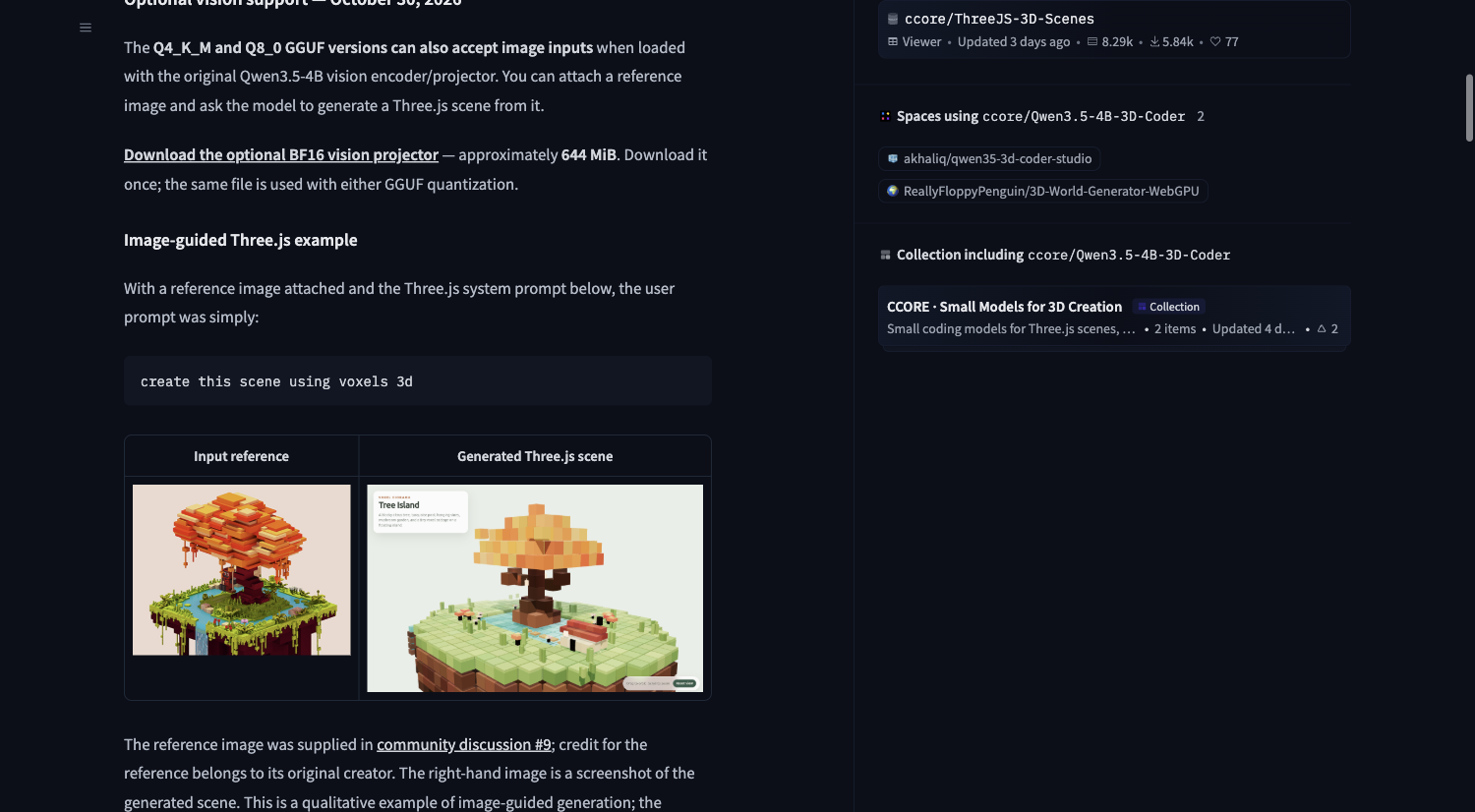
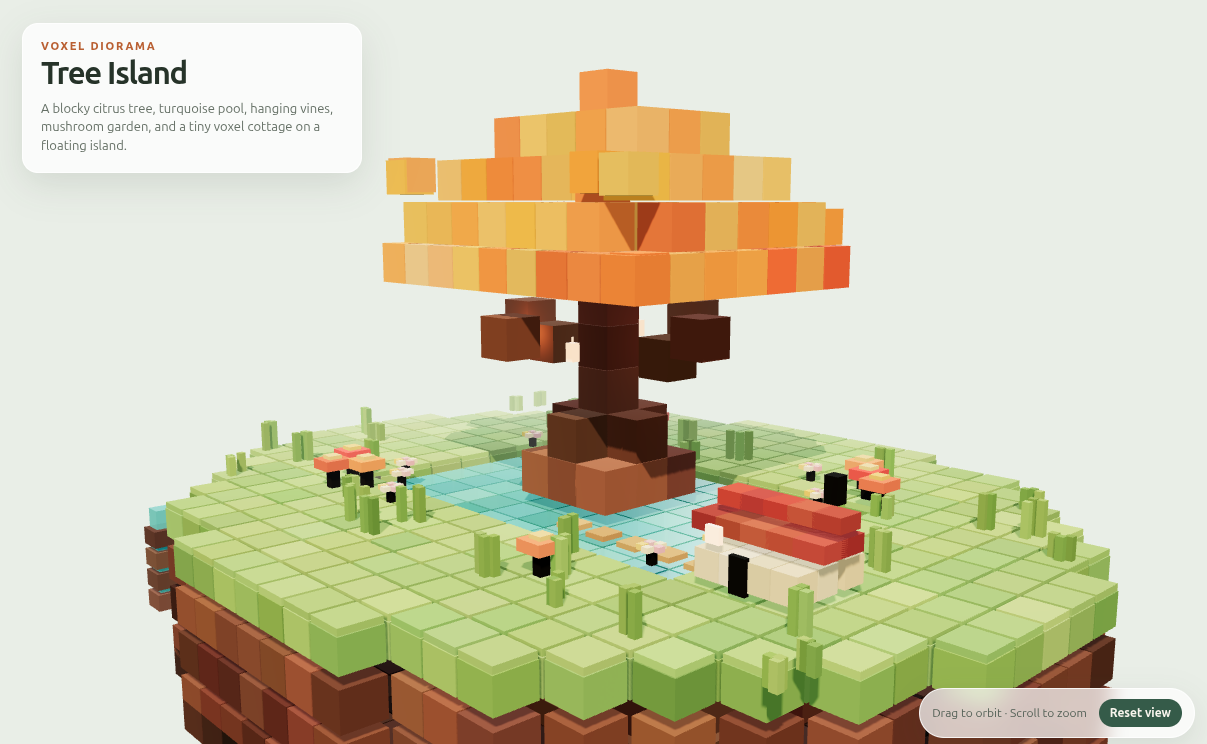
Official galleries show rendered architecture, gardens and voxel objects. The publisher says some generations still need another attempt or correction and notes duplicate variable names as an observed issue. These examples establish intended output, not a one-shot success rate.
A third-party runtime guide distinguishes download sizes from inference memory and procedural scenes from meshes. That is a useful framing, but not an independent controlled quality benchmark. Do not turn a short video tutorial or selected gallery into a universal reliability claim.
A render–inspect–repair loop
Use a fixed brief, revision and settings for comparisons. First reject syntax errors, failed imports and blank canvases; then check camera framing, controls, resize behaviour, lighting and performance. Count every attempt, including retries and manual fixes, so the final screenshot does not hide the work needed.
Run untrusted generated JavaScript in a disposable browser context, not inside a production page with credentials. Restrict network dependencies. If export is required, test the exported asset in the destination engine; the separate GLB-3D-Coder preview should not be silently described as this model’s built-in exporter.
| Gate | Check | Why it matters |
|---|---|---|
| Execution | Console, imports and nonblank canvas | Text completion is not rendering |
| Interaction | Camera, resize and intended action | A screenshot misses broken controls |
| Delivery | Target browser and required export | HTML does not imply production GLB |

Compare by output type, not the word 3D
Compare a general coding model for complex application logic, this fine-tune for local procedural scene drafts, and a mesh-oriented generator for reusable geometry. For faithful real-world reconstruction, use measured or multi-view evidence rather than a textual scene sketch.
Evaluate accepted scenes per total editing time, not only token speed. For a small teaching visual, a constrained local model may be sufficient; a browser application with state, data and authentication needs broader engineering tests.
| Route | Output target | Review priority |
|---|---|---|
| 3D-Coder | Editable Three.js HTML/JS | Rendering and code correctness |
| Mesh pipeline | Reusable geometry | Topology, UVs and engine import |
| General coding model | Larger interactive application | Logic, tests and dependencies |
License and sensible expectations
The model is labelled Apache-2.0, while its released training dataset is labelled MIT. Three.js, fonts, textures and other assets retain separate terms. A model license does not license a copied reference image or another creator’s design.
Keep the preview status and independent publisher identity explicit. The hand drawing illustrates the need to test generated scene code; it is not a screenshot or a model-generated 3D result.
Questions before adoption
Does it output GLB automatically?
The documented focus is HTML and JavaScript scenes. The publisher discusses a separate GLB-3D-Coder preview; do not merge their capabilities. Any exporter or mesh conversion must be added and checked against the actual target engine.
Which settings should I start with?
Use the selected checkpoint’s documented configuration: temperature 0.6–0.8, top-p 0.90–0.95, top-k 20–40 and repetition penalty 1.0 for the listed GGUF versions. The model card also advises disabling LM Studio MTP. Record the runtime and revision.
How do I know a generated scene works?
Serve the HTML locally, inspect errors and test camera, interaction and resizing. Review the actual browser output at your target device size and performance budget. A successful text response, valid-looking source or selected screenshot is not sufficient acceptance.
Sources reviewed
- CCORE — model card and runtime guidance
- CCORE — ThreeJS training dataset
- HowMuchToRunAI — runtime analysis
Explore related tools
Ready to try Qwen3.5-4B-3D-Coder?
Visit the official website to get started
Quick Info
- Website
- huggingface.co
- Category
- 3D Modeling
- Added
- 11/6/2026
- Published
- 11/4/2026
- Updated
- 11/6/2026
Have an AI tool to share?
Submit it to AI Dreamhub
Get your product in front of people actively exploring AI tools.
Submit Your Tool