
Awesome ChatGPT Prompts review: a superb discovery library, not a production prompt guarantee
Awesome ChatGPT Prompts began as a curated GitHub list in December 2022. The canonical repository has since been renamed f/prompts.chat; the old GitHub URL redirects to it, and the README explicitly says “formerly known as Awesome ChatGPT Prompts.” Today the project has several related layers: the CC0 prompt corpus in PROMPTS.md/prompts.csv, the public prompts.chat discovery community, an MIT-licensed Next.js application that organizations can self-host, and interfaces including CLI, MCP and plugins. It is not an OpenAI product, ChatGPT feature or paid prompt-output guarantee.
Maintenance is active at the time of review. GitHub’s API showed the repository was not archived and had a push on 20 August 2026. That does not give the prompt corpus a stable semantic version. The application package calls itself a private 0.1.0 package, which should not be advertised as a public product release. Pin a commit when importing data or self-hosting, and record the model, provider and evaluation date separately.
The project is excellent for discovery: role prompts, reusable structures, variables and community variations can shorten a blank-page problem. But its own Terms say the service is provided as-is and do not guarantee a prompt will produce a specific result. That is exactly right. Output changes with model/version, system instructions, conversation history, tools, retrieved context, decoding settings, safety policy and user data. A popular prompt is an example, not production evidence.
What the project is now
| Layer | What it contains | Decision boundary |
|---|---|---|
| Prompt dataset | PROMPTS.md, prompts.csv and mirrors | CC0 text; pin source commit and review every entry |
| Public prompts.chat | Search, profiles, collections, public submissions and analytics | Account/privacy/Terms apply; submissions become public |
| Self-hosted application | MIT code, database, auth, storage and configurable features | You operate identity, secrets, backups, upgrades and incidents |
| Book and learning content | Interactive explanations and techniques | MIT site-authored content; educational, not benchmark |
| CLI / MCP / plugins | Ways to retrieve prompts inside AI workflows | New supply-chain and tool-permission boundary |
| Community prompt | Untrusted instructions written by another user | Sanitize before inserting into any privileged context |
| Generated output | Model response after prompt plus surrounding context | Not covered by a correctness guarantee; validate separately |
| Third-party products | Extensions, courses or stores using similar names | Not automatically affiliated with f/prompts.chat |
Why copying a prompt is only the beginning
Start by stating the job, not choosing a persona. Define user, input contract, desired output schema, allowed evidence, prohibited claims and success criteria. Then search prompts.chat for useful structures. Keep the smallest relevant fragment, replace vague role-play language with explicit constraints and expose variables rather than embedding real customer data.
Treat each community prompt as untrusted content. It may ask the model to ignore policies, reveal system instructions, call tools, browse arbitrary URLs, exfiltrate data or produce unsafe claims. Text is not executable by itself, but becomes powerful when placed in a system/developer message or an agent with credentials. Review instruction hierarchy, remove hidden objectives and run injection cases before promotion.
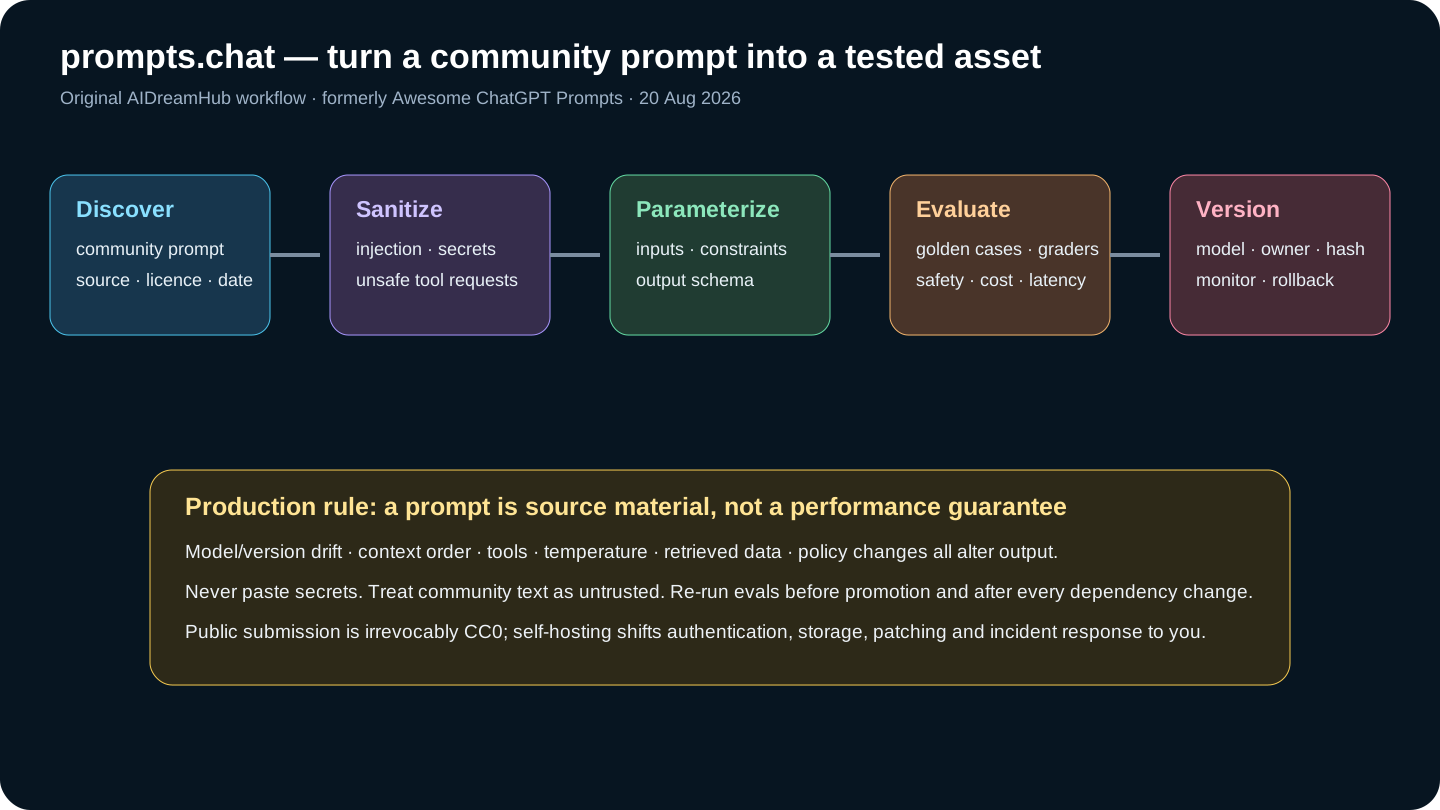
A production prompt is a bundle, not a paragraph: template; variable schema; few-shot examples; model and version; tool permissions; retrieval policy; output validator; evaluation corpus; owner; change log; licence/source; cost and latency budget; rollback. Without those, teams cannot distinguish prompt failure from model drift, bad context, tool errors or data-quality problems.
An eval-driven adoption workflow
- Select one bounded task and write the input schema, output schema, allowed sources, prohibited behavior and success metric.
- Search prompts.chat for structure; record prompt URL, author, licence, retrieval date and repository commit where available.
- Review the text as untrusted: remove policy overrides, secret requests, arbitrary tool calls, hidden objectives and unsupported guarantees.
- Replace real data with typed variables and add clear handling for missing, conflicting or malicious input.
- Choose a pinned model/version, context order, parameters, tool allowlist, retrieval source and output validator.
- Create 30–100 golden and adversarial cases, including prompt injection, sensitive data, ambiguity, long context and multilingual inputs.
- Run baseline and candidate; score correctness, schema, evidence, safety, cost, latency and variance across repeated runs.
- Use deterministic graders where possible, model graders for bounded rubrics and blinded humans for subjective or high-risk output.
- Store the approved template with owner, source/licence, version, evaluation report, known limitations and rollback target.
- Canary on low-risk traffic, log redacted failures and rerun the suite after every prompt/model/tool/retrieval/policy change.
- If contributing publicly, confirm you can irrevocably dedicate the prompt to CC0 and remove all confidential or personal data.
Injection, privacy, copyright and maintenance limits
| Risk | Control | Acceptance evidence |
|---|---|---|
| Prompt injection | Untrusted-source review, hierarchy isolation and attack corpus | No policy override, secret reveal or unauthorized tool call |
| Sensitive data leakage | Typed variables, redaction, least data and retention limits | No secret/PII in prompts, logs or public submissions |
| Model drift | Pin model where possible and rerun on change | Regression deltas within threshold |
| Stale prompt | Owner, review date and deprecation policy | Current dependencies and supported models recorded |
| Hallucinated correctness | Grounding, citations and human review | Factual/unsupported-claim rate meets target |
| Format failure | Schema validation and repair/fail-closed behavior | Machine-readable output pass rate |
| Copyright/IP | Licence provenance and output review | Rights record; no protected material copied blindly |
| Tool misuse | Allowlist, sandbox, confirmation and idempotency | No unauthorized write or irreversible action |
| Self-host security | Patch, auth, secret, backup and incident controls | Restoration test and security owner |
| Metric gaming | Multiple graders and disagreement review | Human audit agrees on sampled cases |
Public sharing has an unusually strong rights consequence. The current prompts.chat Terms say every submitted prompt is immediately and irrevocably released under CC0; contributors waive copyright and related rights to the extent possible, receive no compensation and cannot retract the dedication. The Privacy Policy says account deletion does not remove contributed prompts from the public commons. Never submit proprietary instructions, client material, trade secrets or content whose rights you do not control.
The repository uses a clear dual licence. Source code, site-authored content and the interactive book are MIT; prompt content and data are CC0. That makes reuse permissive, but it does not clear copyrights in user-provided examples, trademarks, personal information, generated outputs or third-party material a prompt asks a model to reproduce. Keep source metadata and conduct a separate output/content review for commercial publication.
Privacy differs between browsing, contributing and self-hosting. The public Privacy Policy lists account profile data, submitted prompts, tags and Google Analytics; public prompts display the username. Self-hosting can disable analytics and keep data under organizational control, but “self-host for privacy” is not automatic security. Operators must configure auth, database, storage, TLS, secrets, backup, retention, logs, dependency updates, abuse controls and vulnerability response.
MCP, CLI and plugins improve discovery inside an assistant but expand the trust boundary. A retrieved community prompt should never silently become a system instruction or inherit unrestricted tools. Label its provenance, show it to the user, limit permissions, separate data from instructions and require confirmation for external writes. Pin package versions and review dependency/source changes.
prompts.chat versus guides, platform tools and an internal library
| Option | Best for | What it does not replace |
|---|---|---|
| prompts.chat / dataset | Broad open discovery, community sharing and self-hostable library | Task-specific evaluation and internal approval |
| DAIR.AI Prompt Engineering Guide | Learning techniques, papers, context engineering, RAG and agents | Ready-made governed company prompt registry |
| Provider playground/optimizer/graders | Model-specific iteration, testing and evaluation | Cross-provider community corpus and licence governance |
| Internal Git prompt library | Versioned approved templates with code review | Broad discovery and community contribution |
| Prompt management platform | Experiments, traces, datasets and deployment governance | Human ownership and domain acceptance criteria |
| Fine-tuning / structured workflow | Repeated behavior or deterministic business process | Still requires data, evals, safety and monitoring |
DAIR.AI’s Prompt Engineering Guide is a better learning curriculum: techniques, papers and broader context engineering, RAG and agents. Provider playgrounds, prompt optimizers and graders are better for model-specific iteration and measurement. prompts.chat is better for breadth and community discovery. An internal Git repository or prompt registry is better for approved, versioned business assets. These options complement rather than replace each other.
Our judgment: prompts.chat is one of the best starting points for inspiration and an unusually reusable open corpus. Its evolution into a full open-source community/self-hosting platform adds real value. The risk begins when teams confuse stars, likes or elegant wording with a reliable result. Import patterns, not authority. Require evidence before a prompt enters customer-facing, regulated or tool-using workflows.
Use an evaluation flywheel. Build a representative set with normal, ambiguous, adversarial, multilingual and policy-sensitive cases. Compare baseline and candidate on task correctness, format, groundedness, refusal, injection resistance, cost and latency. Combine deterministic checks, carefully designed model graders and blinded human review; inspect disagreements. Promote only a versioned candidate that meets thresholds, then monitor failures and rerun after model, tool, retrieval, policy or prompt changes.
Frequently asked questions
Is Awesome ChatGPT Prompts still maintained?
Yes at the review date: the canonical repo is now f/prompts.chat, was not archived and had a same-day push. Pin a commit rather than assuming a stable release.
Is it an OpenAI or ChatGPT product?
No. It is an independent open-source/community project that supports multiple model families.
Is it free?
The repository and public prompt corpus are open; source code is MIT and prompts are CC0. Hosting, models, storage and third-party services can cost money.
Can a copied prompt guarantee the same result?
No. Model, version, context, tools, settings and data change behavior; the project’s Terms disclaim specific-result guarantees.
Can I use prompts commercially?
CC0 prompt data is highly permissive, but review third-party rights, trademarks, personal data and generated output separately.
Can I delete a prompt after posting it?
The Terms make public submissions irrevocably CC0, and the Privacy Policy says account deletion does not remove contributed prompts from the public commons.
Is self-hosting private by default?
It gives control but not automatic security. You must configure and operate identity, storage, analytics, logs, patches, backups and incident response.
What is the prompt-injection risk?
Community text can contain malicious instructions. It becomes dangerous when placed in a privileged context or connected to tools/data without isolation.
How should a team evaluate a prompt?
Use labelled normal/adversarial cases, deterministic and model graders, human review, repeated runs and cost/latency measurements.
What should we store with a prompt?
Source/licence, owner, variables, model/version, tool policy, eval report, limitations, change history and rollback target.
Primary sources
- Canonical prompts.chat GitHub repository
- Dual-license file: MIT code and CC0 prompts
- prompts.chat Terms of Service
- prompts.chat Privacy Policy
- Official self-hosting guide
- Official security policy
- Official contribution guide
- PROMPTS.md dataset view
- DAIR.AI Prompt Engineering Guide
- OpenAI Graders API reference
- OpenAI Cookbook: eval-driven system design
- OWASP LLM Prompt Injection Prevention
Independent review dated 20 August 2026. Repository counts, features, terms, integrations and model behavior change; pin sources and rerun evaluations.